Friday, November 22, 2013

Ready or not...

...here I come! 

I remember shouting this phrase a plethora of times when I was happier younger.  These were the days of playing house and freeze tag, of dolls and Pokemon, of softball and kickball.  But most importantly, those were the days of hide'n'seek with the cousins.  

The rules are pretty simple.  One person is chosen to be 'the seeker' and counts to whatever number seems appropriate at the time, while everyone runs for a hiding spot.  Once the special number is reached, the seeker screams out (or in my case whispers) "Ready or not, here I come!" to warn the others that they better have chosen a good hiding spot because he or she was going to come find them.  The goal was not to be found.  

I remember my favorite hiding spots were the mousehole in my uncle and aunt's house, their linen closet behind some pillows, or in rare cases, under the bed or behind the couch.  I had default hiding spots and would usually take a younger cousin along with me, placing my hand over her mouth to quiet her when the seeker came looking. But whenever "Ready or not, here I come!" was bellowed by one of my cousins, I usually erred on the side of not.  

I knew that I would be searched for, I had a default plan in mind, so I never had to search for a hiding spot, and I always had plenty of time to get to that spot before the seeker was done counting.  But I was never ready to be found.  

In high school, we began playing hide'n'seek with our church youth group, and eventually switched over to a variation of it, known as sardines.  In sardines, the roles are basically flipped.  One person hides and everyone seeks them. Once that one person is found, instead of the game being over, that person hides as well.  The game ends when everyone is hidden in the same space (hence the name, 'sardines') and only one person is left looking.  

When playing sardines in my church, I also had default hiding spots--in the closet with the choir robes, under the table in the library, and in the back of the church, under the pews where the choir sat.  I had a default hiding spot, always plenty of time to get there, but I was never ready to be found.  

I always erred on the side of not.

Today I met with one of the group leaders for the adult day treatment program I will be starting soon. She told me that I will either be starting this coming Wednesday or the following Tuesday.

Ready or not... 

Yesterday I touched on the idea that there is not "perfect time" to start treatment, that a person with an eating disorder will never "be ready" for recovery.  I know this.  I know that ready or not, my body needs this.  I know that ready or not, my mental state needs this.  I know that ready or not, my future and my life need this.

...here I come. 

It's the part that's coming that's going to be miserable. The eating part. The looking into myself and changing cognitions part. The being vulnerable and not hiding behind my anorexia part. The part that author Marya Hornbacher describes here: 

"This is the very boring part of eating disorders, the aftermath. When you eat and hate that you eat. And yet of course you must eat. You don’t really entertain the notion of going back. You, with some startling new level of clarity, realize that going back would be far worse than simply being as you are. This is obvious to anyone without an eating disorder. This is not always obvious to you."


Right now, I feel as if I'm hiding in that linen closet at my uncle and aunt's house or under the table in the library at church and someone is opening the door and saying, "Sarah, I found you! You can come out now." This prospect terrified me as a young child.  

I hated seeking.  I hated feeling confused and alone and trying to find what I who I was looking for because they were always so much better at coming up with hiding spots than me.  Everyone else was safely hidden away, and I was wandering around, confused.  I knew exactly what I was supposed to be doing, but I wasn't sure how to do it or where to look or what course of action to take.

That's exactly what recovery is going to be like--a lot of knowing what I need to do, but searching blindly for it.  A lot of feeling lost in the process and confused and alone. But luckily for me, my treatment program is going to be more like a game of sardines that hide'n'seek.  A group of people, all searching and reaching for the same goal.

I have some many people on my side, supporting me, helping me find the right room where recovery is hiding.  I have a lot of people holding my hand and walking with me--my family, my friends, my treatment team at home, and some very wonderful adults who have done nothing but encourage me in this process.  

I don't know where recovery is hiding.
But ready or not, here I come. 

Thursday, November 21, 2013

It's okay to quit

Three days ago, I was informed by my college that because I am taking medical leave for the rest of this semester that I could not return for Spring semester.  Three days ago, I was incredibly pissed off about it.  And three days ago, I was ready to end treatment, walk away from my health, and go back to school.  

Three days ago, I was ready to quit.

And then I found this post on Psychology Today which gives advice on when it's okay to quit.  The post contains these guidelines on when quitting is okay:

It's okay to quit...
...when you've gathered new information that makes the original plan unworkable;
...when the timing is wrong;
...when you thought you could do more than you can;
...when you're changing directions;
...when to keep going will deplete you of energy you need for something else;
...when you made a mistake;
...when quitting is the most compassionate thing you can do for yourself at the moment.

When I was growing up, my parents taught me not to be a quitter--that if you're going to start something, you better finish it.  You don't quit.  So making the decision to take a medical leave from school this semester--to quit for the rest of the semester--caused a lot of cognitive dissonance.  But reading that article made me think.  And it got me to thinking about my current situation and whether or not it was okay to quit a second time simply because a policy stated that I had to take next semester off from school as well. 


When you've gathered new information that makes the original plan unworkable...
Does not being able to return next semester make my original plan unworkable?  Originally, I planned for taking some time off of school, going through treatment, recovering, and returning to school for spring semester.  Well.  The spring semester thing was a little bit unreasonable.  Recovery from an eating disorder that has taken over six years of my life is not going to happen in two months.  That was an irrational part of my plan.

But now, because I cannot return to school in the spring, does that make taking time off, doing treatment, recovering, and returning to school unworkable?  No.  In fact, it is probably the wiser decision.  Because rushing through treatment and not achieving full recovery before returning back to school will just land me right back here in another year or two.


When the timing is wrong...
The timing for treatment and recovery will never be right.  I will never 'be ready for recovery.'  Actually, the timing is kind of perfect--I have a school willing to work with me, parents here to support me, and no major obligations in the foreseeable future.  The timing, no, is not perfect.  It throws off my four year college plan.  But the timing will never be perfect.  The only things that are wrong with the timing are things that ED wants to get in the way of my recovery. Otherwise, the timing is pretty dang perfect.

When you thought you could do more than you can... 
I'm going to apply this to a couple of different things.  First, finishing this semester at Gettysburg.  It was okay to quit there because I definitely was trying to do more than I was capable of in that situation.  I was in a severe relapse of my anorexia, depression, and anxiety--severe enough that I was not going to class or participating in any outside activities.  Quitting, or taking a medical leave, was exactly the right decision.

Second, quitting at trying to come back in the spring.  One of the reasons that I was given for not being allowed to return is that there is not enough time between now and then for me to show a prolonged period of stability, which is true.  As much as I and many others would like, the recovery process is not short and sweet.  It's not something that I will be able to rush through in a couple of weeks.  Thinking that I can achieve a point of stability and be ready to return in the spring is irrational.  Full recovery takes time.  And I know that if I returned in the spring without having achieved full recovery, although I may be fine for a while, I will eventually relapse.  It's appropriate to quit trying to return before I am ready.

When you're changing directions...
I am changing directions with my life.  I am going from a half-lived life of an eating disorder, regulated by food rules and calorie counting and routine, to a fulfilled life of walking in freedom.  My life is completely changing directions.  So it is okay to quit on school for a while in order to change the direction of my life.

When to keep going will deplete you of energy you need for something else...
Continuing on the path of putting my schooling ahead of my health would literally kill me.  It would allow my body to waste away because of anorexia.  All of the energy spent feeding my eating disorder is better spent absorbing knowledge, taking walks with friends, and living my life.  Continuing on the path of anorexia will deplete me of the energy I need to live.

When you make a mistake...
I did make a mistake.  My mistake was made back in high school when I choose not to buy into treatment and the idea that I had a problem.  My mistake was ignoring all of my team's advice on how to avoid relapse.  My mistake was thinking that I could do this on my own.  And my mistake definitely cost me a lot.  GPA.  Friends.  Experiences.  I made a mistake, so quitting right now is okay.  It is okay to go back, start at the beginning, and work to learn from that mistake so that I will not make it again.

When quitting is the most compassionate thing you can do for yourself at the moment...
When I first got the idea to write this post, I was thinking about the question, 'Is it okay to quit treatment because I can't come back to school next semester?'  When I started writing, that's what I was thinking.  But I've realized now that in the back of my mind, I've still be stuck on the idea of taking medical leave from, or quitting, school for the rest of this academic year.  In the back of my mind, that was still what a question that I had.  'Is quitting school temporarily the best thing for me?'

It's this part of the philosophy of quitting that strikes me the most.  Yesterday, I got into a car accident on my way to the doctor (everyone was fine--it was just a minor rear-ending because I wasn't paying attention on the off-ramp).  When I went to the doctor, she was concerned that my heart rate was so low after an accident, so she did an EKG, which showed bradycardia.  Basically, my heart is beating a lot slower than normal because it is having to work much harder.  It's a sign, in my case, of malnutrition.  It signals that my body is beginning to eat away at its own organs because its nutritional needs are not being met by actual food.  She told me that I was not allowed to have caffeine, do physical activity, or any other type of stimulant.  She also told me that it's probably best for me that I do not return to school in the spring because recovery takes a long time.

I know the physical complications of anorexia.  And I thought I was fine.  It's so easy to be wrapped up in the disorder and in fighting school policy to not look at what my body needs.  My physical body needs my attention.  My body needs nourishment.  My body needs treatment.  Quitting school for the rest of the year is definitely going to suck.  I'm going to hate not being there and not having my friends around.


But it's like the article said, it is okay to quit if: "Quitting is the most compassionate thing you can do for yourself at the moment."

And right now, for me, it is.

Thursday, November 14, 2013

Today, I thought about making a grocery list

I have discovered exactly what people-who-don't-know-what-else-to-say say to you when you take the rest of the semester off in order to recover from your eating disorder: 
"So what did you do today?"

It seems to be the only thing that anyone, anywhere wants to know.  And I've struggled to come up with a good answer to that question.  Here's what I've got so far: 

1. I slept. 
2. I became re-addicted to Bejeweled Blitz
3. I did some blogging. 
4. I read some blogs. 
5. I caught up on my emails.
6. I got out of bed and washed my face/brushed my teeth/etc. 
7. I put on clothes that I had not previously slept in! 
8. I watched Kevin Costner in For the Love of the Game
9. I technologically interacted with friends. 
10. I thought about going to the grocery store. 
11. I got angry about having to take a semester off of college, live at home, and go to treatment, which by the way, might not start for the next two weeks or so because the program is full. 
12. I thought about maybe making a grocery list and that maybe then I would actually go to the grocery store. 

Given, the majority of these are things that 'normal' people do every day.  The word normal has been thrown around all over Facebook and blogs quite a lot recently in reference to mental illness and recovery--from this post by Kelsi to this post here, and honestly, it's been something that's been on my mind quite a bit, as well.  I kind of touched on it earlier today when thinking about failure and re-framing my perspective to make it relevant to me and what my normal is.  


See what's normal for me right now, was written about very eloquently in this post here, which was about a completely different topic, but is on my mind right as I write this: 

"You see, people without an understanding of eating disorders don’t realize that they can have a devastating impact upon every facet of an individual’s life. That their life is dictated by rules, their day can revolve completely around exercise or eating or not eating. That their nights can be completely sleepless or spent in the bathroom or spent in the kitchen. They don’t see the urges that arise when the individual is experiencing guilt for 'only exercising three hours that day' or for 'eating extra sultanas out of the Sultana Bran' at brekky time. People don’t see the exhaustion, or the fears, or the thoughts that harangue the individual every single moment of every single day. They don’t understand the outbursts or the tears at mealtimes. They don’t get the rules or the rigidity; the desperate need to feel safe, and if that need can be fulfilled by eating out of the same bowl every day, then so be it. They don’t see the 4am walks; the exercise in the pouring rain for hours on end which leads to extreme hypothermia. They can’t understand the inability to work or study because of a malnourished brain – caused by deprivation of carbohydrates, leading to incapacity to function adequately. They don’t think about the dry skin, the falling out of hair, the bruises that appear the hell out of nowhere, the endless injuries caused by overexercise, and the excruciating leg cramps that awake the individual in the middle of the night. The low blood pressure. The low blood sugar. The osteoporosis. People don’t see the guilt and grief that is felt when the individual 'can’t' go to their friend’s birthday parties or be social ever, due to having to be exercising instead or out of fear of the food that may be present at said event. And they don’t see that they eventually lose their friends, because those friends will only put up with so much shit before they crack. I could go on for ages, but we’d be here all day."

You see what I mean?  Life is vastly different for an individual with any form of an eating disorder.  Vastly different.  And when you are just beginning an initial period of recovery, the seemingly little things are huge victories.  Little things like putting any form of nourishment into your body.  Little things like admitting that life is not always rainbows and sunshine and that yeah, sometimes it can be really, really crappy.  Life is also vastly different for any individual suffering from depression or anxiety, both of which are linked to all types of eating disorders.  The little victories there are getting out of bed in the morning, getting dressed, any form of communication with anyone.  

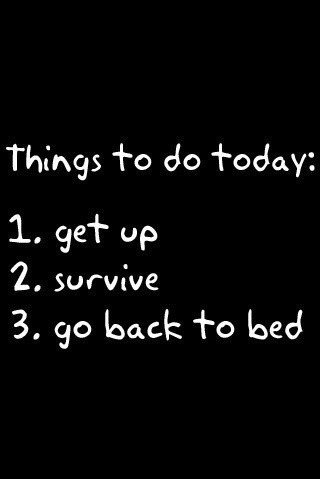
The little victories when facing mental illness in the beginning stages of recovery are all about survival.  

Today I found out that, best case scenario, I can start the DTP program at CCED the week over November 25th.  That's in 11 days.  11 days of being at home and being miserable and struggling to win the smallest of battles.  I was frustrated and angry and feeling really, really defeated because look at what I've done over the course of 24 hours--things most normal people do in a couple hours in morning or that they do without even having to think about them at all!  All of those things took me an entire day! 

One of my recovery buddies and a good friend put it this way when I was freaking out about making it to the point where I am actually in the DTP program and getting through the next 11 (or more!) days: 

"Recovery is going to be a lot of hanging around and surviving."

She did not say that recovery is going to be a lot of progress and accomplishment.  She did not say it's going to be a lot of jumping out of bed in the morning being excited about life and the future, or that it's going to be a lot of instantaneous progress.  She said that it's going to be a lot of surviving.

Surviving to me means winning the tiny battles and racking up the small victories.  Things like, getting out of bed at some point during the day. Brushing my teeth. Putting on clothes that had not previously been slept in. Responding to emails. Things that seem 'normal' to everyone else. 

Even things like thinking about going to the grocery store, or even thinking about making a grocery list.  

That right there is a small victory.  Because on most days, I would not even consider making a grocery list, much less, a trip to the grocery store to buy 'normal' food.  But let's think about what my normal is right now--I'm in the survival stages of recovery.  I am waiting to get into a program, where they will give me a meal plan and I will learn, at 19, how to eat.  I have been living with a very restrictive diet for quite some time and am still getting used to the idea of doing the hard work that recovery entails.  In my normal, a trip to the grocery store causes a lot of anxiety.  Thinking about buying 'normal,' not 'ED food' (it's a thing...), causes a lot of anxiety because it is outside my routine.  Thinking about what I need to have in order to nourish my body, even if it is 'ED food,' causes a lot of anxiety because I do not know how to eat.  Even the simplest task of making a grocery list, fills me with cognitive dissonance that is not present in the world of 'normal' people.

So yes, even though I only thought about making a grocery list and did not actually succeed in making one, that in and of itself is a huge victory.  Yes, when most people have asked me what I have done today, I list all of the other things that I've done, because in the 'normal' world, those seem more productive.  

But in my normal world, where people understand the understand the unique challenges that come with living with anorexia, I am able to respond to 'What did you do today?' with 'I thought about making a grocery list,' and feel like I actually accomplished something worthwhile. What I see as my accomplishments are just going to seem less 'normal' and more trivial because I do not live in the 'normal' world.

And my world is all about survival.  

"Well aren't you just a little failure..."

It is definitely a sign that you miss your roommate when you are hearing her voice in your head, saying the things that she always says, the way that she always says them.  

"Hello!" 
"Something to share with the class..?" 
"You just made my Southern come out!" 
"Why are the stairs so hard?!"
"Well aren't you just a little failure... Aren't I encouraging!?" 

Out of all the things that my roommate says, the only one that continually replays in my head is "Well aren't you just a little failure..."  And that is the track in my head, not because she ever meant it (really, she never did--it was always in a joking manner), but because that's exactly how I feel right now.  That's what my ED wants me to believe right now.


It's also how I am feeling right now.  I mean, look at me.  I am 19-years-old, living back in my parents house.  I can't even go to college on my own.  I can't even be successful at feeding myself.

I feel like a failure in comparison to everyone else.   

Now there are many things about that simple statement right there that need to be broken down, so bear with me. 

The first part of that phrase, "I feel like," says a lot.  Feelings are not always accurate.  Actually, most of the time, they are not, especially in cases of people who struggle with eating disorders, especially anorexia.  I mean, part of my eating disordered thinking right now involves unrealistically high standards--standards that I will NEVER reach, that no one could ever reach.  So I am always going to feel like I'm failing in that regard, even if I am not.  

And looking at the facts of my life, I am not, in fact, failing at anything.  If I would have chosen to not make my health a priority, I most likely would still be juggling academics, extra-curricular activities, work, friendships, and so much more in a very successful manner.  I can be a high-functioning anorexic, when my depression is not acting up and when I make that choice to not care for myself.  

Let me define failure according to the dictionary:
     1.   lack of success
     2.   omission of expected or required action; lack of deficiency of a desirable quality
     3.   action or state of not functioning

Point 1: I am a student at Gettysburg College, one of the top liberal arts schools in the US.  I have A's and B's.  I have a job.  I count all of that as success. 

Point 2: I am taking expected/required actions right now.  I am acting in the best interests of my health, something that is expected by everyone, no matter who they are.  I am taking action to attempt to finish this semester.  I am not inactive.  

Point 3: I am not in a state of not functioning.  I am still writing (obviously).  I am working to come up with a solid treatment plan.  I am working with the college to finish this semester.  I am functioning.  Maybe I am not a fully productive member of society, but I am still functioning.  

I think what I'm really getting hung up on is the "in comparison to everyone else," part of the sentence.  I mean, I look around and all of my friends are on the Dean's List or accepting job offers; doing senior recitals or writing plays; getting engaged or having babies; doing research or leading immersion trips. 

But other people are also not fighting a life-threatening battle with anorexia, so making that comparison is not able to be made.

And I am "failing" to complete a semester of college... Or at least feel like it, but again, using the definition and the explanation above, I am not truly failing.

So maybe this feeling is stemming from the fact that I think I am failing at recovery.  Maybe that is really what this is all about.  

Yesterday at the assessment, I was told that I was the third or fourth person she had assessed in the past week who went through Maudsley/FBT/Adolescent program in late high school, went on to college, and was now back getting treatment in the Adult Program.  So it's apparently pretty common.  


Also, my Wise Mind knows for a fact that the recovery process isn't perfect!  It's full of slip ups and mistakes and lapses and relapses.  
None of that means failure.  

Stop. 
Pause.  
Reframe. 

I am NOT a failure.  
The only way I can fail is if I stop trying to recover. 


Monday, November 11, 2013

I think I'm scared...

I'm really bad at emotions.  I hate them, actually.  Having them, feeling them, identifying them, expressing them, communicating them... its all hard for me.  

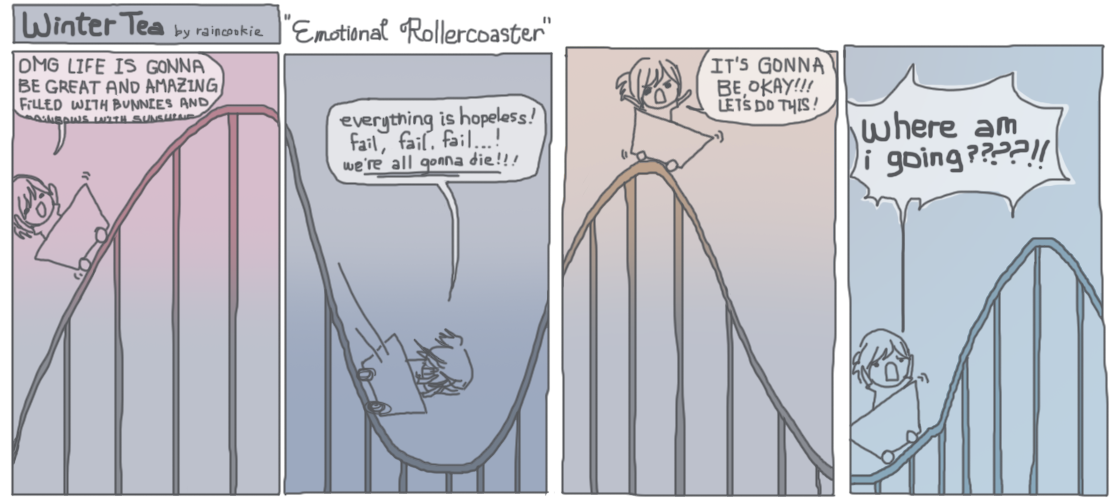
These past few days have been a roller coaster of emotion for me, as much as I hate to admit it.  I've gone from not really feeling anything to anger to apprehension to fear to more anger and I don't know what all else.  Like I said, I am really bad at emotions.  


But right now, I think that I am just afraid.  

I spoke with my mom this weekend for the first time about what has been going on.  Like picked up the phone and called her.  Needless to say, she did not react in a way that I wanted.  That made me angry.  I threw my phone and yelled at my roommate and stormed off.  Exactly how I used to act as a child when I would get angry.  I calmed down a bit, received an angry text from my dad, and then I got angry all over again.  

Sunday morning, I woke up feeling a bit overwhelmed.  I knew that I only had a few more days left here, at Gettysburg, and that worried me.  I knew I was going to have to speak with my suitemates about what was happening, which worried me.  And I still had not heard back again from my parents, which isn't normal, so that also worried me.  

I don't like emotions, especially anxiety because you have to feel it full out--it's not one that can be numbed out with sleeping or television or walks or anything. With depression or angry, I can numb out by sleeping or watching a movie.  I don't have to feel it in order to get through it, and so I don't.  But as much as I try to numb out my anxiety and ignore it, it never actually works.  

I woke up in a panic from a 'nightmare' at 4:30 am this morning.  In it, I was seeing people and having conversations with people who were not able to be seen by other people.  Talking to and seeing people who did not even exist.  I know how crazy that is, even though in my dream, I was on campus in Gettysburg, where people apparently see ghosts all the time.  

I don't believe in ghosts.  
I woke up because I literally went insane in my dream.  

No one is awake at 4:30 am.  Not even my brother, who I'm pretty sure doesn't actually sleep ever.  I typed a note in my phone that says, What if I'm actually crazy?  What if there is really something wrong with me?  I then put some music on and tried to go back to sleep.  I woke up every 15 minutes gasping for air, in tears, until 7:20, when I just decided to give up on sleeping any more.  

At that point, my roommate was awake, so I was able to talk to her about what was going on.  And I told her about my fears of actually being crazy (I do have an uncle with schizophrenia and it does manifest itself around this time in people's lives), and it was her that suggested that maybe it's just my anxiety and fear about this whole situation that is getting away from me.  That maybe that is why I'm not sleeping well and I'm lashing out and my dreams are weird.  

I'm beginning to think that she's right.  I am afraid.  As much as I try to portray that I am not afraid, I am.  So much so this time than every other time I have been forced to seek treatment over the past six years.  

I think it's because this time, I actually want the help.  I want to recover.  Not because I have to in order to work at camp.  Not so that I can go to college in another state.  Not so that my parents will leave me the hell alone.  

I want to recover for my health, for my future, for my life.  There's so much more at stake this time.  And because of that, it is perfectly normal to have emotions like fear and anger.  It's okay to feel them.  What is not okay, however, is turning around and running because of the fear.  

I was reminded of this over the weekend by a very wise woman who has been encouraging me so much in this terrifying process of leaving school to get help: 

"Recovery is not easy. Recovery is hard. Eating disorders are easy. Eating disorders will kill you. This may be one of the hardest things you do in your life, so it's normal for you to feel really anxious and upset and stressed and scared and all of those things! Those are all okay. The right thing and the easy thing are rarely the same thing!!!"


Saturday, November 9, 2013

Reality checked

"Do you actually want to recover?"

That's one of the very first questions that my best friend from treatment asked me in our hour and a half conversation Wednesday night when I first began to tell her that I was struggling.  Not what's going on, but "Do you want to recover?"  We talked through a lot on the phone that night.  About what my behaviors have been, what my thoughts are, what my expectations of going home for treatment were.  And she reality checked everything. 

I've been fighting the idea of going home for a few weeks now, mainly because I don't think that things are that bad.  Denial is something that is fairly common among eating disorder patients.  It sounds something like this for me: 

  • Everyone diets, so what I'm doing isn't bad. 
  • I know what an eating disorder is, and I DO NOT have one. 
  • What I’m doing is no big deal. 
  • There's nothing wrong with me physically and I'm still very high functioning academically, so obviously, I am not sick. 
  • I'm still eating food, so this isn't restricting.
  • I'm not thin enough or skinny enough to have an eating disorder.
  • I’ll just lose weight until I am X pounds and then I’ll stop.
  • I am in complete control, and I could stop if I chose to do so.
  • Things aren't as bad as they were in high school, so I'm obviously not relapsing. 
Denial. 

The sicker I became, the more the excuses seemed real and the more my brain believed them.  I went from eating two meals a day to only one to not taking my meds to restricting even more and limiting myself to under X calories a day to throwing up what little I was eating to abusing diet pills to obsessing over weight.  And I still thought that I was fine because I hadn't seen any physical weight loss.  


Then I went home this past weekend and when saying goodbye to a friend's mom who knows about my struggles with ED and depression, she said that I needed to "Stop losing weight."  
"What?"  
"You've lost a lot of weight since I saw you last in September." 

Even in that moment, it was hard to believe her.  The next day, I got dressed for church in an outfit that I had worn less than a month ago.  I couldn't keep my pants up and my shirt was so baggy... ugh.  Unfortunately, I didn't bring a nice belt home because I didn't think that I would need one, since these pants fit a month ago, they were still going to fit.  

Luckily for me, my brother had left a nice belt at home. And at first, I completely freaked out when I realized that was going to be my only option.  My brother has always been skinnier than me.  Always.  So there was absolutely no way that his belt was going to fit me... even at the very last notch.  But I put it on because I was running late for church and had no other options.  I held my breath while I put it on his belt... It didn't just barely fit.  It fit like any of my belts do.  

Had I really lost that much weight? No.  I couldn't have.  I don't see it, so obviously it can't be true.  This belt is probably just too big for Jacob, which is why he left it at home instead of taking it with him.  

But it still bothered me.  The whole weekend bothered me--exchanges with my parents, with my friend's mom, with how my clothes fit on Sunday, with my brother's belt.  And when I got back to school on Sunday night, I checked my weight, hoping to ease the dissonance in my mind.  

Numbers don't lie.  They showed that I was X pounds under my "ideal weight range," according to my growth curve (my treatment team at home doesn't use BMI to determine ideal weight ranges because of reasons stated here). 

I started to think that maybe I had a problem.  Maybe I needed to go home and get help... but it wasn't that bad yet.  I was still in control.

Monday night I was attempting to study for an exam and had a major depressive episode.  And Tuesday I ended up talking to Dean Cole and we decided that maybe it would be best for me to go home and get some help.  I called my team on Wednesday, trying to reach Katie, mainly, because I like her best (yes, I have favorites...) but was unsuccessful.  Then Annie called me.  I was scared, and I wanted to talk with her, wanted her to make me feel better and tell me that I was right and didn't need any more help and definitely didn't need to go home.  

She called me out on all of my bullshit.  She told me that I was sick, that I needed help, that I was sicker than I was able to understand.  She told me that my idea of going home for a few days or a week was just complete bullshit--I wasn't going to recover that way.  Maybe I would be able to keep things in check for another month or so, but I was just going to relapse again and again until I spent serious time working towards recovery.  

I gave her every excuse to not work toward recovery, and each time she told me, 'Yeah, I totally get that, but here's why you're wrong...'  I talked to her about school and how I was scared that I wouldn't be able to return next semester if I went home for serious treatment.  Her response was that was good, that I'm not going to recover in college--no one can. That I should take the year off and reach full recovery... Something that terrifies me very, very much.  We talked about maybe going to rehab (different from inpatient), so that I could work intensively on my recovery and not have the added stress of being at home.  (Not to mention that it may increase the likelihood of me being able to return to Gettysburg in the Spring).

She reminded me that I am very much diluting the quality of my life and that since she has recovered, she's been able to enjoy things like pizza multiple times a week and ice cream and all the foods that I am terrified to eat right now.  And now that she's comfortable with her body, she can do all sorts of things she never would have before.  She also reminded me that I am killing myself.  

I hung up the phone with her feeling like someone had just punched me in the face.  But also convinced that whether I recover or not is completely up to me and that I need to put the effort in and work my ass off in treatment so I can get better and get back to my life.

Wednesday, November 6, 2013

Preparing for remission

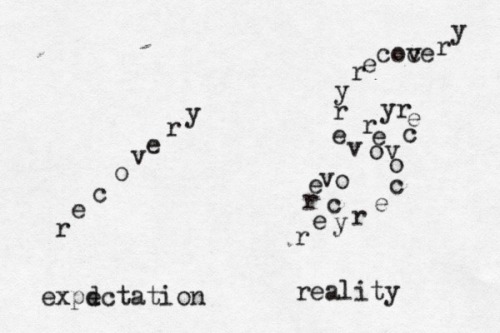
"If you hear some in the eating disorder community talk about recovery, you could be forgiven for thinking that they were trying to get you to buy a timeshare at a resort. Recovery, they say, is where you love yourself. You love your body. You accept your imperfections. Your life is good, so good. You’ve gotten to the root of your disorder. And you are never, ever, NEVER going to relapse. You are IN RECOVERY and you are here to stay.

Of course, plenty of people acknowledge that recovery isn’t perfect. But if you look at the way the eating disorder community tries to construct recovery, it tends to be built as this idealized form of what Life is Going to be Like from Now On, Forever and Ever, Amen. This isn’t what recovery is like. Getting hit in the face with the rude reality of the day in, day out, utter slog of recovery (didn’t I just eat yesterday?) was enough to make me seriously consider quitting.

[...]

There’s a saying floating around in the world of Pinterest or Tumblr that “The worst day in recovery is still better than the best day in relapse.” To be really honest (am I even allowed to say this?), sometimes it isn’t. Sometimes, when life is really painful, the ED is numb and that feels a whole hell of a lot better than recovery. I know it’s not in my best long-term interests to return to the ED, but there you have it. I didn’t fall into the trap of an ED because I wanted to be thin. I fell in the trap because I finally found something that would make the anxiety and depression just a little bit better."


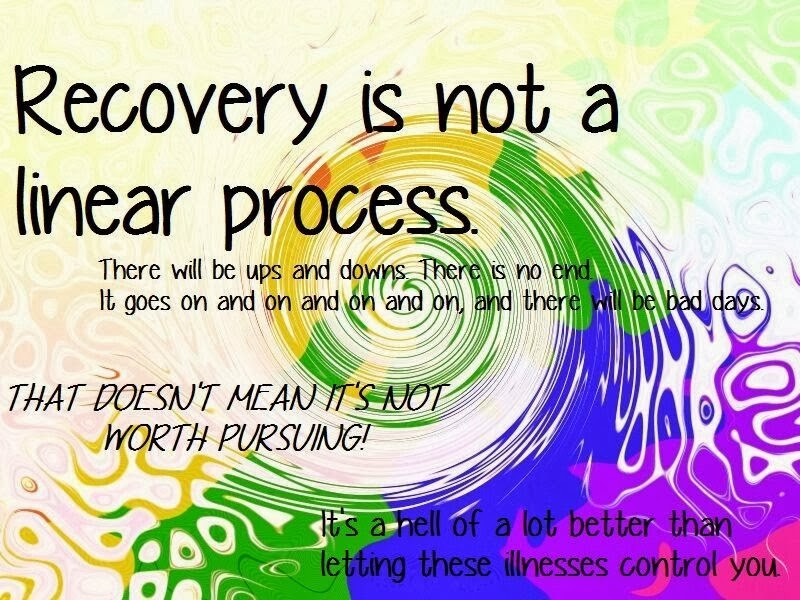
A couple of days ago, I stumbled across Carrie Arnold's blog post, entitled "Letting go of the idealized recovery."  And it hit really close to home; I mean, aren't you supposed to go through treatment just once and then you're cured forever?  Good girls don't relapse.  Especially if you are a psych major--you know better.  

But here I am.  

Last night, I was talking to a friend of mine and I told her that I thought that maybe I needed IOP.  And I have been thinking more and more lately about maybe talking to my mom and my team at home and possibly taking the rest of the semester off in order to get back on my feet.  

But eating disorders are hard.  Mine doesn't want me to move forward.  It really, really does not want me to get any sort of help.  Because like Carrie Arnold said, "When life is really painful, the ED is numb and that feels a whole hell of a lot better than recovery... I didn't fall into the trap of an ED because I wanted to be thin.  I fell in the trap because I finally found something that would make the anxiety and depression just a little bit better."  Then it just consumes you and prevents you from seeking help, from moving forward.  

Since I first brought up the fact that I was relapsing to my professor and Dean Cole, things have gotten worse both behaviorally, emotionally, and cognitively.  I know that (I just don't care a majority of the time), but now they're both starting to know that as well.  And people I saw at home over the weekend were worrying and well... Dean Cole decided that it was time to involve my parents, especially since I was thinking about maybe taking some time off of school.  

And the two of us talked over a few options that I had as far as when would be a good time, how that would work on the college's end, and so on... But I still don't know what I need.  I know what I want, which is very eating disorder minded.  But I don't rationally know what I need because I don't have an objective sense of how bad things are right now.  Which is hard.  I just know things have gotten worse (to put numbers on it, I would say that when I first noticed I was relapsing, my brain was about 25ish% eating disordered, but now it's definitely closer to 90% eating disordered).  

So I came up with the idea that I go home and see my team for some sort of assessment and then figure out what sort of treatment it is that I need.  And Dean Cole agreed that was a good idea.  I still was very adamant about not talking to my mom, though.  So I sent her a text, which I finally received a reply to a little while ago.  

I don't know why the response that I received angered me so much.  It did, but the second response that I received made me more angry.  She asked me if I was going to be safe tonight, like just because I'm relapsing, I'm going to kill myself or harm myself in some other permanent way.  Right.  That makes me really want to actually talk to her and go home now... 

But that isn't my point. 

See, over the course of tonight, I have talked with two very wise women and both of them have used medical examples as ways to explain to me why relapse is, for lack of a better word, okay and why there is no shame in it.  

My aunt said this: "You know enough about it to know there are relapses and remissions-- almost like a cancer patient.  You need to do what it takes to put it in a very long remission."

Just keeping it all in perspective, that eating disorders are, in fact, an illness.  That we classify them solely as mental disorders is misleading for many and that we treat them as things that can be cured by one round of antibiotics is also incorrect; they are sicknesses that require treatment--medical appointments with a physician, chemo, radiation, nutrition, support.  They're not something that you can just get over or something that will be cured easily.  It takes a lot of time, hard work, and pain in order to heal.  It's a lot of doing things that scare you and make you uncomfortable.  

One of my biggest fears at this point is that my team will tell me they don't want me to come back to school once they talk to me.  I'm trying to convince myself that it's more important for me to take care of my health and well-being than it is to finish this semester properly, but it's going to take some convincing, especially since my mindset is so eating disordered (as evidenced by me asking my friend last night why I needed to eat again if I had already eaten once yesterday).  

But if I think about the illness part of it, if this was cancer, I wouldn't myself to suck it up and wait for the right time to get treatment.  I shouldn't be telling myself that with my eating disorder either.  And I definitely still shouldn't be feeling shame about struggling again.  This is just a relapse.  Going home and following my team's instructions, even if I do not like them, will hopefully help to put this illness into remission.  

My other big fear is that people will see me differently because I am struggling again.  I found this quote by Daniell Koepke the other night that makes me feel a lot better about that: 

“The fact that you’re struggling doesn't make you a burden. It doesn't make you unlovable or undesirable or undeserving of care. It doesn't make you too much or too sensitive or too needy. It makes you human. Everyone struggles. Everyone has a difficult time coping, and at times, we all fall apart. During these times, we aren't always easy to be around — and that’s okay. No one is easy to be around one hundred percent of the time. Yes, you may sometimes be unpleasant or difficult. And yes, you may sometimes do or say things that make the people around you feel helpless or sad. But those things aren't all of who you are and they certainly don’t discount your worth as a human being. The truth is that you can be struggling and still be loved. You can be difficult and still be cared for. You can be less than perfect, and still be deserving of compassion and kindness.” 

Regardless of how shitty and shameful I feel about relapsing and needing to go home, I am still worthy of love; I am still worthy of being cared for; I am still worthy of kindness and compassion, from other people, but especially from myself.

And that includes getting the treatment that I need.