Showing posts with label acceptance. Show all posts

Thursday, February 6, 2014

Winning > Losing

I avoided Facebook for much of yesterday, which is a problem. Not in the sense that taking a time out from technology like Facebook is bad, but because I've been avoiding it for another reason.

Tuesday night was the finale of The Biggest Loser, as I'm sure most everyone is aware by now due to massive media coverage of it and all the critiquing that has been done post-reveal. I personally do not watch the show nor do I care to begin. I actually hate the show and secretly (I guess it's not much of a secret now) judge every person who watches that show--I mean, seriously, who spends their time watching a show that encourages people to engage in self-starvation and overexercise?! How is essentially teaching eating disorders entertainment? I literally have no idea. But what I do know is that my Facebook yesterday was flooded with articles about the controversy over how much weight the winner had lost... And that a lot of people were calling her anorexic and saying she looks sick and way too thin.

(First problem. Making judgments about another's body. Just stop. None of us know if that is a healthy weight for her. None of us know her medical history or how she's feeling. Also, stop with the criticism! Seriously. Just stop it. You have no right to stick labels on someone for how much they do or do not weigh.)

I had a conversation with friends I met at the NEDA Conference in October about it. One said, "Just looked at some of The Biggest Loser stuff (I never pay any attention to that crap)... So infuriating! She's not a winner, she's sick!" followed by, "I hate the show. I hate Jillian Michaels. I hate it all!" Another friend from the conference advised me against looking into show and even writing a blog post on it.

I've tried to avoid reading most of the articles because I've generally found them to be triggering, but I'll share a few of the good ones that I've skimmed here (trigger warning for numbers in these articles):

The Biggest Loser and a Bigger Hypocrisy by Carrie Arnold
The Biggest Loser and the Eating Disorder Epidemic by Lee Wolfe Bloom
Freaked Out by Rachel Frederickson's Biggest Loser Win? Read This by Golda Poretsky
The Biggest Losers by Timberline Knolls' CEO and Medical Director (Not specifically about last night's show, but worth the read)
Why Her 'Biggest Loser' Win Left Me at a Loss by Meredith Turits

I'm not writing this to express my concern over Frederickson's weight loss. I'm not writing this to chime in on the same chords so many of these articles have touched on--that the loss of 60% of your body weight and a BMI of 18 are medical criteria for anorexia. I'm not writing to warn against the dangers of extreme dieting and self-starvation and how that can lead to binge eating. I'm not even writing this to talk about the fat- and thin-shaming that is going on as a result of this show.

I'm writing this because I disagree my eating disorder disagrees with all the people who have called her too thin and sick looking. My eating disorder idolizes how she looks.

Yes, I said it. I want My eating disorder wants to look like that.

But here's the thing, my body is not built to look like that. It's genetically not wired to look that way. In fact, if I looked like that, I would probably be in the hospital because my organs would be eating themselves, I'd be severely bradycardic and orthostatic, and I generally just wouldn't be able to function. That's why it is so important in eating disorder recovery to get to your set point weight--not a 'healthy' BMI, like many believe, but set point weight. Set point weight is the weight that your body genetically is programmed to be at. It does not follow BMI charts--it could be under or over what is considered to be normal. It does not follow societal standards for what is acceptable. But is is what is best for your body.


I don't like my set point weight. I'm not sure that anyone with history of eating disorders actually likes their set point weight. But instead of getting angry and turning to ED behaviors in order to be less than what my body wants naturally, I'm working on trying to accept it. Trying to radically accept the fact that my body and genetics want me to weigh X pounds instead of the X pounds that I my eating disorder would prefer to weigh.

So here's what I'm trying to focus on--all the wonderful things that my body, at it's healthy, set point weight, can do. What's important to me, in this moment, is respecting my body's limitations. If it's tired, I sleep. If it's hungry, I feed it. If it's restless, I go for a walk. If it's craving intellectual nourishment, I read and write and study. But I'm learning to be fully present in my body, not to just inhabit it. And if I am fully present in my body, that means I am listening to it. I am taking care of it's needs and wants and not forcing it to do things that it doesn't want to do.

Our society is good at telling us exactly the opposite. It's good at telling us that we need to be less, take up less space, weigh less, be thinner. It's good at telling us that when exercising, no pain means no gain. It's good at telling us to not eat the carbohydrates, the proteins, and the lipids, the basic macronutrients required for survival, that our body so desperately needs and craves. And shows like The Biggest Loser only reinforce these things.

And after reflecting on all of the outcry about The Biggest Loser finale, I have questions. Why are we so concerned with Rachel Frederickson, her weight loss, and her health? Why are we not this concerned when our sisters, mothers, friends, relatives, etc engage in similar unhealthy behaviors in order to lose weight? Why are we so concerned with losing weight instead of creating healthy and strong bodies? Why are we so concerned with being the biggest loser?

If I look only at the number on the scale, the size on my clothes, the calories I am consuming and burning, I will always be unhappy because there will always be someone who weighs less, who is a smaller size, who ate less and exercised more. My focus becomes so zeroed in on these things that I forget about everything else.

Through my recovery process, I'm learning to not focus on them. My dietitian asked me a couple days ago if I wanted to know anything regarding my weight range--if I was in it, above it, below it, what end of it I was in. And I simply told her no. I know I will never be satisfied with a number on the scale because what satisfies me is having a healthy body and a healthy soul. This means nourishment, rest, and moderate exercise for my physical body. It means listening to it when it tells me to take a break or slow down or that I'm pushing too hard. But it also means realizing that I am so much more than my body and that I am not defined by a number nor am I defined by what I look like on a particular day. It means cultivating relationships, feeding my intellect, expressing my interests and regularly doing something "just because."
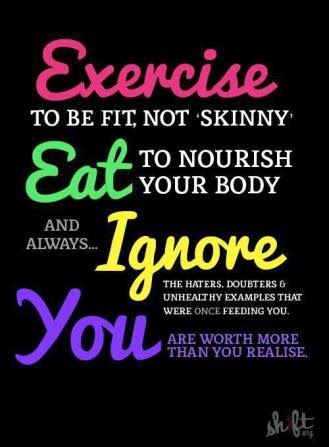

It means living my life and not caring whether or not I am the biggest loser. By accepting my body as it is, at it's set point weight, in it's rightful, healthy state, I am the biggest winner because I'm winning my life. Not a smaller dress size or a ton of money or more confidence, but a life full of adventures and possibilities.

My friends, winning is always better than losing. May we all try to be the biggest winners of life and not the biggest losers of weight.


For more information about set point weight, see Kelsi's posts here:
Set Point
Overshooting Set Point Weight
Overshooting Set Point & Kristi's Story

Thursday, December 12, 2013

Reasons to Recover

I haven't written for a while, and frankly, I've just been so completely exhausted at the end of the day to even process what happened and very emotionally disregulated.  Things have changed rapidly for me in the past few days--my insurance company decided that since I have behaviorally stabilized (meaning, since I followed my meal plan for an entire week) and that since I'm mostly medically stable, that I needed to be stepped down to IOP (intensive outpatient), which is essentially the same thing as DTP, except it is only three and a half hours and not six. But initially, I was overcome with a lot of fear and anxiety that this is making me rush treatment, which will just put me back at CCED in another year or so. The other thing that this drop did was to completely invalidate how I felt about recovering from my eating disorder. Insurance companies are really good at doing that. They see a person simply as money, especially when it comes to mental health problems (but seriously, if I had cancer, this would not be how they would be treating me), and don't go by the guidelines for real healing. They just want to have to pay for as little treatment as possible and if the results are just barely in their checklist, then you are magically better and they will not pay for treatment any more.

Luckily for me, instead of dropping me completely, they allowed me to just step down into IOP, but even still, I don't feel okay with it. I feel fake because my actions and medical charts are improving, but my mental state is actually getting worse. Which is normal in eating disorder recovery world. But it makes me feel crazy because to normal people, I am getting better externally while internally I am feeling worse. It's a very frustrating process.


On the bright side, dropping to IOP, it means no more rush hour traffic, no more waking up at 6am, no more driving in the dark. It means no more exposure to one girl's defiance and protest to being in programming and no more exposure to another's hopelessness and desire to be the most pitied girl in the room. So I'm just trying to breathe through it and see how I feel at the end of the week.


One thing that has been the most helpful in getting me to this point where externally things are looking better is to remind myself continually why I am recovering. Why I want to get better. Why I need to get better. And at the beginning, I could not discern any of it for myself. So my favorite professor gave me a little help with why I need to get better, which got me following my meal plan all the time. And now in this time of change when I feel like my illness is being trivialized by my insurance company and I feel invalidated and like I need to get sicker to "prove" that I need the help, reminding myself of my reasons to recover helps me turn my mind from the distorted eating disorder thoughts to wise mind thoughts that allow me to continue following my meal plan. Here are the original 20 reasons to recover that my professor sent to me, which I keep coming back to as my base:


Reasons why you need to get better (which  means following your meal plan): so you can...

1. be HAPPY!


2. live normal again (whatever normal is) =)
3. come back to school and attend awesome classes
4. hang out with your Gettysburg friends
5. chat during my office hours
6. let your body recover
7. finish school and get a great job
8. get that job to help others
9. NOT let the disorder win


10. be that awesome success story that motivates others to get better


11. play with Eric and other little ones (because that is fun)
12. have your own kiddos someday (if that is of interest to you)
13. enjoy meeting up with friends
14. eat out in social situations and actually enjoy delicious food
15. go to church without anxiety
16. truly enjoy family gatherings
17. take back control of your emotional state
18. continue to help all of those friends that need you
19. use all of the potential that is waiting inside of you
20. simply live!


And as treatment has progressed, I've been able to add some more reasons to this list. I need to recover so I can... 

21. enjoy the holidays and not fear or dread them
22. travel and visit new places and far away friends 
23. have an identity outside of my disorder
24. go grocery shopping on my own 
25. fully experience everything around me
26. not have my life ruled by food, calories, and weight


27. stop hurting myself 
28. care for myself in ways that are not self-destructive
29. live freely and be able to have spontaneously with food
30. tell others that recovery from an eating disorder IS possible and actually mean it


Last night, I was asked, "What are the things you DO want? The healthy things? To come back to school, right?" And I responded with, 

"Yes. And to play with kids and smile and laugh and not be self conscious while I'm doing it. I want to be fully alive and able to experience EVERYTHING--to travel. To not be afraid of the unknown. I want to have kids and a rewarding career where I get to help others. I want to love and be loved. I want to live."

Progress.

Friday, November 29, 2013

An Attitude of Gratitude in the Chaos

I promised myself that I would blog about my first day of day treatment (from here on out, known as DTP).  I promised myself that I would blog about Thanksgiving and how to survive it and have a super compilation of all of the articles I read about how to survive it if you have an eating disorder and how to support a loved one through Thanksgiving. And I did neither of those things. 

My first day of DTP was a whirlwind, from which I went straight into a car for the five hour journey to Michigan, where Thanksgiving happened, then we made the five hour trek back home, and I completed my second day of DTP. So none of the blogging got done because well, DTP is exhausting and I was tired, and I also didn't have the interwebs in the car.  

"By this point, I had long since accepted that I had a problem that could be called anorexia, although I didn't think I was thin enough to 'qualify' for the diagnosis. I was also quite happy to recover from my eating disorder, just as long as I didn't have to eat and gain weight."
--Carrie Arnold, Decoding Anorexia

I started reading Decoding Anorexia by Carrie Arnold last week sometime, and I have still to make it past the introductory chapter because I'm not sure right now is the time for me to read this book.  The quote above has stuck with me ever since I read it the first time because that's exactly where my mind is right now.  I have a foot in both camps--one is in the do-whatever-it-takes-to-recover camp, while the other remains in the I-like-the-idea-but-don't-want-to-eat/not lose-weight camp.

I keep having this discussion with people--from school, from treatment, from my team.  And every single one of them finds it normal that I feel this way and normal that I feel conflicted at this stage.  I mean, I currently have two competing ideologies in my head.  

And I still don't completely understand how sick I am.  I can look at the DSM and see how I fit the diagnosis of anorexia (Criterion B in the DSM: Intense fear of gaining weight. Check.), and I can be told again and again by doctors and therapists and friends and family that I am sick, and I think that I'm just finally becoming on board with that.  I still have my moments though.  

But recovery vs. continuing with my eating disorder?  I don't know.  I can still barely wrap my head around having an ED.  

In DTP, the group leaders have both told me that this is perfectly normal and that acceptance and commitment to recovery will take time for me to develop, but that it will happen and that will be a big part of my recovery.


My doctor today told me that it is going to take time for my mind to get there.  She said that as long as I continue to show up and do the hard work, it will get easier to want to recover.  And she also said that it's completely okay to have one foot in the recovery camp and one foot in the not recovery camp, even if I'm only 51% in the first and 49% in the latter, as long as I'm letting that 51% win.  And sometimes, my balance shifts and it becomes more like 50.00000001% in the recovery camp.

For days I have been feeling like the most insane person on the planet with all of these dissonant thoughts running around in my head.  But today, I feel better because of DTP and because of the supportive staff that work there and I am so thankful for that.

So today, the day after what I'm renaming "Thankfulness Day" because it really is supposed to be about giving thanks, I'm going to turn my mind to the blessings that I have right now, in the chaos, in the uncertainty, in the hard times. And right now, in this moment...

I'm thankful to exist and to be alive;


I'm thankful for warm blankets and naps that bring rest and for knitting, and Criminal Minds to distract after a long few days;

I'm thankful for writing, for blogging, for journaling and for the outlet it gives me right now;

I'm thankful for family and friends who are supportive of my recovery journey;

I'm thankful for a house and loving parents to come home to;

I'm thankful for Gettysburg friends who have been sending love and encouragement, for administrators who have gone above and beyond the call of duty to help me with all the logistics (and to encourage me when I need it), for professors who are becoming more like family away from home and who continue to encourage and support from afar;

I'm thankful for my home community and for older and wiser friends, who I am now becoming close to because of my struggles;

I'm thankful for babies to snuggle and children to watch, for the reminder that life is precious and for the joy their presence brings to me;

I'm thankful for everyone I know who is struggling or has struggled with an ED--for my friends, for those I met and am meeting in treatment, for those I've met by being vulnerable about my own life, for those I've met at school and the NEDA Conference, for those who I blog-creep on--because every single one of these people make me feel less alone and give me a reason to fight my own ED;


I'm thankful for CCED and their staff who are supportive of my recovery and validating of my fears, who understand how overwhelming it is to "just eat" or to "just follow your meal plan," who care about every individual in DTP, who come to work every day with a smile and know exactly what to say to make me laugh, who give me a place of safety where I can be vulnerable and where people just get how I'm feeling;

And I'm thankful for the 50% of me in the recovery camp that gets me to actually go to treatment, because like my therapist continues to tell me, the best thing I am doing for myself right now is simply showing up.

Thursday, November 21, 2013

It's okay to quit

Three days ago, I was informed by my college that because I am taking medical leave for the rest of this semester that I could not return for Spring semester.  Three days ago, I was incredibly pissed off about it.  And three days ago, I was ready to end treatment, walk away from my health, and go back to school.  

Three days ago, I was ready to quit.

And then I found this post on Psychology Today which gives advice on when it's okay to quit.  The post contains these guidelines on when quitting is okay:

It's okay to quit...
...when you've gathered new information that makes the original plan unworkable;
...when the timing is wrong;
...when you thought you could do more than you can;
...when you're changing directions;
...when to keep going will deplete you of energy you need for something else;
...when you made a mistake;
...when quitting is the most compassionate thing you can do for yourself at the moment.

When I was growing up, my parents taught me not to be a quitter--that if you're going to start something, you better finish it.  You don't quit.  So making the decision to take a medical leave from school this semester--to quit for the rest of the semester--caused a lot of cognitive dissonance.  But reading that article made me think.  And it got me to thinking about my current situation and whether or not it was okay to quit a second time simply because a policy stated that I had to take next semester off from school as well. 


When you've gathered new information that makes the original plan unworkable...
Does not being able to return next semester make my original plan unworkable?  Originally, I planned for taking some time off of school, going through treatment, recovering, and returning to school for spring semester.  Well.  The spring semester thing was a little bit unreasonable.  Recovery from an eating disorder that has taken over six years of my life is not going to happen in two months.  That was an irrational part of my plan.

But now, because I cannot return to school in the spring, does that make taking time off, doing treatment, recovering, and returning to school unworkable?  No.  In fact, it is probably the wiser decision.  Because rushing through treatment and not achieving full recovery before returning back to school will just land me right back here in another year or two.


When the timing is wrong...
The timing for treatment and recovery will never be right.  I will never 'be ready for recovery.'  Actually, the timing is kind of perfect--I have a school willing to work with me, parents here to support me, and no major obligations in the foreseeable future.  The timing, no, is not perfect.  It throws off my four year college plan.  But the timing will never be perfect.  The only things that are wrong with the timing are things that ED wants to get in the way of my recovery. Otherwise, the timing is pretty dang perfect.

When you thought you could do more than you can... 
I'm going to apply this to a couple of different things.  First, finishing this semester at Gettysburg.  It was okay to quit there because I definitely was trying to do more than I was capable of in that situation.  I was in a severe relapse of my anorexia, depression, and anxiety--severe enough that I was not going to class or participating in any outside activities.  Quitting, or taking a medical leave, was exactly the right decision.

Second, quitting at trying to come back in the spring.  One of the reasons that I was given for not being allowed to return is that there is not enough time between now and then for me to show a prolonged period of stability, which is true.  As much as I and many others would like, the recovery process is not short and sweet.  It's not something that I will be able to rush through in a couple of weeks.  Thinking that I can achieve a point of stability and be ready to return in the spring is irrational.  Full recovery takes time.  And I know that if I returned in the spring without having achieved full recovery, although I may be fine for a while, I will eventually relapse.  It's appropriate to quit trying to return before I am ready.

When you're changing directions...
I am changing directions with my life.  I am going from a half-lived life of an eating disorder, regulated by food rules and calorie counting and routine, to a fulfilled life of walking in freedom.  My life is completely changing directions.  So it is okay to quit on school for a while in order to change the direction of my life.

When to keep going will deplete you of energy you need for something else...
Continuing on the path of putting my schooling ahead of my health would literally kill me.  It would allow my body to waste away because of anorexia.  All of the energy spent feeding my eating disorder is better spent absorbing knowledge, taking walks with friends, and living my life.  Continuing on the path of anorexia will deplete me of the energy I need to live.

When you make a mistake...
I did make a mistake.  My mistake was made back in high school when I choose not to buy into treatment and the idea that I had a problem.  My mistake was ignoring all of my team's advice on how to avoid relapse.  My mistake was thinking that I could do this on my own.  And my mistake definitely cost me a lot.  GPA.  Friends.  Experiences.  I made a mistake, so quitting right now is okay.  It is okay to go back, start at the beginning, and work to learn from that mistake so that I will not make it again.

When quitting is the most compassionate thing you can do for yourself at the moment...
When I first got the idea to write this post, I was thinking about the question, 'Is it okay to quit treatment because I can't come back to school next semester?'  When I started writing, that's what I was thinking.  But I've realized now that in the back of my mind, I've still be stuck on the idea of taking medical leave from, or quitting, school for the rest of this academic year.  In the back of my mind, that was still what a question that I had.  'Is quitting school temporarily the best thing for me?'

It's this part of the philosophy of quitting that strikes me the most.  Yesterday, I got into a car accident on my way to the doctor (everyone was fine--it was just a minor rear-ending because I wasn't paying attention on the off-ramp).  When I went to the doctor, she was concerned that my heart rate was so low after an accident, so she did an EKG, which showed bradycardia.  Basically, my heart is beating a lot slower than normal because it is having to work much harder.  It's a sign, in my case, of malnutrition.  It signals that my body is beginning to eat away at its own organs because its nutritional needs are not being met by actual food.  She told me that I was not allowed to have caffeine, do physical activity, or any other type of stimulant.  She also told me that it's probably best for me that I do not return to school in the spring because recovery takes a long time.

I know the physical complications of anorexia.  And I thought I was fine.  It's so easy to be wrapped up in the disorder and in fighting school policy to not look at what my body needs.  My physical body needs my attention.  My body needs nourishment.  My body needs treatment.  Quitting school for the rest of the year is definitely going to suck.  I'm going to hate not being there and not having my friends around.


But it's like the article said, it is okay to quit if: "Quitting is the most compassionate thing you can do for yourself at the moment."

And right now, for me, it is.

Thursday, November 14, 2013

"Well aren't you just a little failure..."

It is definitely a sign that you miss your roommate when you are hearing her voice in your head, saying the things that she always says, the way that she always says them.  

"Hello!" 
"Something to share with the class..?" 
"You just made my Southern come out!" 
"Why are the stairs so hard?!"
"Well aren't you just a little failure... Aren't I encouraging!?" 

Out of all the things that my roommate says, the only one that continually replays in my head is "Well aren't you just a little failure..."  And that is the track in my head, not because she ever meant it (really, she never did--it was always in a joking manner), but because that's exactly how I feel right now.  That's what my ED wants me to believe right now.


It's also how I am feeling right now.  I mean, look at me.  I am 19-years-old, living back in my parents house.  I can't even go to college on my own.  I can't even be successful at feeding myself.

I feel like a failure in comparison to everyone else.   

Now there are many things about that simple statement right there that need to be broken down, so bear with me. 

The first part of that phrase, "I feel like," says a lot.  Feelings are not always accurate.  Actually, most of the time, they are not, especially in cases of people who struggle with eating disorders, especially anorexia.  I mean, part of my eating disordered thinking right now involves unrealistically high standards--standards that I will NEVER reach, that no one could ever reach.  So I am always going to feel like I'm failing in that regard, even if I am not.  

And looking at the facts of my life, I am not, in fact, failing at anything.  If I would have chosen to not make my health a priority, I most likely would still be juggling academics, extra-curricular activities, work, friendships, and so much more in a very successful manner.  I can be a high-functioning anorexic, when my depression is not acting up and when I make that choice to not care for myself.  

Let me define failure according to the dictionary:
     1.   lack of success
     2.   omission of expected or required action; lack of deficiency of a desirable quality
     3.   action or state of not functioning

Point 1: I am a student at Gettysburg College, one of the top liberal arts schools in the US.  I have A's and B's.  I have a job.  I count all of that as success. 

Point 2: I am taking expected/required actions right now.  I am acting in the best interests of my health, something that is expected by everyone, no matter who they are.  I am taking action to attempt to finish this semester.  I am not inactive.  

Point 3: I am not in a state of not functioning.  I am still writing (obviously).  I am working to come up with a solid treatment plan.  I am working with the college to finish this semester.  I am functioning.  Maybe I am not a fully productive member of society, but I am still functioning.  

I think what I'm really getting hung up on is the "in comparison to everyone else," part of the sentence.  I mean, I look around and all of my friends are on the Dean's List or accepting job offers; doing senior recitals or writing plays; getting engaged or having babies; doing research or leading immersion trips. 

But other people are also not fighting a life-threatening battle with anorexia, so making that comparison is not able to be made.

And I am "failing" to complete a semester of college... Or at least feel like it, but again, using the definition and the explanation above, I am not truly failing.

So maybe this feeling is stemming from the fact that I think I am failing at recovery.  Maybe that is really what this is all about.  

Yesterday at the assessment, I was told that I was the third or fourth person she had assessed in the past week who went through Maudsley/FBT/Adolescent program in late high school, went on to college, and was now back getting treatment in the Adult Program.  So it's apparently pretty common.  


Also, my Wise Mind knows for a fact that the recovery process isn't perfect!  It's full of slip ups and mistakes and lapses and relapses.  
None of that means failure.  

Stop. 
Pause.  
Reframe. 

I am NOT a failure.  
The only way I can fail is if I stop trying to recover. 


Friday, June 14, 2013

Your Approval Isn't Needed

I think that this may have possibly been one of the longest weeks of my life. Staff training. 


I hate staff training. It's so uncomfortable. I feel like I don't fit in anywhere and I don't belong in this big group. 


But then I remember that I am, in fact, an introvert. And therefore, being around this many people at one time is very overwhelming for me. 

Then I also remember that I am someone who tends to define herself by the approval of others. If people like me, I'm valuable and good enough. If they don't, then why do I exist?


But think about this. I am at a camp. A camp for a church that affirms everyone because they are created in the image of God and are God's beloved children. 

So who am I trying to impress? 


What is it about us as humans that we always feel that it is necessary to be accepted?  Yes, it is human nature to want to be with people and be loved and given attention, but I am loved unconditionally by my Heavenly Father and therefore, the approval of others is completely irrelevant. 


But I'm never going to stop feeling like I need to be accepted or included to be seen as good enough. It's in my nature. I just need to continually remind myself that I am a beloved daughter of the Most High and nothing can change that. 

Not my appearance. 
Not my grades. 
Not the approval of others. 


Resting in that is difficult, especially when I don't feel that it's true. But truth isn't always the same as what I feel is true. 

So yes, this week was rough, but it's over. I don't need approval to be good enough. And next week, I'll have campers and be surrounded by fewer adults and feel less pressure to fit in and be accepted because they already accept me and because it is there that I feel accepted and loved without trying to be either. 


And eventually, I will be surrounded with only people who build me up, accept me, and love me.

It will be okay.