Showing posts with label recovery. Show all posts

Tuesday, October 21, 2014

Things I Wish People Knew About (My) Depression

It's been almost a full month since I last wrote. Wow. I would say that is hard for me to believe, but it's really not--not when I look back at how difficult and sometimes excruciating this past month has been for me. I knew returning to Gettysburg this fall was going to have its ups and downs, good days and bad days. Realistically, staying at home would have also had ups and downs because that is what the reality of living with any mental illness. I was prepared for this. But what I wasn't prepared for was bad days turning into bad weeks turning into a bad month.

I wasn't prepared for this level of depression. I thought I was stable depression-wise, after I changed medications this past spring. I was feeling okay at home, and when I came back to school, I wrote off my symptoms the first few weeks as needing an adjustment period to being back on campus. But now, its past the period of newness and I'm finding myself having a depressive episode at a time when I can't really afford to have one.

I wish people knew how frustrating depression is for me. It comes suddenly, without much warning, and I don't really know what triggers it in me. But the most frustrating part is when there's nothing I can do to make it better--the times when showering, getting up and getting dressed, going to class, doing my homework, being social, going for walks, taking my meds--the times when none of that works. Those are times when I just want to pull my hair out and scream because there's absolutely nothing I can do because I have a freaking chemical imbalance in my brain and I am not in control of that.

I wish people knew everything is 400 times harder to do because I have depression. Going to class? I spent two hours this morning convincing myself to get off the couch and actually go. Doing my homework? That's difficult even on a good day. On a bad day, it just isn't in the realm of possibilities. The mental effort it takes to make my body go through the most basic motions is enough to tire me out for the rest of the day. Often after class, I feel the need to go home and sleep for hours because everything is so difficult. Lately all I've been able to do is the bare minimum to be functional here--class, meetings, immediate graded homework. Studying or working ahead is near impossible.

I wish people knew how difficult it is to not isolate all the time, whether my depression is bad or not. One of the most crucial pieces of my depression recovery is not isolating. Isolating just feeds my depression more and more, but the same time, going anywhere and seeing anyone is the last thing I want to do. Initiating contact with a friend is not an easy task when my depression is bad. Accepting an invitation to hang out is almost as difficult.

I wish people knew I am a bad friend when I am depressed. This means I might snap at you over a tiny thing. It means I might ignore what you are saying to me because I don't care at the time. It means I might not be able to help you when you are struggling. It means I might say mean things. It means I'll forget to text you or text you too much or cancel plans. I am always sorry, even if I do not say so.

I wish people knew I hate using my depression as an excuse. Any mental illness makes functioning hard. I try not to let it impact my every day life--my schoolwork, my commitments, my relationships. But sometimes I really cannot fulfill an obligation because my brain literally will not function properly. Sometimes I need extra time to finish an assignment because showing up to class over-exhausts me to the point where I cannot do anything else. I have depression and it impacts my life. It is an illness and has similar impacts as any other illness, so sometimes I need to be accommodated, which I hate. So don't make me feel bad about asking for an extra to turn in an assignment or to be excused from a meeting--it is always my last resort.

I wish people knew my depression is not about being sad or feeling bad, although it sometimes is. But mostly, its a feeling of nothingness, emptiness. It feels like drowning slowly. Sometimes I am sad, but mostly, its a heaviness and a darkness that overwhelms all of me.

I wish people knew medication does not cure depression (and needing medication does not make me crazy). Medication helps. Ditto therapy. Ditto walks. Ditto food and friends and support. Nothing fixes it. Depression, as I experience it, is not a problem to be solved, not something over and done with. When I first started taking medication four years ago, I was hesitant about needing a drug to feel normal. Don't only crazy people need meds? Now that I understand more about depression and how the brain works, I understand how biological this illness is and how it needs to be treated like any other condition, like asthma for example. My brother has asthma and he has to take his inhaler every day in order to keep his lungs healthy. Its the same with depression--I have to take my meds every day to keep my brain healthy.

I wish people knew my depression is also physical. I get tired, really tired. Sometimes all I can do is sleep because I am so tired. I lose my appetite completely, and as someone who has a history of an eating disorder as well, this is a very difficult thing.

I wish people knew depression causes a disconnect between my mind and body. Part of this involves not being fully "present" in class or in a conversation. My body will be there and my mind won't necessarily be somewhere else, but it will not focus or concentrate. I've sat through many classes this semester where I took extensive notes and walked out having no idea what we covered. Another disconnect is when I struggle to organize my muscles to do what I need. Mostly this involves getting out of bed or getting up to go somewhere.

I wish people knew I struggle to reconcile my faith and my depression. I often feel like less of a Christian when I cannot feel joy during worship. Or when I'm just going through the motions in church or in my devotions and I feel nothing. When my heart just isn't there. These things make me feel guilty and like less of a Christian because Christians are "supposed" to feel joyful. I struggle to reconcile why God is allow me to suffer like this and why he doesn't heal me. I struggle when someone tells me my depression is a result of something I am doing or not doing spiritually. I struggle when people tell me I need Jesus and not medication or therapy.

I wish people knew its okay to ask me questions about my depression and any of my other mental illnesses. I am not ashamed of them because I know they are partially because of biology and how my brain is wired. I like questions. I like helping people to understand what I am going through because it reduces stigma in our society about mental illness, something that is all too prevalent and damaging.

I wish people knew I just want to know I'm not alone in fighting my depression. Most people ask what they can do or they offer to listen if I need to talk, which are nice gestures. But what I need is someone to snuggle and watch movies with, someone to send me encouraging things in the morning or before class, someone to just give me hugs. Someone to eat with. Someone to reassure me. Someone to tell me it really will be okay and I can get through this. Someone to remind me I am stronger than my depression. Someone to tell me they are proud of me for fighting this hard.
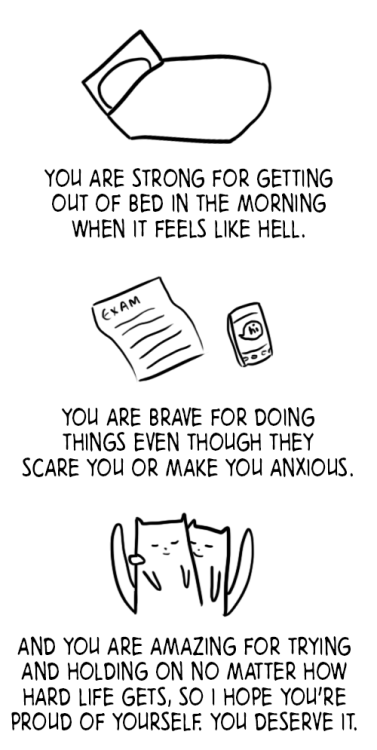
Thank you, Jordie, for this reminder and encouragement.

Monday, September 22, 2014

On Performance

I've been feeling rather weary lately. This whole college thing is starting to drain me and zap my energy levels and in addition, I have this whole set of mental health issues to keep under control. It's exhausting, so I come home most days and all I want to do is sleep, but I am hindered from napping or even going to bed early by what seems to be endless piles of reading, as well as extracurricular and social activities. All of these things are good and normal. 

But there comes a point when I can't actually handle all of this and I get overwhelmed -- usually around the time I start pressuring myself to do everything and to do it really well. This pressure, of course, comes with the fear of disappointing and failing, which paralyzes me. So I try to keep going, pushing myself to do better and try harder and do more, and I inevitably end up failing because the truth of the matter is I cannot do everything and I definitely cannot do everything well. 

The good news is its not about my performance, its not about how much I do, and its not about how well I do things. 

In Primetime on Friday, we looked at how Jesus redefines our performance in John 13: 36-38 (NIV): 

36 Simon Peter asked him, “Lord, where are you going?” Jesus replied, “Where I am going, you cannot follow now, but you will follow later.” 37 Peter asked, “Lord, why can’t I follow you now? I will lay down my life for you.” 38 Then Jesus answered, “Will you really lay down your life for me? Very truly I tell you, before the rooster crows, you will disown me three times!

When we talk about Simon Peter, we want to throw him under the bus most of the time. But in this moment, all Peter wants is to follow Jesus all the way. But here's the thing about this moment -- Peter is trying to spotlight his own performance, saying "I will lay down my life..."

Peter's performance is not the point. 

Jesus' crucifixion is his greatest moment of glory. This is the point. Because Jesus sacrificed himself for us, absolutely nothing we can do will earn us favor with God. Peter was trying to prove his love and devotion and possibly that he was the greatest disciple by offering to die for Christ. But its not about him. 

Back in the scripture, Jesus says to Peter "Will you really lay down your life for me? ...you will disown me three times!" Peter tried so hard to earn Jesus' favor and to prove his love, and he failed because he made it about him. 

This same thing happens to me -- I try so hard to do everything and do it all well so as to prove myself, but I fail because I am making it about me. I make it about how Sarah can be glorified and how Sarah can be seen as good. But Jesus' performance on the cross is sufficient for me and therefore, I do not have to rely on my own performance to prove my worth or show I am good enough to be deserving of love. 

Which is good, because I fail and will continue to fail. I will probably always make it about me and my performance. But the cross covers that! 

In church on Sunday, we looked briefly at Hebrews 6:17-20 (NIV): 

17 Because God wanted to make the unchanging nature of his purpose very clear to the heirs of what was promised, he confirmed it with an oath. 18 God did this so that, by two unchangeable things in which it is impossible for God to lie, we who have fled to take hold of the hope set before us may be greatly encouraged. 19 We have this hope as an anchor for the soul, firm and secure. It enters the inner sanctuary behind the curtain, 20 where our forerunner, Jesus, has entered on our behalf. He has become a high priest forever, in the order of Melchizedek.

Because of Jesus' performance, we have a stable and secure hope in the work and person of Jesus because God promises that, and God does not lie. Therefore, we are no longer tied to our own performance, but anchored to that of Christ. 

So even though I will continue, like Peter, to perform in order to prove my worth and to make it about me, I no longer have to live in fear of failing and not being enough. 

I have the assurance of salvation regardless. I have hope regardless. I am loved regardless.

I am not my performance. I am free. 

Thursday, September 18, 2014

"Please Love Me"

"Please love me." 

Sometimes I think that by screaming those words out, something will change. That the mere fact of saying those words will relieve the aching in my chest and dissipate the pain I feel in my soul. That there will be no more sleepless nights where the nightmares are real and every breath echoes the words, "I am alone."

I crave the reassurance that says, "You are okay. You are loved. You are enough."

My greatest fear is not that I am inadequate, but that I am abandoned because I need too much. I need too much comfort. I need too much reassurance. I need too much love.

I need too much just to stay afloat.

My life is not an easy one to be a part of these days, with all the chaos of rediscovering what my life even is and who I want to be. My days revoke every consistency, it seems. Today might have been good, but tomorrow? Tomorrow might be miserable. My mind is unbound chaos and focus is ever-absent.

So every night, my mind wanders to how I can fix the broken pieces of me and put my emotional puzzle back together so I can be someone worth staying for. So that someone will love me. So that someone will want me.

Just tell me I am okay. Tell me you love me. Tell me you won't leave.

Because I can't take another sleepless night, wondering if any of those things are true. I can't take another night yearning for someone to reassure me. I can't take another night of this alone-ness.

I can't take another night with "This is only a feeling, not fact. It will pass." echoing in my mind because this feeling is constant enough to be fact. It is with me when I wake in the morning, when I sit in class hours later, when I spend time with a friend, when I lie down again at night. It haunts me, regardless of my actions or how many people are around. This loneliness has settled deep in my soul.

In my pain, I cry out to my Father and beg for comfort, yet in the morning, I do not see new mercies. I fear I am walking through this valley all alone.

Come to me, and please... tell me you'll stay.

Tell me you'll stay regardless of the late nights when I need you to stay up reminding me that I am loved and not abandoned. Tell me you'll stay even on my bad days when I push you away and tell you I don't need you. Tell me you'll stay even when you don't understand any of this.

Tell me you'll walk with me, no matter what the road looks like. And then tell me again and again and again until I am able to tell myself - if I am ever able to tell myself.

Remind me of what is true. Remind me who my Father is. Remind me of the promises He has for me. 

Let me cling to you, just for now, until I can do these things for myself.

But please, please love me.


Monday, September 1, 2014

First Day of School

I survived my official first day back Gettysburg in almost a year. I managed to make it through each of my three classes today without much trouble, but now I am extremely exhausted and ready to sleep for a while (especially since my anxiety kept me up much of last night, which is just how you want to start a new semester at college...) 

Awkward first day of school picture.

Today didn't suck. Parts of it did, but as a whole, today was okay. 

I felt a great amount of shame walking into and sitting through my stats class and Introduction to Brain & Behavior, mostly because I should have completed both of these courses last fall. It is really hard for me to come to terms with having to retake them, even though I know those medical withdrawals last fall were for my health and will be best for me in the long run. Most of the time I can't see the forest for the trees, especially when it comes to my future and my recovery. 

(I know most would think retaking these courses would give me an advantage because the majority of the material--at least for the first two months--will be review. This is not the case! I was active in my eating disorder last fall, which means my brain was not processing information to long term memory as effectively as usual, thus resulting in my not remembering much of what I learned last year. I am in for a frustrating semester with these two courses... So please, stop telling me they should be easy for me.)

On Monday and Wednesday afternoons, I'm taking this course called "Writing through Conflict," taught by Hugh Martin, a contemporary author (read more about him here). It'll be an interesting course, for sure, albeit a ton of work. I think the hardest part of the course for me will be handling the stress of its workload, as well as the memories the professor's presence brings to my mind--he reminds me of someone I'd much rather forget. 

Academically, I think this semester will be okay. It'll be an intellectual challenge, but I think the hardest part will be acting against this perpetual exhaustion I've been feeling to get myself to class, get myself out of my apartment, get myself to do my work.

The most difficult part of this semester, by far, is going to be dealing with the loneliness/aloneness I've felt since arrival. Don't get me wrong--I have friends here. At least, I think I still do. Little by little, I've been realizing the friends I still have here, although it's going to take time before I feel loved and cared for and supported here again. It's going to take time to build my relationships back up. I know that, logically. 

I can't help but feel I don't have someone I can turn to here when I'm having a bad day. I feel like I'm fighting the war all on my own, which is a hard thing to do when it seems each battle is never-ending. I feel I can't articulate my needs to people here. I feel I can't share my emotions here. I feel I'm walking on such eggshells here. I thought that was because of knowing if things get bad again, I going home and not coming back, but I'm realizing it's not. 

In a conversation with someone today, I was told, "Congratulations on beating eating disorders!" I was a bit taken aback by this statement at first, until I thought about it some more. 

I think there is this expectation of people--my friends, professors, acquaintances--that once I'm back, I'm better. That ten months at home is enough to "fix me" or "make me feel better." I don't think it's anything uncommon, but most people believe mental illnesses like depression, anxiety, and eating disorders can be cured, when in reality, I don't think they can. 

My Brain & Behavior professor gave an example from the media in class today when talking about depression and I think it applies well here. He said someone (I forget the name) rich and famous was being interviewed on the radio and was asked how he could be depressed when he was so well-off. This person responded with a question, inquiring how someone similarly well-to-do could have asthma or cancer or any other more socially acceptable illness. 

My professor was trying to illustrate the idea of mental illness being a result of an inconsistency in the body, but I think his analogy was slightly incomplete. Mental illness is more accurately depicted as a chronic condition--asthma or allergies, for example. It's not something you can treat once and then it will go away. (Wouldn't it be nice if it worked that way?!) 

Eating disorders, like depression and like anxiety, are something you learn to live in spite of (Most people say you learn to live with these conditions, but they suck the life from you, so I think it is more accurate to say live in spite of these conditions). I am learning to live in spite of my disorders. I am earning my education in spite of my disorders. I am back at Gettysburg and got through my first day of classes in spite of my disorders. 

Let that be enough.

Tuesday, August 26, 2014

Unpacking

I will not cry. I will not cry. I will not cry. 

Those words have been my mantra tonight, at least for the past few hours. I've been on the verge of tears and/or in tears tonight. 

Today, I moved back to Gettysburg, one of my favorite places in the world. I should be happy and joyful and excited to be back. 

[I see you over there, "Should Statements," trying to distort my cognitive functioning...]

Tonight I am sad and anxious and lonely and in pain. Tonight I am an emotional mess. Tonight I am crying because my emotions are real and valid and important simply because I feel them (Thanks, Laura Jensen, for reminding me!). 

And I was thinking about these feelings in the shower and trying to get to the root of why I'm feeling this way already, after not even being here for 24 hours and I realized: it's because I'm not unpacked yet. 

I don't mean not literally unpacked, although I am not that kind of unpacked either, but settled here. I'm not in a routine. I don't officially have a treatment team here yet. I'm not sure what my life here looks like. 

I don't know what I look like here. 

Yes, I've been here before but it's completely different. I'm different. 

I guess it's similar to when you move and you're trying to fit all your old stuff into your new house (or apartment or dorm room). Trying to fit the old and the new together and figure out what it all looks like and how to make it work. 

I guess it's a little like that. 

Because right now I don't know what sort-of-recovered-and-still-in-recovery-Sarah looks like at Gettysburg because I've never been in this position here before. I suppose that maybe after my assessment tomorrow, maybe once more friends get here, maybe when classes start, I'll feel more settled and okay and unpacked. Who knows? 

Right now, I know I am having emotions that I don't like. I know I'm having emotions that I shouldn't be having right now. I know I don't think I can handle being back if I can't handle tonight. 

All of this is okay and valid and real because I am feeling it; so I am going to let myself feel it--all of it--every bit of pain and fear and anxiety and loneliness and sadness, every bit that thinks I can't handle this. 

And it's going to get better (and easier), right? 


Sunday, August 3, 2014

Sunday Sermons: Recalculating

Lately I've had a love/hate relationship with church. It seems every Sunday, I sit through the sermon and I leave feeling like I was smacked in the face with some important life truth. This Sunday was no exception, however, I also left questioning my plans to return to college in the fall. Pastor Jeff is doing an excellent job of challenging me in my faith. 

Today's sermon was based on Numbers 22:21-35: 
22 But God was very angry when he went, and the angel of the Lord stood in the road to oppose him. Balaam was riding on his donkey, and his two servants were with him. 23 When the donkey saw the angel of the Lord standing in the road with a drawn sword in his hand, it turned off the road into a field. Balaam beat it to get it back on the road.
24 Then the angel of the Lord stood in a narrow path through the vineyards, with walls on both sides. 25 When the donkey saw the angel of the Lord, it pressed close to the wall, crushing Balaam’s foot against it. So he beat the donkey again.
26 Then the angel of the Lord moved on ahead and stood in a narrow place where there was no room to turn, either to the right or to the left. 27 When the donkey saw the angel of the Lord, it lay down under Balaam, and he was angry and beat it with his staff. 28 Then the Lord opened the donkey’s mouth, and it said to Balaam, “What have I done to you to make you beat me these three times?”
29 Balaam answered the donkey, “You have made a fool of me! If only I had a sword in my hand, I would kill you right now.”
30 The donkey said to Balaam, “Am I not your own donkey, which you have always ridden, to this day? Have I been in the habit of doing this to you?”
“No,” he said.
31 Then the Lord opened Balaam’s eyes, and he saw the angel of the Lord standing in the road with his sword drawn. So he bowed low and fell facedown.
32 The angel of the Lord asked him, “Why have you beaten your donkey these three times? I have come here to oppose you because your path is a reckless one before me. 33 The donkey saw me and turned away from me these three times. If it had not turned away, I would certainly have killed you by now, but I would have spared it.”
34 Balaam said to the angel of the Lord, “I have sinned. I did not realize you were standing in the road to oppose me. Now if you are displeased, I will go back.”
35 The angel of the Lord said to Balaam, “Go with the men, but speak only what I tell you.” So Balaam went with Balak’s officials. 

Pastor Jeff began his sermon by talking about the conspiracy Mapquest, GoogleMaps, YahooMaps, and all other directional websites have to get him lost. (Personally, I just think it's a user error...) Then he spoke about how now, he has a GPS, but sometimes, he still gets lost and when he does, it passive-aggressively complains about the fact it has to recalculate. 

His question was: Is the exasperated recalculating voice our own when we have to shift direction in order to find where we need to go?

We all have goals for our lives--dreams we want to achieve educationally, professionally, personally--and even though we know the directions, we sometimes miss a step or turn or a new situation may arise, be it a health problem, a family problem, or just a door being shut. And in these moments, we find we need to recalculate and this may come with anger, frustration, sadness, annoyance and other emotions. 

In Numbers, Balaam has a special relationship with God. He's going to meed the king of Moab, but God is not super thrilled by that idea, so He sends an angel with a sword to stand in Balaam's path and for some reason only allows Balaam's donkey to see it. The donkey, seeing the danger, diverts the course in order to save Balaam from percieved danger three times, and Balaam, frustrated because he has to recalculate, hits his donkey each time for not staying on course. 

After the third time, the donkey says to Balaam, "WHY DO YOU KEEP DOING HITTING ME?! IT HURTS!" And the donkey and Balaam then argue, until God allows Balaam to see the angel, who explains why the donkey kept averting the course. 

Balaam, now realizing he maybe should not be going to see the kind of Moab, wisely decides he should go home rather than risk his life, but the angel encourages him to go on to meet with Balak, but only if he does what God says. 

Pastor Jeff then began to talk about the journey of faith and how it involves discernment. There are moments when life recalculates us, and in those moments, we need to ask, is God leading us or are we deciding where we go? We need to discern the difference between our voice and God's. We need to be actively figuring our which is which, following the one and leaving the other.

Especially when life seems to recalculate us. We need to turn to God and ask, "Now what?"

This process of discernment means paying attention to the divine messengers God places in our paths--our friends, teachers, mentors, maybe even our donkeys. Who is God asking us to pay attention to? What are the voices saying? Is God asking us to recalculate our plans for our lives or to go ahead with His blessing?

God is always speaking to us in the moments when life recalculates us, not passive aggressively, with exasperation, anger, frustration, or annoyance, but with a voice of love, challenge, and grace.

Ten months ago, my life recalculated me. It sent me home from my dream college to deal with my health and mental illnesses. It took me down a road I never thought I would be on at this point in my life. I still find myself exasperated and saddened I missed out on a semester and a half of college.  

In 22 days, I am planning on moving back to Gettysburg for what should be my junior year of school. And for the past four months or so, I have been having doubts about returning. Others in my life have also been having similar doubts, to which I've put on a brave front, but the truth is... I'm filled with so much anxiety and fear about returning that I'm not sure it's the right decision. If it was the right decision, I'd feel 100% confident in it, wouldn't I? 

And this morning, I was challenged to ask myself another question: Is God leading me or am I the one deciding where I go? 

I honestly don't know. If I look at the could-be messengers God has placed in my path, I am hearing mixed opinions. I'm listening to the voices but I don't know what they're saying to me. 

How do I know who God is speaking through? How do I know if God is telling me to go ahead with the journey I'm on or if He is asking me to recalculate my plans? What if I don't have enough faith to discern any of this? What if I misunderstand God's voice and make the wrong decision? 

I don't know. 


Thursday, July 31, 2014

On Being a Recovery Blogger In Recovery

I am a recovery blogger.

I write about my recovery from my eating disorder and my other co-occurring conditions.

On my Facebook page, I share links about mental illnesses and recovery. I share body positive articles; I share articles about anxiety and depression recovery, about body image, about mental health in general.

I am an eating disorder and mental health activist.

I am an Assistant Editor and Writer for Libero Network, and I blog on occasion for The Project Heal.

I am a psychology major hoping to one day specialize in the treatment of eating disorders.

But I am also in recovery.

This means that sometimes, I am full of hypocrisy. Sometimes, the words I write, the articles I share, the advice I spew out of my mouth is full of truths I don't believe. Sometimes it's riddled with ED's deception goals to fake people into thinking everything is peachy. Sometimes it's all just bullshit.

Sometimes I have months like these past few and cannot for the life of me spin my experiences in a positive manner. Months where I take two trips to the emergency room and receive stitches for self-harm. Months where I accidentally drink too much in front of my entire extended family. Months where I am not even close to full meal plan compliance and my doctor threatens to not let me go back to school. Months where I struggle just as much to keep food down as I do to get food in my body.

I think I sometimes get so wrapped up in my role as advocate that I try to manage perceptions of me so I will seem more credible and trustworthy because I've been through the war. Who wants to wants to read a recovery blog by someone who's struggling? What kind of credibility do I have offering advice on healing when I'm not healed? How do I promote acceptance and recovery when I don't always want it for myself?

So instead of admitting I don't know all the answers, instead of admitting weakness, instead of sharing my struggles, I hide. I avoid coming to my blog and sharing my journey. I avoid writing posts and articles for other organizations. I avoid commenting on any articles I share on Facebook.

Here's the thing--the very nature of recovery means some days will be miserable and others will be amazing. It means some days are wired for struggle while others are pure bliss. It means there will be bad days and good days.

Sometimes my wanting to control my image perception as an advocate gets in the way of my recovery. It's hard to focus on recovery when you become obsessed with gaining blog followers and becoming a successful writer. It is harder to recover when you are consumed by your image, your credibility, your fears.

I originally began this blog for me, as a way to connect with others, process my journey, and chronicle my life. It was a way to achieve healing and peace within my own mind. I just wanted to write.

I think it's time I get back to that.


Tuesday, June 3, 2014

Sometimes I forget I have depression...

Sometimes I forget I have depression.

Not because I've suddenly recovered from it or it's miraculously gone away, but because most of the time, I am so focused on the fact that I have and eating disorder and I need to recover from my eating disorder. I never really, truly think about recovering from my depression. 

When I think about recovery, I always think about it in terms of eating disorder recovery. I guess that's because it's so easily tangible, whereas depression recovery is not. With eating disorder recovery, I can see the recovery by seeing records of my following my meal plan, by being told by my doctor that I am in my weight range, by no longer being orthostatic or bradycardic. But with depression recovery, it seems like the only thing defining recovery is the ambiguous 'feeing better.' 


I guess depression recovery can be measured by how much more I am leaving my house, how much less I am isolating, how many times I reach out to friends, but none of that seems to signify recovery to me. My depression is this all-consuming feeling of drowning, of being suffocated in this endless pool of hopelessness and pain. It is like being in a cave full of only darkness, where there are absolutely no exits anywhere. It's continual grieving for something that you never knew existed. 

Depression is not so much behavioral as an eating disorder--more mental and emotional, but it is so much more complicated than that. All that depression is becomes so mangled and tangled up inside of my head and interwoven into my life that operationally defining it is not something I can do. I know people have done it--professionals--but defining and explaining it for me, as someone who experiences its intricacies and quirks day in and day out, nothing seems adequate. 

It wasn't until recently I actually noticed I've been completely forgetting about my depression. I obviously know it exists... It crosses my mind every night when I take my antidepressants that, "Hey, Sarah, you have depression and if you stop taking these drugs, you'll soon feel like shit." But other than that, it's hardly ever a thought. 


A little over a week ago, I spent my part of my night/early morning in the emergency room because for the first time in months, I had selfharmed and I was worried I may have gone a little too far. A friend decided I needed to go to the hospital, whether I wanted to or not--I was definitely on the side of not, and so we went. I spent that early morning and the days following trying to figure out exactly what had happened, what had triggered me to do what I did that night. And no matter how much I thought about it, I was not able to quite discern what happened (usually it is fairly simple to see a causal relationship with my behaviors). 

It's slowly come to me that I used selfharm as a way to cope with the overwhemingness of the depression that I was feeling inside of myself that night. Nothing happened to trigger it, just like nothing ever happens to trigger it. It just is, sudden and suffocating. 

I guess lately that I've just been tuning out my depression, focusing on the tangible aspects of my eating disorder recovery, seeing everything I was feeling as an effect of no longer using eating disorder behaviors, and ignoring the fact I have a dual diagnosis of an eating disorder AND depression. 

I've realized I can't treat one and just ignore the other. Recovery does not happen on it's own, and although eating disorders and depression can share similar symptomology, they are not the same illness. I have to work on recovering from both. So now it's time to focus on both maintaining the progress I've made in my ED recovery and learning how to manage and live with my depression. 

Because even though I sometimes forget about it, I do have depression and it does highly impact the qualitiy of my life. 

Thursday, May 15, 2014

Saying Goodbye to Julie

Goodbyes are really hard for me--always have been. I remember leaving to go home from visiting family and being absolutely miserable because I wasn't going to see them for another few months. Every summer, saying goodbye to my campers and staff was always the hardest part; I missed them almost immediately. And when I graduated high school, I said goodbye to many close friends who I loved dearly and we all went our separate ways. Some of these people I rarely talk to anymore. 

The past few months have been a time of farewells for me. In September, I said goodbye to my PopPop when he lost his battle with cancer. In November, I said goodbye to Gettysburg to come home and get treatment for my eating disorder and depression. In January, I said goodbye to day treatment and IOP as I transitioned to outpatient programing, leaving behind wonderful staff and supportive friends. In February, I officially said goodbye to Katie, the nurse practitioner who had worked with my ED doctor; she was my salvation in high school as I fought against Maudsley therapy and she saved my life in the most literal way. And today, I had to say goodbye to Julie, my dietitian, who is one of the most wonderful women I have ever met. I didn't know she was leaving until today. 

I originally met her in day treatment. She would fill in for Christina on the days Christina wasn't available to check meals. I loved her for how laid back she was about everything. She was really responsive when I told her that standing behind me made me nervous, and when I hadn't seen her in a while, she gave me a hug on a day that I really needed it. When I asked Julie if she would see me for outpatient, she was so excited to work with me, which made all the difference to me. In her nutrition sessions, I learned so much about why dieting is bad, why all foods are good foods, and what normalized eating looks like. 

Working with her in outpatient, I learned so much about how to take care of myself and I was always supported by her in everything. In one of our first couple of sessions, she told me that she thought that my brain had caught up with its health, but that I just hadn't decided to be kind to myself yet. She took the time to explain what that meant--being kind to myself meant being my own friend. How if I was talking to a friend, I would tell her not to use diet pills because they don't work, only give false hope, and are bad for her heart. If I was talking to a friend, I would tell her she needed to eat because food keeps her alive and functioning. And Julie told me that I would tell a friend all of her good qualities and say she was beautiful inside and out and she should accept herself the way she is because she can't change who she is. She can't change the body she was given. And in that conversation, I could tell how much Julie meant all of those things for me and how much she wanted me to believe them. 

"I came to love her the way you love someone who saves you from drowning."

It was always so easy to talk to Julie, even when things were hard. She let me talk about my body image issues, which are really hard for me to even talk about with anyone. And she was really comforting in those moments. She reminded me that I am stuck with the body I have--my shape, my height, my hair color, my skin complexion, etc, and that I might as well accept it and love it because its not going to change. She reminded me that I was more comfortable in my ED body than my weight restored body because I was comparing myself to a 12-year-old's body. She encouraged me to start loving my body now becase it is going to keep changing as I get older. And she was always really honest about her own body image struggles, and Julie always stressed how important self-care is in helping her on those days. 

But there were also times in outpatient when I was really angry with her, like in February when she told me that I basically needed to get my shit together or she was going to not see me until I was more willing. I was so angry with her about that. She told me that she can only do so much for me and at some point, I have to make the choice to listen. Julie also said that she gets offended when she spends time working with clients and they don't listen to what she's saying. I was really upset about this because I felt like she was just giving up on me, even though she told me that she cares about me, worries about me and wanted to keep working with me. She could be really harsh when I needed it to get back on track... Like the week that she threatened to send me back to day treatment for two weeks. 

As harsh as she was when I was struggling (and when I really needed a kick in the butt to get me back on track), Julie was incredibly encouraging and gave lots of praise when I was doing well. It always made me uncomfortable when she told me I was "rocking it" or some other compliment because I never really felt it, but I have no doubt that she believed it with all her heart. Today, after she gave me one last hug, she told me that she had complete faith in my ability to recover and stay healthy. She told me that she believed I could do anything that I put my mind to and that I was going to do great in college. Julie told me that she does not doubt my ability to succeed in anything. 

I don't know how to say goodbye to someone who has challenged me and changed my life forever. I don't know how to express my gratitude for everything that she has done for me or how to tell her how much I'll miss eating snacks with her or looking at pictures of her kids. 

I have no idea how to say goodbye to this woman who has helped to save me from myself.

Goodbyes are hard. I wish this one didn't have to happen, but I know it was inevitable. In a few short months, I'll be saying more goodbyes to people who saved my life and have changed me for good, and I'm not sure how I'll manage it.

How do you say goodbye to someone who you basically owe your life to, knowing that you'll probably never see them again because that's just how these things are? How do you let go? How do you find closure when the relationship ends? And how do you be okay when someone who saved your life is suddenly gone? 

Tuesday, May 13, 2014

Sunday Sermons: "Life After 'Welp'"

I am the worst at posting these on Sundays, but I will get to it one of these days. My notes from May 11th will be up soon!

**Note: I did not write the sermon. Pastor Jeff spent time on it, so please don't plagiarize and steal the sermon from my notes.

-----

"Life After 'Welp'"
May 4, 2014
Grace UCC, Pastor Jeff Nelson

Scripture:
Acts 2: 14a, 36-41
Luke 24: 13-35

  • The expression 'welp' is used to show fatalism, acceptance, resignation
    • Usually about something beyond one's control
    • One usually would have rather it happened otherwise; not an ideal situation, painful
    • Trying to move on
    • For example, 
      • A ball is fumbled on an important play--'Welp'
      • Someone hits a home run off the best pitcher--'Welp'
    • Apply this same spirit to more serious matters--natural disasters, loss, end of relationships, etc. 
    • Similar to saying 'What are you gonna do?' 'That could have gone better,' etc
    • Gives a collective voice to resignation, pain, and the struggle forward
  • In Luke, the disciples walking are in their collective 'welpness' because of Jesus' death
    • There were two certainties in that time: 
      • Death
      • What Rome wanted to happen would happen (ie. Jesus' death)
    • The disciples were resigned and in 'welp'
    • Stranger comes along, who is actually Jesus, but the disciples cannot see him
      • Asks what the disciples are talking about
      • The disciples tell the story of Jesus and of how the women went to the tomb and found that he was raised
      • They are trying to understand
    • The stranger (Jesus) talks of a different suffering Messiah
    • They get to where they are going and Jesus walks on, but the disciples invite him to stay
    • All of them sit down to share a meal
      • Jesus breaks bread and the disciples see him as Jesus
      • The disciples realize that Jesus has been with them the entire time in their 'welp'
    • The disciples go back and tell the story
      • "It is true!" 
      • Jesus was with us the entire time
  • Ignatius of Loyola wrote a meditation on how God is present in all things
    • Not just the good, the easy, the feel good, but the things that upset us, that hurt, the things that make us cry out, the 'welp'
    • God is actively loving, creating, sustaining, etc in all things
  • When we celebrate the sacraments, we remember that God is with us in all things, even though we can't see him walking with us
    • It happens in moments when people come together and this is how our 'welp' becomes 'It is true.'

My thoughts: 
The other day on Facebook, I posted an image that now seems more relevant than ever. It is reminiscent of the poem "Footprints in the Sand" and relates very well to this sermon. 


I have a hard time believing that God is with me even in my state of 'welp.' I struggle to see how God is actively loving, creating, and sustaining me in times of pain and hardship, in times of struggles and relapse. In those times, I just feel like I am being dragged along by someone who wants me to suffer, instead of carried. And there's moments when I get a glimpse and am able to say 'It is true!' that God is with me always--an evening spent in conversation with a friend, the smile and laughter of a child, words of encouragement from a mentor, and so on. But for the most part, I don't see it. I'm in my state of 'welp' right now, not in the part after it. 

Friday, May 9, 2014

Set Point Theory

Two days ago, I sat in my doctor's office waiting to see her for the first time in a month. I'd had my weight and vitals checked two weeks prior, of course, but never actually got to see my doctor. Finally, I heard the faint knock on the door which signaled her entrance into the exam room and saw her all-too-familiar smile as she opened the door. Before I could forget, I handed her paperwork and asked if she could fill it out so I could return to college in the fall. 

"Sure... As long as you get back into your weight range." 
"I'm not in my range?" 
"Nope. You're out just by a little bit... X pounds."
"Why?" 
"I don't know. You tell me!" 

Inside I was pissed (and I still am)--how the hell am I out of my weight range? I've been following my meal plan for the most part... I don't understand. Followed immediately by the frustrations of doing everything 'right' and how I'm supposed to, yet still being 'wrong.'


Then there was the conversation with my doctor about what my dietitian said last week: 
I don't care what your weight is as long as you are following your meal plan.

My dietitian's rationale was that if I am eating and exercising appropriately, my weight is going to fall where it is supposed to be because there exists a weight my body naturally wants to be. My doctor's reasoning, on the other hand, has to do with my not having been in recovery long enough for my brain to be able to regulate things like my natural weight; she says it can sometimes take over a year for your brain to get back to normal once your body has been restored to an effective weight, which is why it is important to stay in a certain weight range. Going outside of one's range may make one more vulnerable to relapse. For example, when I returned to school this past fall, I was slightly under my weight range and I slipped and then relapsed--HARD. She said she wants me to have a bit of a buffer so if I start to struggle again, I won't fall as hard. 

My doctor and my nutritionist at first glance, appear to have conflicting professional opinions, which is why I did some of my own research when I went home. My research found that both my dietitian and my doctor are speaking to the same concept--this thing called 'set point.' 

Carrie Arnold defines set point weight as "the weight range (usually around 5 to 10 pounds) your body will maintain comfortably without any external input from you--that is, without calorie counting, food restricting, excessive exercise, or purging."


Mirror Mirror, an organization dedicated to educating about eating disorders, has a very good article on set point theory, which you can read in full here. I just want to hit some of what I found relevant--

"Everyone has a set point and just like you have no control over how tall you will be, or what color your eyes and hair will be, you also have no control over what your set point will be. Your body is biologically and genetically determined to weigh within a certain weight range. Set points vary for each individual person. That is why it’s not a good idea to go by the weight charts that you see in medical books or hanging in your doctor’s office."
Read: Weight is biologically and genetically determined; you can't change it. Also, BMI charts are crap.
    "When you go below your body’s natural set point, your metabolism will react and start to slow down to try and conserve energy. Your body will start to sense it’s in a state of semi-starvation and will try to use the few calories it receives more effectively. You may start to sleep more, your body temperature will drop, which is why you hear so many anorexics complaining of being so cold, and after too much weight loss many women experience the loss of their menstrual cycle. Basically their reproductive system shuts down because their bodies probably could not handle a pregnancy. Many people that are dieting also experience uncontrollable urges to binge. That is because your body is telling you that it needs more food than you are providing it to function properly.
    "Just as your metabolism will slow down when you go under your body’s set point, it will also increase if you go above it. The body will try to fight against the weight gain by increasing the metabolism and raising the body’s temperature to try and burn off the unwanted calories."
    Read: Your metabolism will adjust accordingly to keep your body as close to your set point weight as possible. 
    "If you have been dieting for years, it can take up to a year of normal eating for your body’s metabolism to function properly and return you to the weight range that is healthy for you."
    Read: It takes time for your body to figure out it will be regularly getting appropriate amounts of nutrition, so your metabolism will not start functioning properly as soon as your start eating. It takes time to adjust--sometimes up to a year!
    I guess what I took out of all of this is the idea that my body has already genetically and biologically determined what the most effective weight is for me. There is nothing I can do to change my weight. And while what Julie said is true--as long as I am following my meal plan and getting adequate nutrition and exercise, my weight will take care of itself--however, I am in recovery from an eating disorder. In layman's terms, my brain and body are confused and unstable so even missing a single snack or getting in a 20 minute walk can cause my fragile metabolism to shift. Therefore, I need to trust my doctor and stay in my weight range until I am more stable, and then my body will be able to take care of itself. 

    (But really, someone remind me of this tomorrow. And today. And every other day. Because although writing about it helps me understand it, the writing doesn't make me believe it any more than I did before.)


    -----

    To read more about set point theory, check out these articles: 
    "Set Point Theory" by the Centre for Clinical Interventions
    "A Hunger Artist" by Emily Troscianko, published on Psychology Today
    "A Thigh of Relief" by Jenni Schaefer

    Thursday, May 1, 2014

    Sunday Sermons: "See for Yourself"

    I've decided I'm going to start a new weekly series exploring my faith on my recovery journey called "Sunday Sermons." (Yes, I know it's not Sunday, but eventually I will actually get it posted on Sundays!) Basically, I'm going to include my sermon notes and then some of my thoughts on what I got out of the sermon. 

    **Note: I did not write the sermons. The person who did spent a lot of time on it, so please don't steal the sermons from my notes. 

    -----

    "See for Yourself"
    April 27, 2014
    Grace UCC, Pastor Jeff Nelson

    Scripture:
    John 20: 19-31
    1 Peter 1:3-9
    • ​Think about an embarrassing moment and/or a moment when you've been the only one to give voice to a different perspective 
      • ​Sometimes others have defined you by this moment
      • This isn't fair
    • Doubting Thomas is how we know him
      • The name is because on the evening of the empty tomb, Christ appears to the disciples and they rejoice, but Thomas wasn't there. When the disciples tell Thomas what they saw, he is skeptical​.
      • Christ reappears to them all a week later and Thomas believes because he's seen with his own eyes
      • Jesus says "Blessed are those who have not seen and believe"
        • ​This is read as a scolding
        • ​However, other disciples probably would have reacted the same way
    • How would we have reacted if we were told this had happened? 
      • As people, we tend to want to experience things for ourselves
    • There is a temptation​
      ​ to see confirmation as the end of everything, as if there's nothing left to know or explore
      • ​This is false. 
      • We need to explore, learn, and ask questions so that new things can emerge
      • We need to claim the promises and beliefs for ourselves
    • ​Bottom line: Our faith is never finished--there are always new things, so we need to seek our own experience, not just take the word of others. 

    ​My thoughts: 

    This really hit home for me as I've been struggling in my faith lately. I know the Bible and I know Christianity and what I'm supposed to believe and say and do and all of that, but I really need to claim the promises for myself. I need to claim the beliefs for myself and figure out how they fit in my life. I need to be more like Thomas and ask the questions that ​
    ​aren't yet fully formed in my mind so that I can grow in my faith and really develop a personal relationship with God. 

    The last bit I totally related to recovery. I have a hard time believing in true freedom and true recovery because I haven't experienced it for myself or even watched someone recover (although I've met people post-recovery). And that's okay. I need to question, doubt, explore, and learn so that I can figure out exactly what recovery is for me, because it's not the same for everyone. Also, just like faith, recovery is never finished. There's always something new to experience, so instead of taking the word of others about what recovery should or should not feel like, we need to seek it for ourselves. 

    It's kind of cool (and extremely frustrating) how recovery and faith can go so hand-in-hand. This message really challenged me to re-explore what both of these things are for me, personally, instead of just relying on the word of those around me as to what I should believe, think, do, feel, etc. 

    I guess it's time to start/continue figuring out what faith and recovery REALLY mean for myself! 

    Thursday, April 17, 2014

    Willfulness vs. Willingness

    Lately I've been doing a lot of thinking about willingness and willfulness, probably something to do with the fact that it seems like every time I have a conversation about my ED, it comes back to those two words. In DBT, there is a lot of talk about willingness vs. willfulness. Marsha Linehan describes willingness and willfulness like this: 

    Willfulness is... 
    Sitting on your hands when action is needed, refusing to make changes that are needed. 
    Giving up. 
    The opposite of "doing what works," being effective.
    Trying to fix every situation. 
    Refusing to tolerate the moment. 

    Willingness is...
    Doing just what is needed in each situation, in an unpretentious way. It is focusing on effectiveness. 
    Listening very carefully to your wise mind, acting from your inner self. 
    Allowing into awareness your connection to the universe--to the earth, to the floor you are standing on, to the chair you are sitting on, to the person you are talking to. 

    In skills group, we've talked about how willfulness tends to create more black and white thinking and, willfulness usually ends up hurting you in the long run. We also discussed how you have to decide whether you want to work on being willing, but your motivation has to come from yourself. 

    I  don't feel like being willing at all right now. I don't feel like being effective, listening to my wise mind, acting from my inner self, or allowing into awareness my connection to the universe. I feel like sitting on my hands and not making changes. I feel like giving up. I don't feel like tolerating the moment. I don't feel like doing what works. 

    I feel really willful. 

    I've been working with my therapist a lot about how to be more willing, and the last time I saw her, we talked about how even though I am doing things as if I was willing to do them, but I'm not feeling willing at all. And she said that willingness does not equal feeling willing, but that willingness means doing the next right thing, even if I don't feel like it and I hate it. Willingness is a behavior, not an emotion! 


    I don't have to feel the least bit willing to be engaging in willingness. I just need to be doing the next right thing in that moment. Which means eating my next meal or my next snack. It means taking my meds every day. It means getting up, taking a shower, and leaving my house every day. It means doing all of these things, even when I'm having a bad depressive day, even when I'm overwhelmed with anxiety, even when I'm having a bad body image day. 

    And maybe, just maybe, doing these things will seem less robotic and feelingless. Maybe one day, I will actually feel willing, instead of just behaving willingly. Maybe one day things will get better.

    But for now, I guess I'm just stuck going through the motions. As the saying goes, "You don't have to want to... Just be WILLING." 

    Sunday, March 2, 2014

    Where Nature Meets Nurture

    Today at church was Camp Sunday. Unquestionably, it has always been one of my favorite days of the year, especially since I started volunteering and working at camp four years ago. Today, I stood up in front of my church family and talked about how much camp has changed my life. I said something similar to this:

    When Kim asked me to talk about my camp experience, I jumped at the opportunity to share something that I am so passionate about, but then, I realized that summing up something that has radically changed who I am in 3 to 5 minutes is basically impossible. I spent only one week as a camper when I was 12, and I honestly don’t remember much of it. I returned to camp at 16 as a counselor in training, at 17 as a volunteer, and at 18 and 19 as part of summer staff, which caused me to experience, in some capacity, almost every camp Outdoor Ministries has to offer. 
    Working at camp forced me to do a lot of things that felt uncomfortable and scary to me at the time, like leading songs and talking in front of large groups, thinking on my feet and rearranging an entire day for forty-some kids at the drop of a hat—which is not easy, resolving conflicts between campers and between staff, functioning most days on little to no sleep, meeting and working with a new team of volunteer directors and counselors every week, having to be upbeat, positive, and enthusiastic 100% of the time. I was out of my comfort zone the first day of staff training when I walked into a room of thirty or forty people that I would be living and working with for the next seven weeks, all of whom seemed more adult and much more capable than I was.  
    But the thing about being pushed to do something you’re uncomfortable with is that it forces you to grow as a person, learn who you are, and really develop your sense of self. The most important lessons I learned in life, I learned at camp. Every child I worked with had something to teach me. From my kids, I learned to balance a spoon on my nose, to try new things, to be patient, to embrace my own weirdness, to be flexible, to be brave, to laugh at myself, to face my fears, to love... I could talk forever. 
    My favorite weeks were the ones where I got to work with middle schoolers. Both summers I worked on staff, I was placed at fishing camp, and the kids I got to work with were all so unique and at camp, they’re free to just embrace who they are. Last year, there was one cabin of girls, all of whom had been my campers before at various camps. They bonded almost instantaneously. We had a lot of laughs that week, but we also had some serious conversations. Every night after the lights went out, my girls felt free to be vulnerable to me and to each other and we talked about their fears and insecurities about growing up, and I shared some of my experiences with them about friendships and life, but I mostly listened as they encouraged one another. 
    I chose to work at camp because I wanted to make a difference in the lives of kids. I have no idea what sort of impact that I had on any of them or even if I made one. But what I do know is that these kids—my kids—all changed my life in some way or another. We had a running joke on staff that we didn’t get paid enough for what we had to put up with—the late nights, the storms both literal and metaphorical, the power and water outages, the lack of sleep and sanity—but honestly, I would go back and do it all over again for free because the experiences I had and the lessons I learned are priceless. 
    This summer, I will unfortunately not be able to attend camp in any capacity because I have to take summer classes, and this is heartbreaking for me. But I want to encourage all of you to go to camp this summer—either as campers or as volunteers, which camp really needs right now, because it truly is a life changing experience and something you will never forget. If anyone has questions about the different camps offered or about volunteering as a counselor, please come talk to me! I’d love to give you more information!

    You would think that something so significant to me would be easy to talk about, but it really isn't. Not when you have anorexia and so much of your recovery journey is tangled up in your time as a counselor (This post only briefly touches on how the two are intertwined).

    Camp was the first place that I'd ever "come out" about my eating disorder, my depression, and my self-harm. I was 16 and a counselor-in-training, and something about the stress of the week or just the atmosphere of camp, I felt comfortable being vulnerable and breaking down, first to one of the counselors and then to one of the directors.

    It was the director who really got me started on the path to recovery. She called my mom the week after and told her, when I was in St. Louis on a mission trip with my youth group. Enter my mom, enter therapy, enter my life changing. E continued to support me in the coming years--encouraging my recovery, letting me vent my frustrations, and just being a really good friend. I am forever grateful for this relationship.

    One year later, I was back at the same camp. I remember one of my campers making a comment at dinner, something like, "The reason you're fat is because you eat too much." That hit exactly where I was vulnerable because I was only going through the motions of recovery. I handled her comment appropriately, but after, completely had a meltdown to another one of the counselors.

    The next year, I was working on summer staff. When I was figuring out what I was going to say at church today, I looked back to a paper I had written about my first summer on staff for a class last year. It says this of my fifth week:

    On Friday night, I received a phone call from a high school friend of mine.  She was in tears, and I couldn’t really make out what words she was saying.  But eventually I learned that her boyfriend had dumped her and that her battle with anorexia had landed her in the hospital.  Her heart was skipping beats like crazy; she was dying.  I hung up with her and I cried.  
    I cried because she was so sick.  I cried because she was both literally and figuratively heartbroken.  I cried because I was two hours away and couldn’t be there with her.  But mostly, I cried because that could have been me.  
    What you don’t know is that in the months leading up to my summer at camp, I had been in treatment for anorexia.  It had gotten to the point that my parents were going to pull me out of my senior year of high school and send me to residential treatment.  I wasn’t supposed to be working at camp that summer. 
    But I was; pretty successfully, I might add.  So while I was busy taking care of my kids and my camp family, they were also taking care of me in ways they couldn’t even imagine.  They were helping me heal, helping me become confident in myself, and helping me prove that I could go to college in the fall.  Camp had gotten me through treatment and ready for the real world.  
    I spent almost my entire twenty-four hours off with my friend at the hospital. I went home only to shower, hand my dirty laundry off to my mom, and sleep.  I arrived late for the start of camp on Sunday afternoon and promptly fell apart.  However, my boss understood and let me talk everything out with her before my kids came that afternoon.

    Camp was the immediate reason that I cared about even trying to get better at the end of my senior year of high school.  A couple weeks before it was supposed to start, my doctor told me that I wasn't allowed to go work at camp for the whole summer. I was furious and this fury pushed me to see her concerns and agree to follow what she was instructing, in order for me to work at camp.

    That first summer on staff completely changed my life. It pushed me to my limits, but I was also held in by some wonderful, wiser, and loving people that I am so privileged to now call friends. At the time, two of these women were my bosses and were really supportive and encouraging of my recovery and my health, even in the chaos that is summer camp. I developed relationships with campers, counselors, and directors who loved and accepted me just as I was and who gave me the strength to keep fighting, the courage to be myself, and a reason to keep going, even after the summer ended. That week after I spent my time off with my friend in the hospital, I called E and told her how grateful she was that she had called my mom those two years before. I was determined to stay in recovery.

    The next year, during my camp interview, my boss asked me indirectly about my ED and how things were going. She felt comfortable enough with my progress to hire me back for a second summer, but she was--and still is--there for me when times get rough.

    That second summer was hard. I went through lifeguard certification, which was tough because I had been avoiding exercise as it is an ED behavior for me, but I passed. I dealt with so many insecurities and so much drama from other people on staff. But I also met some amazing kids... Kids who were afraid to be who they were because they were worried about what others thought. Kids who were bullied at school. Kids with appearance insecurities. Kids who thought that no one would ever love them for who they were. And some of these moments, I could share bits of my story with them.

    I'm not going back to camp this summer, as I said at church this morning. I have to take summer classes, and honestly, I don't think it would be healthy for me to go back to camp this summer because recovery takes time and I can't force it into a timeline. Lately, I've been feeling so disconnected from this young woman who worked two summers on camp staff--this young woman so determined to recover and be healthy and a good role model for these precious kids. Even talking this morning in church seemed so inauthentic because I couldn't say the real impact that camp had on my life.

    As much as camp allowed me to enter into periods of recovery, it also left me vulnerable to relapses later, like the one that sent me home from college this year. But camp also taught me so much. That I am strong. That I am worth fighting for. That I am loved. That I don't have to be perfect. That I don't have to change. That I don't have to be something that I'm not. That I can have questions and doubts and insecurities and still be loved. That life isn't perfect. That I can be flexible. That I'm okay just as I am. That I can make it through anything I put my mind to.

    Camp allowed me to become, at least while I was there, the woman who is capable of fully recovering from her eating disorder. In the time since then, I have lost that person. But she's not gone forever. One day, she will be back at camp again.
    Camp and my kids have kept me alive thus far. Today, I feel like I have a renewed purpose to fight for my life and health, like I have a renewed strength.
    Camp has--and will continue to--save my life.