Showing posts with label ramblings. Show all posts

Monday, September 1, 2014

First Day of School

I survived my official first day back Gettysburg in almost a year. I managed to make it through each of my three classes today without much trouble, but now I am extremely exhausted and ready to sleep for a while (especially since my anxiety kept me up much of last night, which is just how you want to start a new semester at college...) 

Awkward first day of school picture.

Today didn't suck. Parts of it did, but as a whole, today was okay. 

I felt a great amount of shame walking into and sitting through my stats class and Introduction to Brain & Behavior, mostly because I should have completed both of these courses last fall. It is really hard for me to come to terms with having to retake them, even though I know those medical withdrawals last fall were for my health and will be best for me in the long run. Most of the time I can't see the forest for the trees, especially when it comes to my future and my recovery. 

(I know most would think retaking these courses would give me an advantage because the majority of the material--at least for the first two months--will be review. This is not the case! I was active in my eating disorder last fall, which means my brain was not processing information to long term memory as effectively as usual, thus resulting in my not remembering much of what I learned last year. I am in for a frustrating semester with these two courses... So please, stop telling me they should be easy for me.)

On Monday and Wednesday afternoons, I'm taking this course called "Writing through Conflict," taught by Hugh Martin, a contemporary author (read more about him here). It'll be an interesting course, for sure, albeit a ton of work. I think the hardest part of the course for me will be handling the stress of its workload, as well as the memories the professor's presence brings to my mind--he reminds me of someone I'd much rather forget. 

Academically, I think this semester will be okay. It'll be an intellectual challenge, but I think the hardest part will be acting against this perpetual exhaustion I've been feeling to get myself to class, get myself out of my apartment, get myself to do my work.

The most difficult part of this semester, by far, is going to be dealing with the loneliness/aloneness I've felt since arrival. Don't get me wrong--I have friends here. At least, I think I still do. Little by little, I've been realizing the friends I still have here, although it's going to take time before I feel loved and cared for and supported here again. It's going to take time to build my relationships back up. I know that, logically. 

I can't help but feel I don't have someone I can turn to here when I'm having a bad day. I feel like I'm fighting the war all on my own, which is a hard thing to do when it seems each battle is never-ending. I feel I can't articulate my needs to people here. I feel I can't share my emotions here. I feel I'm walking on such eggshells here. I thought that was because of knowing if things get bad again, I going home and not coming back, but I'm realizing it's not. 

In a conversation with someone today, I was told, "Congratulations on beating eating disorders!" I was a bit taken aback by this statement at first, until I thought about it some more. 

I think there is this expectation of people--my friends, professors, acquaintances--that once I'm back, I'm better. That ten months at home is enough to "fix me" or "make me feel better." I don't think it's anything uncommon, but most people believe mental illnesses like depression, anxiety, and eating disorders can be cured, when in reality, I don't think they can. 

My Brain & Behavior professor gave an example from the media in class today when talking about depression and I think it applies well here. He said someone (I forget the name) rich and famous was being interviewed on the radio and was asked how he could be depressed when he was so well-off. This person responded with a question, inquiring how someone similarly well-to-do could have asthma or cancer or any other more socially acceptable illness. 

My professor was trying to illustrate the idea of mental illness being a result of an inconsistency in the body, but I think his analogy was slightly incomplete. Mental illness is more accurately depicted as a chronic condition--asthma or allergies, for example. It's not something you can treat once and then it will go away. (Wouldn't it be nice if it worked that way?!) 

Eating disorders, like depression and like anxiety, are something you learn to live in spite of (Most people say you learn to live with these conditions, but they suck the life from you, so I think it is more accurate to say live in spite of these conditions). I am learning to live in spite of my disorders. I am earning my education in spite of my disorders. I am back at Gettysburg and got through my first day of classes in spite of my disorders. 

Let that be enough.

Thursday, July 31, 2014

On Being a Recovery Blogger In Recovery

I am a recovery blogger.

I write about my recovery from my eating disorder and my other co-occurring conditions.

On my Facebook page, I share links about mental illnesses and recovery. I share body positive articles; I share articles about anxiety and depression recovery, about body image, about mental health in general.

I am an eating disorder and mental health activist.

I am an Assistant Editor and Writer for Libero Network, and I blog on occasion for The Project Heal.

I am a psychology major hoping to one day specialize in the treatment of eating disorders.

But I am also in recovery.

This means that sometimes, I am full of hypocrisy. Sometimes, the words I write, the articles I share, the advice I spew out of my mouth is full of truths I don't believe. Sometimes it's riddled with ED's deception goals to fake people into thinking everything is peachy. Sometimes it's all just bullshit.

Sometimes I have months like these past few and cannot for the life of me spin my experiences in a positive manner. Months where I take two trips to the emergency room and receive stitches for self-harm. Months where I accidentally drink too much in front of my entire extended family. Months where I am not even close to full meal plan compliance and my doctor threatens to not let me go back to school. Months where I struggle just as much to keep food down as I do to get food in my body.

I think I sometimes get so wrapped up in my role as advocate that I try to manage perceptions of me so I will seem more credible and trustworthy because I've been through the war. Who wants to wants to read a recovery blog by someone who's struggling? What kind of credibility do I have offering advice on healing when I'm not healed? How do I promote acceptance and recovery when I don't always want it for myself?

So instead of admitting I don't know all the answers, instead of admitting weakness, instead of sharing my struggles, I hide. I avoid coming to my blog and sharing my journey. I avoid writing posts and articles for other organizations. I avoid commenting on any articles I share on Facebook.

Here's the thing--the very nature of recovery means some days will be miserable and others will be amazing. It means some days are wired for struggle while others are pure bliss. It means there will be bad days and good days.

Sometimes my wanting to control my image perception as an advocate gets in the way of my recovery. It's hard to focus on recovery when you become obsessed with gaining blog followers and becoming a successful writer. It is harder to recover when you are consumed by your image, your credibility, your fears.

I originally began this blog for me, as a way to connect with others, process my journey, and chronicle my life. It was a way to achieve healing and peace within my own mind. I just wanted to write.

I think it's time I get back to that.


Sunday, March 9, 2014

I Got In A Fight Last Week...

I got into a fight. On Twitter. It sounds so lame and immature... But someone needed to say the things that I did, and honestly, I regret nothing.


One night last week, I was scrolling through my Twitter feed, when I can across a tweet claiming that the cure for depression is "a weekend of nature, sit[ting] under a tree and watch[ing] the water cascade over a cliff." As someone who has struggled with diagnosed clinical depression for a very long time, I was offended by this tweet. My response to it was: "Depression is a disease and chemical imbalance in one's brain, not an emotion. Stop #mentalhealthstigma & belittling the problem!" (Let's take a minute and think about how hard it is to tell someone facts and why they're wrong in 140 characters...) The replies I received were less than informed, and in some cases down right mean. I think my favorites were the ones that told me I was "brainwashed" and "Perhaps the chemical imbalance in your brain is a RESULT of you negative thinking/attitude" and "#YourHashtagsMeanAsMuchAsYourDegree #Nothing."


Depression is a serious mental illness that affects 5-8 percent adults in the United States each year. Less than half of these people will get help for their disease. This is a problem. Stigma and misinformed people are a problem. So let's look at some myths (and some arguments) that I came across in my Twitter fight.

Myth #1: Depression is not a disease.
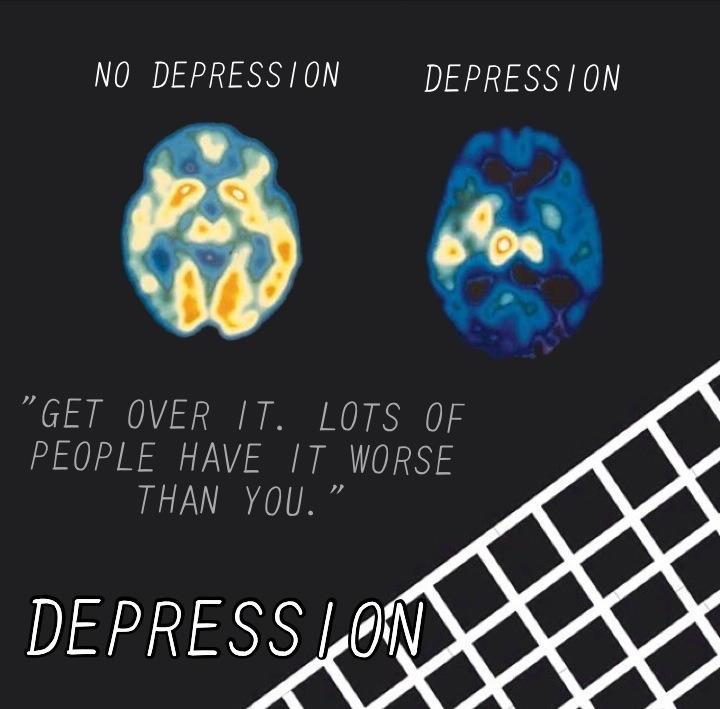
The dictionary defines disease as "a disorder of structure or function in a human, animal, or plant, esp. one that produces specific signs or symptoms or that affects a specific location and is not simply a direct result of physical injury." By this definition, depression must be a disease because brain scans have shown decreased activity in certain areas of the brain in depression patients, higher levels of stress hormones, and various genetic and biological causes that cause symptoms impacting one's thoughts, feelings, behavior, mood, and physical health. For some, depression is a life-long condition in which periods of wellness alternate with recurrences of illness. Depression is a leading cause of disability worldwide and represents a global public health challenge. According to the World Health Organization, it is the forth-leading contributor to Global Burden of Disease, and by 2020, depression is projected to be the second-leading cause.


There is no doubt, then, that depression is an illness.

Myth #2: Depression is a disease.
This is intentionally contradicting the point I just made. Depression is a disease, but it is not a straightforward medical disease. Confused? So was I, don't worry. Dr. John Grohol explains it in this way:
Diseases are manifestations of a problem with some physical organ or component within the body. And while the brain is also an organ, it is one of the least understood and easily the most complex organ within the body. Researchers and doctors refer to a diseased organ when something is clearly wrong with it (via a CAT scan or X-ray or laboratory test). But with our brains, we have no test to say, “Hey, there’s something clearly wrong here!”
One could make the argument, as many have, that because brain scans show abnormalities in certain biochemical levels within the brain when they suffer from depression or the like, this “proves” that depression is a disease. Unfortunately, research hasn’t gotten quite that far yet. The brain scans show us something, that much is true. But whether the scans show the cause or the result of depression has yet to be determined. And more tellingly, there is a body of research that shows similar changes in brain neurochemistry when people are doing all sorts of activities (such as reading, playing a video game, etc).
Depression is not a pure medical disease in the traditional sense, but a mental illness or mental disorder. It is complex in that reflects its basis in psychological, social, and biological roots. While it has neurobiological components, it is no more of a pure medical disease than ADHD or any other mental disorder. Treatment of depression that focuses solely on its medical or physical components — e.g., through medications alone — often results in failure.

Dr. Azadeh Aalai relates it in this way:
Psychiatrists oftentimes use the parallel of the diabetic who takes insulin to treat his condition; so, too, must the depressive take his or her meds, they claim. This is a wildly inaccurate parallel for a number of reasons. Firstly, one can definitively diagnose and validate diabetes as a medical condition. One can also identify with certainty the underlying medical reasons behind the diabetic’s condition. Lastly, one can also identify with certainty the extent to which the disease can be controlled/treated with the administration of insulin (in the case of type I diabetes in particular). There is no definitive blood test or otherwise physical examination that can determine a depression diagnosis. In fact, contrary to the entire medical paradigm, the symptoms of the illness actually serve as the basis of the diagnosis in the case of depression. Moreover, there is not a clear intervention, medical or otherwise, that can be implemented for a depressed individual that will work in all cases.
Summary: Depression is a mental disorder or mental illness--not a disease purely in medical sense, but it is still a disorder.


Myth #3: Depression is a product of your environment.
This one made me laugh a little bit. The boy who said this was clearly confused because he gave an example of a kid being depressed because his parents were fighting. First of all, that is not clinical depression--that's sadness. The two are not synonymous, but I will get to that later. Second of all, all mental illnesses are biopsychosocial in nature.

The first component is biology, which includes both the biochemical makeup of the brain, as well as inherited genes. Neurochemistry, especially neurotransmitters like serotonin, has been shown to correlate with depression, but the brain is so complex, that much is left undetermined for certain. Lately, research has started to show a genetic predisposition to mental illnesses like depression, but none of this determines if an individual will be affected. Having a relative with depression only increases your risk for getting depression by 10-15 percent. Correlation does not equal causation. The second component of this model is psychological, which includes a person's personality, how he or she was raised to deal with stress, how he or she deals with emotions, and other aspects. The final component of this model is social, which includes relationships and how we interact and communicate with others.

The biopsychosocial model is the most widely accepted model in all of psychology because it states that mental illness cannot be caused by biological or psychological or social factors alone--it takes a combination of all three to bring about any mental illness.

Myth #4: Depression is a choice.
Depression is not something that a person chooses to have! Seriously. A person with depression does not want to feel the way that he or she feels. It is not something that can be willed away any more than cancer or diabetes can. Research has shown depression correlates with chemical changes in the body, which cannot be overcome simply by a change in thinking. Depression is a medical condition that arises from errors in brain chemistry, function, and structure due to biological, psychological, and environmental factors.


Myth #5: Depression is just sadness/laziness/weakness
False. Equating depression with any of these things is like saying a common cold is the same as pneumonia.
Depression is not just ordinary sadness, grief, or laziness. Again, to quote Dr. John Grohol:
Depression is overwhelming feelings of sadness and hopelessness, every day, for no reason whatsoever. Most people with depression have little or no motivation, nor energy and have serious problems sleeping. And it’s just not for one day — it’s for weeks or months on end, with no end in sight.
Depression is not a sign of weakness--it can strike anyone at anytime. It does not discriminate against gender, race, age, sexuality, religion, culture, or any other factor. Someone with depression is not just feeling sorry for him or herself. Some of the most prominent and accomplished individuals have suffered from some form of depression, including:  Alexander the Great, Napoleon Bonaparte, Abraham Lincoln, Theodore Roosevelt, Winston Churchill, George Patton, abolitionist John Brown, Robert E. Lee, Florence Nightingale, Sir Isaac Newton, Stephen Hawking, Charles Darwin, J.P. Morgan, Barbara Bush, Ludwig von Beethoven and Michelangelo.


Myth #6: Depression is just a phase and if ignored, it will go away. 
This is false. Depression is a medical condition that requires treatment and support. In fact, many times symptoms of depression will get worse if left untreated. One of the most effective treatments of depression is through behavioral activation. This is the idea that in order to decrease depressive symptoms, one must act opposite to them--activate one's behavior--in order for them to decrease (which will not be instantaneous).

Myth #7: Antidepressants work no better than a placebo and have dangerous side effects.
This one I had to do some extensive research on and the jury is still out on it, not just in my brain, but in the scientific community. Talking about antidepressants, Dr. Azadeh Aalai wrote:
The standard the FDA requires for psychiatric meds to be approved and sold to consumers is not a high one: only two independent studies that yield significant results in favor of drugs is required, regardless of how many trials may be required to render such findings. In other words, “so long as research eventually yields evidence of efficacy, the failures would remain off the books. This is why antidepressants have been approved even though so many studies have shown them to be ineffective” (Greenberg, 2010, p. 216). Moreover, research suggests that the reduction of depressive symptoms seen with antidepressant use may be more indicative of a placebo effect than the merits of the drug itself. For instance, some sources contend that up to 80% of the effectiveness of antidepressants is due to placebo effects (see Greenberg, 2010). This comes at a high cost, given the documented (and not so documented) side effects—chief among them that in some cases, ironically, use of antidepressants actually increases suicidal ideation (particularly among adolescents).
A study done by Harvard in 2005 more deeply probed the risks of antidepressants, as did a study at the University of Colorado. Multiple studies have shown the effectiveness of antidepressants over the use of a placebo. People will analyze these studies inside and outside and upside down, but the speculation that antidepressants are no more effective than a placebo has not yet been evidenced in research, and like all medications, psychiatric medications come with their risks and side effects. However, if the medications are taken properly, under supervision of a trained medical doctor, the risks are generally minimal.

Myth #8: School shootings are caused by antidepressants, proving they do more harm than good. 
So. I don't even know what to do with this one. To me, it is a clear case of people assuming that correlation is the same as causation. I did a Google search of school shootings and antidepressants and found not a single credible source in the first few pages of results. To make sure that I was not missing anything, I did a search of PsychInfo, which gave me no results. There has been no research done in the academic community which states a definitive link. I read a statistic (and only one statistic, and not from a valid, peer-reviewed source) that stated 90 percent of school shootings could be linked to antidepressants. Since Newtown, there have been 44 school shootings in the United States, as of February. An estimated 31 million Americans are on antidepressants. That is a very small percentage, even if all those involved in the school shootings were taking antidepressants. Correlation does not imply causation. A link between two things, is not always causal, and in this case, assuming that cause is not only incorrect, but irresponsible AND it continues to promote stigma that keeps people from getting help!


Myth #9: The only way to treat depression is through the use of antidepressants. 
Treating depression is not as simple as just taking a pill. Medication alone is not enough and is generally most effective in addition to psychotherapy. Cognitive Behavioral Therapy (CBT) has been shown to be particularly effective in the treatment of depression. Lifestyle changes such as balanced nutrition, regular exercise, and adequate sleep have been shown to help as well as things like mindfulness, meditation, and yoga.


-----
Resources and References:
http://www.nimh.nih.gov/health/topics/depression/index.shtml
http://psychcentral.com/lib/an-introduction-to-depression/000650
http://www.nami.org/Template.cfm?Section=depression
http://www.nytimes.com/health/guides/disease/major-depression/overview.html
http://www.huffingtonpost.ca/2013/11/13/depression-myths-_n_4268047.html
http://psychcentral.com/lib/what-is-depression-if-not-a-mental-illness/000896?all=1
http://www.psychologytoday.com/blog/evil-deeds/200809/is-depression-disease
http://psychcentral.com/blog/archives/2009/10/18/7-myths-of-depression/
http://www.psychologytoday.com/blog/the-first-impression/201302/5-myths-about-depression
http://www.healthcentral.com/depression/just-diagnosed-822-143_3.html
http://psychcentral.com/blog/archives/2009/10/18/7-myths-of-depression/
http://www.healthline.com/health-slideshow/9-myths-depression#1
http://www.hpb.gov.sg/HOPPortal/health-article/10202


Sunday, January 26, 2014

Taking the Semester Off

I'm getting to the time where everyone is asking me why I am not back at school. It's not winter break any longer, although it certainly is winter here. And I'm getting asked questions that I usually have no idea how to answer. Things like, "Are you going to school somewhere else?" or "What are you going to do now that you're home?" or "Why aren't you at school?" And I usually respond with the generic, I'm just taking the semester off to figure out some life stuff and I'm going back to school in the fall. It's a perfectly reasonable explanation, I think, especially after the advice that one of my professors gave me: 

"It is difficult to answer people's questions. They never mean any harm by them, yet its very awkward when you don't want to talk about it. You'll have to come up with a short, very generic answer. It is important to remember that people take time off from college for a variety of reasons... A semester off is nothing. I know other students who took off for medical leave, but some just want a break for a while to figure out their path. That is really mature (and wise) to do. So often young adults just jump on the path they think is 'correct' by their parents, friend, or society without looking at all of the options. You get the luxury of looking at your options!"

So I personally think my answer is really good. But then, some people ask me the dreaded question of all questions... 

WHY?

And it's not that I want to lie to people--I am not a liar (if I was a liar, I would probably still be at school right now)--but I don't exactly know how to read people and judge how they'll react to me telling them the truth. For example, some of the elderly people at church, what would they think? EDs weren't really a thing back then, besides, everyone knows that they all gossip and talk to each other and I don't want anything I say to get misinterpreted and rumors to be spread and whatnot. And a lot of times, people will ask and it won't be an ideal time to share that information because they'll be other people around who I don't want to overhear what I'm saying or there won't be enough time for me to explain the entire situation because you can't just throw it out there that, hey, I've had an eating disorder for almost 7 years and that's why I'm taking time off of school. It doesn't really work like that. 

Also, like my mom told me the other day--it really is none of their business. She was referring to a situation where someone who our family barely knows was asking about why I was taking time off of school. My business is my business and no one else's. 


I do, however, pride myself on being open about my ED because I want to change the conversation we have in society about EDs and the stigma that surrounds them. I am totally okay with speaking freely about my struggles and my illness, but there is a time and a place for it. I know that, and I try to do what I am most comfortable with in the moment. If that means talking about it, then by all means, I will talk about it. But if that means shrugging off the question with a generic answer, then that is exactly what I will do and if people aren't okay with that, well, that's just too freaking bad because it is none of their damn business in the first place. 

I am not selfish for putting my recovery before my education,
my family, my future, and everything else.
Putting everything else on hold to recover is not selfish.
You are not selfish for taking time out to heal.
But there are ways in which I am willing to share what's really going on--through an email, through a text, through a one-on-one conversation where there are no interruptions. Because as easy as it is for me to say I'm taking the semester off, it's a really challenging feat for me, one that I struggle every day to accept, to embrace, and to not judge. 

Most people don't get that I just might not be 100% okay with what I'm doing right now when they ask these questions. And again, they don't mean any harm by them, I'm sure. But every time that I have to look at someone and say that to them, another piece of my heart breaks. 

I sent an email to a high school teacher of mine the other day, sharing a really cool video that I thought she would find useful in her classes. She emailed me back and asked me how school and life were going for me, and I was very open with her about everything. She responded saying: 

"I hope that you can rest in the fact that it is all right to be at home right now.  My youngest also had to take time out from college to get her bearings back, and during that time I know that 'being out' was really hard for her, even though it was the right thing to do.  Life is bigger than our plans, sometimes."

I want people to think a little bit more before they ask questions and pry into people's lives, especially if they do not know them very well. I want them to think about the timing and the location of their questions, especially with something like this. Anyone who knows me well knows that I love school, especially Gettysburg, and that I hate quitting something or not finishing something, so anyone who knows me would know that me being home right now is 1) not a normal behavior for me and 2) not something that I would opt to do on my own free will. I also think people need to be aware of the degree to which it is acceptable to pry into the life of another person in a particular situation. I'm completely okay with telling everyone, in any situation, that I am taking the semester off of school. It's the questions that follow that are not always timed the best, and I'm not always comfortable saying that I don't want to talk about it in that moment. 

And again, I know that people don't mean any harm or hurt to come of their questions, and that usually they are just curious or trying to make conversation, which is fine. I just wish that people would be more careful about when and where they choose to ask things and that they would recognize that this taking a semester off thing isn't as easy as it looks for me, that it pains me to be sitting at home and not in my dorm room or in class and that I'm not just taking a break from school--I'm trying to rewire my brain. And that, my friends, is not easy or simple. 

Sunday, December 1, 2013

I Feel Alone.

A few days ago, I watched a video about how even though we are the most connected to others than we have ever been--thanks to social media like Facebook, Twitter, Foursquare, YouTube, Tumblr, Pintrest, etc and things like smartphones and texting that make anyone easily accessible--we are more lonely than we have ever been. I've linked the video here: 


After watching it a third time, it still makes my head spin when I watch it, but it also makes so much sense if you really think about the message it contains. 

Today, I was sitting in church next to my dad and he had his arm around me, like he usually does every Sunday we're in church together.  I was surrounded by a sea of people, most of whom had watched me grow from a first grader into a college sophomore.  I was surrounded, essentially, entirely by my family. 

And I felt completely alone. 

Right before the service began, I had a conversation with a lifelong friend about all that has been happening in my life, if being home was being helpful, how I was feeling, and it ended, like all of these conversations do, with her saying something to the effect of 'Let me know if you ever need anything. I'm here for you, and I love you.' 


So many people have told me that recently. And I very well know that I am not, in fact, alone. I have friends here who have tried to get together with me, but I've just been too tired or just not wanted to be social. I've received letters and care packages from school friends. I've gotten daily texts from some of my closest friends. And on the rare occasions that I have ventured out into the real world, one that is not my house or treatment, I've spent a couple quality hours with people who have been in similar situations. 

But I still feel alone. 

I don't know if I would say that I feel 'lonely,' because I don't think that's what I'm feeling. Lonely to me means missing people you care about, and although I do miss Gettysburg friends and home friends and extended family, that's not what is consuming me. It's the feeling of isolation, of not being understood, of not being fully known or heard, of people just not 'getting' me. The feeling of being alone. 

I know this has to do with my depression and my eating disorder. The two of them are not mutually exclusive from each other--experts still cannot determine a causal relationship between the two things, just that they tend to be highly correlated. But both add to this feeling of alone-ness, or isolation if you will. 

So even in those moments where I am not physically isolating myself, in the moments where I am not letting my social anxiety win, in the moments where I am not actually alone, the feeling of isolation and alone-ness is still there and it feels more present than it does when I am physically alone. 


Maybe this feeling of isolation and alone-ness has to do with my lack of vulnerability in these social situations.  All morning I was answering questions of 'How's school?' 'Are you glad to have had some time off?' 'Are you looking forward to winter break?' as if nothing were wrong. As if, in fact, I was making the five hour trek back to Gettysburg to have one more week of classes, a week of finals, and then over a month off for winter break. Maybe I need to be more vulnerable. 

Or maybe it has to do with the idea that I'm not constantly surrounded by my friends or that I can walk to class and pass four of my closest friends along the way. Maybe it is actual loneliness because some of those who know me best are not present, here, with me. 

Maybe it has to do with my being an introvert and not feeling fulfilled and cared for in large group settings, like church or like family Thanksgiving. But even in the one-on-one contact that I've had with people where I've been vulnerable and open, I have still felt alone. 

But mostly, my feeling alone has to do with the illness. The fact that I suffer from anorexia and depression and anxiety and that person sitting next to me does not. Or that person sitting across the room, although he or she may also suffer from depression, he or she does not also have an eating disorder and anxiety. The fact that I, alone, am being attacked by this specific illness and this specific combination of comorbid conditions makes me feel alone. 

Our culture puts such an emphasis on individuality, and I've been reading about it all semester in social psychology and how different psychological phenomena are experienced differently in collectivist cultures. If I lived in such a culture, would I feel any less alone right now? Probably not. 

Eating disorders are very individualized. Every person who suffers from any type of eating disorder suffers differently. That's why treatment must be individualized to the person in order for it to be effective. My eating disorder is not the same as any of the other people sitting in DTP with me or anyone else who has gone through CCED or suffered with an ED. 

I feel alone because psychologically, I am alone right now. 


This is one of those posts that isn't going to be wrapped up all nice and pretty and topped with a bow. This feeling of alone-ness is not going to go away just by placing myself in a room full of people, or a small group of people that know me well, or even in a room full of people who 'get it.' Because I will still feel alone. No matter how many letters I receive, texts and emails I get, words of encouragement I am told--the feeling of being alone remains.

And in this moment, sitting with this alone-ness and the discomfort it brings is just going to be something that I have to do. 
And maybe, one day, it won't be here anymore. 

Friday, February 8, 2013

Exhaustion.

I am so exhausted. 
Not tired, not stressed, not overwhelmed. 
Exhausted. 

Like the kind of tired where I can't possibly function because the urge to sleep is so overwhelming. 
Or the tired that I get when out boogie boarding in the ocean when the waves are really strong. 
Or the tired like I was just at a funeral tired. 

I forgot how exhausting this illness was. 
I forgot that it consumes me. Defines me. Destroys me. 

But what's more exhausting is the constant battle.  
I'm not sure how much longer I can keep this up. 
Not that it matters because it seems like I'm failing anyway--I cancelled on my therapist, am restricting, am increasing exercise, etc.  But mostly, I'm not fighting the thoughts.  I'm not denying them. 

Because right now, they seem more true than ever. 

I am so exhausted.