Showing posts with label stigma. Show all posts

Wednesday, September 10, 2014

World Suicide Prevention Day 2014

Every day, every 40 seconds, someone dies by suicide. Take a moment and let that sink in, and then think about this - for every one successful suicide attempt, statistics have shown there are at least 20 other unsuccessful suicide attempts, meaning that every 40 seconds, 21 people - people who are just the same as you and me - attempt (and succeed) at taking their own lives.

Read it again.

Every day, every 40 seconds, someone dies by suicide. Take a moment and let that sink in, and then think about this - for every one successful suicide attempt, statistics have shown there are at least 20 other unsuccessful suicide attempts, meaning that every 40 seconds, 21 people - people who are just the same as you and me - attempt (and succeed) at taking their own lives.

40 seconds. That's how long it just took you to read the first paragraph twice. In that time, someone, somewhere died by suicide and 20 others attempted it.

Suicide is the second leading cause of death in 15-29-year-olds. The SECOND LEADING CAUSE OF DEATH of adolescents and young adults whose lives are filled with so much potential, whose lives have not even really begun.

Suicide is preventable. 

The World Health Organization has just recently released a report that covers in-depth the risk factors for suicide and summarizes it with this: "Social, psychological, cultural and other factors can interact to lead a person to suicidal behaviour, but the stigma attached to mental disorders and suicide means that many people feel unable to seek help (2014)."

I am not (yet) qualified enough to speak about the factors leading to suicidal behavior and thoughts. I can only speak from my own experience. And my own experience includes stigma.

The stigma is real, my friends.

Over the past years, as I've struggled with anxiety, depression, eating disorders, self-harm, and various other things, there have been a few points where I wanted nothing more than to not be alive. I was done - done going to therapy, done talking about it, done fighting, done trying. I wanted to not exist. I wanted to go to sleep and not wake up.

For the longest time, I was afraid to say anything about my suicidal thoughts to anyone because I was afraid of what they would think, of what they would do. I was afraid I would be seen as a crazy person. I was afraid I would be restrained in a hospital bed. I was afraid I would be medicated to the point of not knowing who I was. I was afraid I would be institutionalized and would never come out. I was afraid that once I came out as not okay, I would never again be treated as okay.

We do this thing in our society where we skirt around anything major. We don't give the real answers when someone asks how we are because we think they don't care or they'll judge us. We don't talk about the hard stuff. We don't talk about suicide. 

Except we do, when a celebrity dies of it. A few months ago, Robin Williams committed suicide and then for a week or two, we talked about it. Briefly. The conversations, though, seem to have focused more on his depression than on his suicide, which although is a start, it isn't okay.

It isn't okay because although mental illnesses like depression have a correlation to suicidality, they are not always the cause. Many people living with mental illnesses are not affected by suicidal behaviors. Not everyone who dies by suicide has a mental illness. It is myths like these that contribute to stigma.

September is Suicide Prevention Month. It is a time when organizations and people attempt to bring the conversation to how we can work together to prevent suicide because, according to the World Health Organization, "Despite the evidence that many deaths are preventable, suicide is too often a low priority for governments and policy-makers (2014)."

In my experience, the best prevention is being there to ask the hard questions, to talk about the tough stuff, to care about the messy, broken parts when a friend is struggling. As Will Hall writes:

"When we begin to listen we also discover something very surprising. Suicidal feelings are not the same as giving up on life. Suicidal feelings often express a powerful and overwhelming need for a different life. Suicidal feelings can mean, in a desperate and unyielding way, a demand for something new. Listen to someone who is suicidal and you often hear a need for change so important, so indispensable, that they would rather die than go on living without the change. And when the person feels powerless to make that change happen, they become suicidal.

"Help comes when the person identifies the change they want and starts to believe it can actually happen. Whether it is overcoming an impossible family situation, making a career or study change, standing up to an oppressor, gaining relief from chronic physical pain, igniting creative inspiration, feeling less alone, or beginning to value their self worth, at the root of suicidal feelings is often powerlessness to change your life – not giving up on life itself."

By allowing someone to tell their story, you give them what they desperately need - power. By not keeping a story untold, the author of it gains a bit of power and control over the situation. Things seem to get more hopeful because there is one more character in that story. It's not a one act play anymore. At least that's how it was for me.

I had people in my life to tell me I mattered. To tell me I was important. To tell me no one else could play my part.

And tonight, I'm telling you.

You matter.
You are important.
No one else can play your part. 


"Welcome to Midnight. That's what we say when the ball drops and a new year begins. i like that moment because beyond the fireworks and resolutions, beyond the kisses and celebration, is the quiet hope that something can be new. That it's possible to leave the past behind and start again. There's nothing extra special on television tonight, no clapping crowd in Times Square, no parade scheduled for the morning. But this midnight means World Suicide Prevention Day, and we would like to think this day can be significant. Not because the world needs another holiday, and not because we need a stage to stand on. We believe in World Suicide Prevention Day for the same reasons we love New Year's Eve and New Year's Day. Because perhaps it's possible to change. Perhaps it's possible to start again. Perhaps it's possible for things to be new. We know that change takes more than a moment, and we aren't saying it will be easy, but we're saying that it's worth it. This life. This night. Your story. Your pain. Your hope. It matters. All of it matters. You're loved. You matter to this world and you matter to the people who love you. So stay. Please stay. No one else can play your part." 
-Jaime Tworkowski, founder of TWLOHA


Notes:
The conversation does not end at midnight. Organizations like To Write Love On Her ArmsActive Minds, and American Foundation for Suicide Prevention are working to change the conversation. 

If you are struggling with suicide, please call 1-800-273-TALK (8255) or visit http://www.suicidepreventionlifeline.org/.

World Health Organization. 2014. Preventing Suicide: A Global Imperative. http://www.who.int/mental_health/suicide-prevention/world_report_2014/en/

Hall, Will. 2013. Living with Suicidal Feelings. http://beyondmeds.com/2013/04/24/living-with-suicidal-feelings/

Tworkowski, Jamie. 2014. Welcome to Midnight. Welcome to World Suicide Prevention Day. http://twloha.com/blog/welcome-world-suicide-prevention-day


Sunday, March 9, 2014

I Got In A Fight Last Week...

I got into a fight. On Twitter. It sounds so lame and immature... But someone needed to say the things that I did, and honestly, I regret nothing.


One night last week, I was scrolling through my Twitter feed, when I can across a tweet claiming that the cure for depression is "a weekend of nature, sit[ting] under a tree and watch[ing] the water cascade over a cliff." As someone who has struggled with diagnosed clinical depression for a very long time, I was offended by this tweet. My response to it was: "Depression is a disease and chemical imbalance in one's brain, not an emotion. Stop #mentalhealthstigma & belittling the problem!" (Let's take a minute and think about how hard it is to tell someone facts and why they're wrong in 140 characters...) The replies I received were less than informed, and in some cases down right mean. I think my favorites were the ones that told me I was "brainwashed" and "Perhaps the chemical imbalance in your brain is a RESULT of you negative thinking/attitude" and "#YourHashtagsMeanAsMuchAsYourDegree #Nothing."


Depression is a serious mental illness that affects 5-8 percent adults in the United States each year. Less than half of these people will get help for their disease. This is a problem. Stigma and misinformed people are a problem. So let's look at some myths (and some arguments) that I came across in my Twitter fight.

Myth #1: Depression is not a disease.
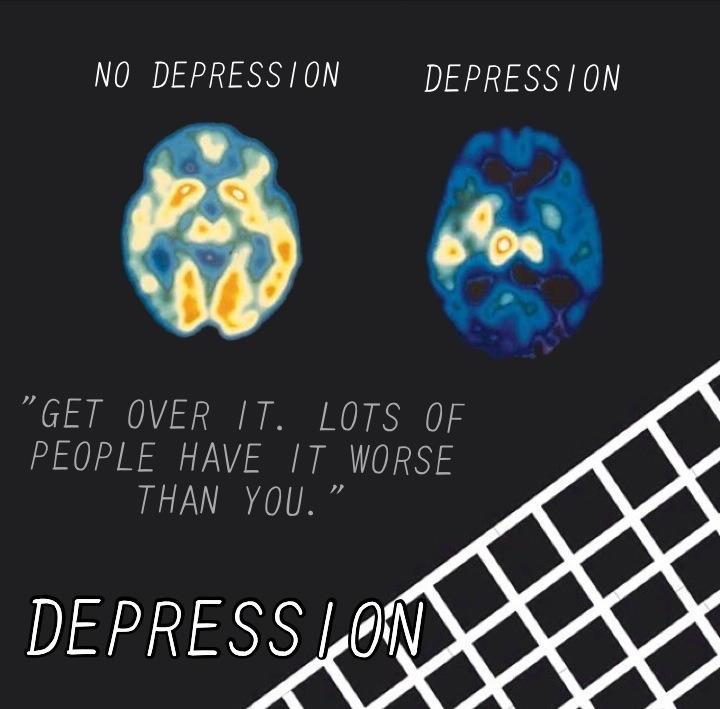
The dictionary defines disease as "a disorder of structure or function in a human, animal, or plant, esp. one that produces specific signs or symptoms or that affects a specific location and is not simply a direct result of physical injury." By this definition, depression must be a disease because brain scans have shown decreased activity in certain areas of the brain in depression patients, higher levels of stress hormones, and various genetic and biological causes that cause symptoms impacting one's thoughts, feelings, behavior, mood, and physical health. For some, depression is a life-long condition in which periods of wellness alternate with recurrences of illness. Depression is a leading cause of disability worldwide and represents a global public health challenge. According to the World Health Organization, it is the forth-leading contributor to Global Burden of Disease, and by 2020, depression is projected to be the second-leading cause.


There is no doubt, then, that depression is an illness.

Myth #2: Depression is a disease.
This is intentionally contradicting the point I just made. Depression is a disease, but it is not a straightforward medical disease. Confused? So was I, don't worry. Dr. John Grohol explains it in this way:
Diseases are manifestations of a problem with some physical organ or component within the body. And while the brain is also an organ, it is one of the least understood and easily the most complex organ within the body. Researchers and doctors refer to a diseased organ when something is clearly wrong with it (via a CAT scan or X-ray or laboratory test). But with our brains, we have no test to say, “Hey, there’s something clearly wrong here!”
One could make the argument, as many have, that because brain scans show abnormalities in certain biochemical levels within the brain when they suffer from depression or the like, this “proves” that depression is a disease. Unfortunately, research hasn’t gotten quite that far yet. The brain scans show us something, that much is true. But whether the scans show the cause or the result of depression has yet to be determined. And more tellingly, there is a body of research that shows similar changes in brain neurochemistry when people are doing all sorts of activities (such as reading, playing a video game, etc).
Depression is not a pure medical disease in the traditional sense, but a mental illness or mental disorder. It is complex in that reflects its basis in psychological, social, and biological roots. While it has neurobiological components, it is no more of a pure medical disease than ADHD or any other mental disorder. Treatment of depression that focuses solely on its medical or physical components — e.g., through medications alone — often results in failure.

Dr. Azadeh Aalai relates it in this way:
Psychiatrists oftentimes use the parallel of the diabetic who takes insulin to treat his condition; so, too, must the depressive take his or her meds, they claim. This is a wildly inaccurate parallel for a number of reasons. Firstly, one can definitively diagnose and validate diabetes as a medical condition. One can also identify with certainty the underlying medical reasons behind the diabetic’s condition. Lastly, one can also identify with certainty the extent to which the disease can be controlled/treated with the administration of insulin (in the case of type I diabetes in particular). There is no definitive blood test or otherwise physical examination that can determine a depression diagnosis. In fact, contrary to the entire medical paradigm, the symptoms of the illness actually serve as the basis of the diagnosis in the case of depression. Moreover, there is not a clear intervention, medical or otherwise, that can be implemented for a depressed individual that will work in all cases.
Summary: Depression is a mental disorder or mental illness--not a disease purely in medical sense, but it is still a disorder.


Myth #3: Depression is a product of your environment.
This one made me laugh a little bit. The boy who said this was clearly confused because he gave an example of a kid being depressed because his parents were fighting. First of all, that is not clinical depression--that's sadness. The two are not synonymous, but I will get to that later. Second of all, all mental illnesses are biopsychosocial in nature.

The first component is biology, which includes both the biochemical makeup of the brain, as well as inherited genes. Neurochemistry, especially neurotransmitters like serotonin, has been shown to correlate with depression, but the brain is so complex, that much is left undetermined for certain. Lately, research has started to show a genetic predisposition to mental illnesses like depression, but none of this determines if an individual will be affected. Having a relative with depression only increases your risk for getting depression by 10-15 percent. Correlation does not equal causation. The second component of this model is psychological, which includes a person's personality, how he or she was raised to deal with stress, how he or she deals with emotions, and other aspects. The final component of this model is social, which includes relationships and how we interact and communicate with others.

The biopsychosocial model is the most widely accepted model in all of psychology because it states that mental illness cannot be caused by biological or psychological or social factors alone--it takes a combination of all three to bring about any mental illness.

Myth #4: Depression is a choice.
Depression is not something that a person chooses to have! Seriously. A person with depression does not want to feel the way that he or she feels. It is not something that can be willed away any more than cancer or diabetes can. Research has shown depression correlates with chemical changes in the body, which cannot be overcome simply by a change in thinking. Depression is a medical condition that arises from errors in brain chemistry, function, and structure due to biological, psychological, and environmental factors.


Myth #5: Depression is just sadness/laziness/weakness
False. Equating depression with any of these things is like saying a common cold is the same as pneumonia.
Depression is not just ordinary sadness, grief, or laziness. Again, to quote Dr. John Grohol:
Depression is overwhelming feelings of sadness and hopelessness, every day, for no reason whatsoever. Most people with depression have little or no motivation, nor energy and have serious problems sleeping. And it’s just not for one day — it’s for weeks or months on end, with no end in sight.
Depression is not a sign of weakness--it can strike anyone at anytime. It does not discriminate against gender, race, age, sexuality, religion, culture, or any other factor. Someone with depression is not just feeling sorry for him or herself. Some of the most prominent and accomplished individuals have suffered from some form of depression, including:  Alexander the Great, Napoleon Bonaparte, Abraham Lincoln, Theodore Roosevelt, Winston Churchill, George Patton, abolitionist John Brown, Robert E. Lee, Florence Nightingale, Sir Isaac Newton, Stephen Hawking, Charles Darwin, J.P. Morgan, Barbara Bush, Ludwig von Beethoven and Michelangelo.


Myth #6: Depression is just a phase and if ignored, it will go away. 
This is false. Depression is a medical condition that requires treatment and support. In fact, many times symptoms of depression will get worse if left untreated. One of the most effective treatments of depression is through behavioral activation. This is the idea that in order to decrease depressive symptoms, one must act opposite to them--activate one's behavior--in order for them to decrease (which will not be instantaneous).

Myth #7: Antidepressants work no better than a placebo and have dangerous side effects.
This one I had to do some extensive research on and the jury is still out on it, not just in my brain, but in the scientific community. Talking about antidepressants, Dr. Azadeh Aalai wrote:
The standard the FDA requires for psychiatric meds to be approved and sold to consumers is not a high one: only two independent studies that yield significant results in favor of drugs is required, regardless of how many trials may be required to render such findings. In other words, “so long as research eventually yields evidence of efficacy, the failures would remain off the books. This is why antidepressants have been approved even though so many studies have shown them to be ineffective” (Greenberg, 2010, p. 216). Moreover, research suggests that the reduction of depressive symptoms seen with antidepressant use may be more indicative of a placebo effect than the merits of the drug itself. For instance, some sources contend that up to 80% of the effectiveness of antidepressants is due to placebo effects (see Greenberg, 2010). This comes at a high cost, given the documented (and not so documented) side effects—chief among them that in some cases, ironically, use of antidepressants actually increases suicidal ideation (particularly among adolescents).
A study done by Harvard in 2005 more deeply probed the risks of antidepressants, as did a study at the University of Colorado. Multiple studies have shown the effectiveness of antidepressants over the use of a placebo. People will analyze these studies inside and outside and upside down, but the speculation that antidepressants are no more effective than a placebo has not yet been evidenced in research, and like all medications, psychiatric medications come with their risks and side effects. However, if the medications are taken properly, under supervision of a trained medical doctor, the risks are generally minimal.

Myth #8: School shootings are caused by antidepressants, proving they do more harm than good. 
So. I don't even know what to do with this one. To me, it is a clear case of people assuming that correlation is the same as causation. I did a Google search of school shootings and antidepressants and found not a single credible source in the first few pages of results. To make sure that I was not missing anything, I did a search of PsychInfo, which gave me no results. There has been no research done in the academic community which states a definitive link. I read a statistic (and only one statistic, and not from a valid, peer-reviewed source) that stated 90 percent of school shootings could be linked to antidepressants. Since Newtown, there have been 44 school shootings in the United States, as of February. An estimated 31 million Americans are on antidepressants. That is a very small percentage, even if all those involved in the school shootings were taking antidepressants. Correlation does not imply causation. A link between two things, is not always causal, and in this case, assuming that cause is not only incorrect, but irresponsible AND it continues to promote stigma that keeps people from getting help!


Myth #9: The only way to treat depression is through the use of antidepressants. 
Treating depression is not as simple as just taking a pill. Medication alone is not enough and is generally most effective in addition to psychotherapy. Cognitive Behavioral Therapy (CBT) has been shown to be particularly effective in the treatment of depression. Lifestyle changes such as balanced nutrition, regular exercise, and adequate sleep have been shown to help as well as things like mindfulness, meditation, and yoga.


-----
Resources and References:
http://www.nimh.nih.gov/health/topics/depression/index.shtml
http://psychcentral.com/lib/an-introduction-to-depression/000650
http://www.nami.org/Template.cfm?Section=depression
http://www.nytimes.com/health/guides/disease/major-depression/overview.html
http://www.huffingtonpost.ca/2013/11/13/depression-myths-_n_4268047.html
http://psychcentral.com/lib/what-is-depression-if-not-a-mental-illness/000896?all=1
http://www.psychologytoday.com/blog/evil-deeds/200809/is-depression-disease
http://psychcentral.com/blog/archives/2009/10/18/7-myths-of-depression/
http://www.psychologytoday.com/blog/the-first-impression/201302/5-myths-about-depression
http://www.healthcentral.com/depression/just-diagnosed-822-143_3.html
http://psychcentral.com/blog/archives/2009/10/18/7-myths-of-depression/
http://www.healthline.com/health-slideshow/9-myths-depression#1
http://www.hpb.gov.sg/HOPPortal/health-article/10202


Tuesday, November 26, 2013

Why I Write & Why I Share

Sometimes people ask me why I blog--why I would choose to chronicle my journey and recovery in such a public manner.  Actually, the majority of people in my life don't even know that I keep a blog.  Which is strange, considering that I've lately taken to sharing my blog posts on Facebook.  

But one of the most common questions I get is something along the lines of, "Why are you so open about your struggles?" Or the stated variation of that question, "It's really brave of you to talk about this so openly and honestly." 


Why do I talk about it? And why do I blog about it? 

I write because one post takes a lot less time to write than it does to explain what I'm going through to all of my friends and family. I write, sometimes, to simply give out information.

I write because writing is therapy for me. I shared one of my latest blog posts with a professor at school, who responded, "Your post, while written almost like you are educating others, seems like you're trying to convince yourself of everything you're typing." I write to understand. To understand myself, my life, and the world around me better. I write because it helps--getting it all down on paper. It helps to take all the facts and information and articles that have been bouncing around in my head and combine them into an imperfect masterpiece that helps me to understand myself. 

I write because I want to remember. No, I take that back. I don't want to remember these days.  These days are pure hell.  They are miserable and I don't want to remember them.  I NEED to remember them.  I need to remember them because according to statistics (and the fact that I am a psychology major hoping to specialize in eating disorders), I am one day going to be sitting across the table from a young woman who is in a similar position to what I am in today and I need to be able to look her in the eyes and say, "I know what you are going through because I lived through it, and I promise you, it will get better." I need to remember because it will make me a better therapist, a better empathizer, and a better human being. 

I write because there are approximately 24 million men and women in the United States suffer from a clinically significant eating disorder. Let me point out that clinically significant in the statistic only includes binge eating disorder, bulimia, and anorexia. There are other types of eating disorders out there with the most common being Eating Disorder Not Otherwise Specified (EDNOS), which is what I was originally diagnosed with in 2011. 

I write because there are hundreds of thousands of people suffering in silence from an eating disorder, anxiety, and/or depression and who feel like they are completely alone in their struggle. Since I've been more open and vulnerable with my struggles and my past, many of my friends, family, and acquaintances have reached out to me and said, 'Me too.' They can't always relate to all of it, but they can relate to some of it. And each and every one of them have told me about their fears of speaking out about their struggles or about how brave I am to speak openly about mine.


I write because there is still stigma around mental disorders.

I write because people are still afraid to seek professional help for psychological disorders because society still thinks that having a mental disorder makes you crazy, insane. Because our society looks down on any type of weakness, even if that weakness or struggle is no fault of that person.

I write because there are still people who think that eating disorders and depression and anxiety are just choices that a person makes.  That someone with an eating disorder can just 'start eating normally' again, or that someone with depression can just 'stop being sad and be happy,' or that someone with anxiety can just 'get over it.'  

I write because there are still people who don't believe that eating disorders have biological, environmental, psychological, social, and genetic causes. There are people who still think that eating disorders are just diets or just a phase. There are people who still think that, as Carrie Arnold says in Decoding Anorexia, "Bad parenting caused eating disorders. Our thin-is-in culture caused eating disorders. A need for control caused eating disorders. Low self-esteem caused eating disorders," even though recent research has proved them wrong. 


I write because when someone finds out that you are diagnosed with cancer, they bring you casseroles, ask how you're doing, and offer to help in any way that they can. But no one wants to know if you have been diagnosed with a mental illness for what? Some irrational fear that they might catch it? The author of this Slate article talks about the ignorance of mental illnesses in this way: 
"Friends talk about cancer and other physical maladies more easily than about psychological afflictions. Breasts might draw blushes, but brains are unmentionable. These questions are rarely heard: 'How’s your depression these days?' 'What improvements do you notice now that you have treatment for your ADD?' 'Do you find your manic episodes are less intense now that you are on medication?' 'What does depression feel like?' 'Is the counseling helpful?'"
I write because stigma around mental health issues not only exists, but is very present in our society. And maybe by telling my story, it can help to lessen that stigma just the tiniest bit. 

Maybe it will help some random person out there to feel less alone. 

Or maybe it just helps me to understand it all.