I live in a bubble. I live in a bubble where people understand mental illnesses like depression and anxiety. And in that same bubble, are a few people who understand eating disorders. A few more of those people are willing to learn about eating disorders and the majority are willing to believe me when I say that I suffer from anorexia. I live in a bubble where when I tell people that I am dealing with all three of those things, they usually say, "I'm so sorry. Is there anything I can do?" or something similar to that.
But what still blows me away is the ignorance of people concerning eating disorders. Today, in an effort to make Thanksgiving less painful and stressful on myself, I decided to email all of my relatives on that side about my current situation. This was mainly to avoid the awkward, "So how's school going?" question that seems to be the most popular topic of conversation whenever I see any adult that I haven't seen in a long time. And my extended family has been responding in the most supportive manner and, and for that, I am thankful.
 But then I received this response:
"Unless you are now grossly underweight, <X lbs, I wouldn't think that anorexia is really an issue."
This has always been one of my biggest fears when coming clean about being anorexic--that people wouldn't believe me because I am "too fat to have an eating disorder." It's one of my greatest fears in treatment--that I'm going to be the fattest, heaviest, biggest person that has the highest weight there. That people think that I don't deserve to be in treatment for any type of eating disorder because I am considered to be a 'healthy' weight.
And the thought slipped into my mind: maybe I don't actually need treatment. Maybe I'm fine. I'm at a healthy weight according to BMI, right? I mean, it's not what my ED doctor recommended for me when I was in treatment, but if I'm still in a healthy weight range... I must be fine. Dr. G is just overreacting.
It also brought to mind my sophomore summer and junior year of high school when I was working with a doctor, dietitian, and therapist at Akron who actually told me (while I was teetering on the edge of full-blown anorexia) that I was technically, according to BMI, overweight and that I could continue to lose weight if I wanted. So they put me on a meal plan that was designed for weight loss, and even though I was eating 'normally,' it totally fueled the eating disordered part of my brain more.
If you want to read more about why this is, this blogger does a really good job of covering what happens to your body when, even if you are eating healthy and exercising, you can develop ED mentalities and other negative effects: I Am Overweight. (Trigger warning on this one... there's numbers thrown around).
My target weight rang--the range that my ED doctor gave me, which helps them determine if I am 'healthy and recovered' or not--technically puts me in the 70-ish% of Americans who are overweight or obese. My HEALTHY weight puts me there. For a general, health conscious American, just being barely over that line would cause me to maybe get a little more exercise, maybe eat a bit healthier, the general stuff.

But because I am anorexic, my brain hears 'healthy' and thinks fat. It hears 'barely overweight according to BMI,' which excludes so many factors that contribute to a person's weight, shape, and size, and thinks lose weight. My brain doesn't want to hear healthy. When I wrote my email this afternoon, I attached some links to my family about "What Not to Say to Someone with an Eating Disorder" and one of the first things on that list is to not say anything about looking healthy because an ED brain hears healthy and thinks fat.
 Just as EDs do not discriminate against race, gender, sexuality, age, class, etc., they do not discriminate against size either. People of all body types, sizes, and shapes suffer from eating disorders. You can't tell just by looking at a person. Society has this image of emaciation and protruding bones of adolescent girls with anorexia and other stereotypes of bulimia and BED. A brave young woman wrote about that and her struggles with her own anorexia, even after being weight restored here. I've probably referenced that same article before, but it is worth the read, even if you have already read it once.

I am a psychology major. I've been in treatment for an ED for four years now, although my ED has spanned almost seven years of my life. I know the diagnostic criteria. And I meet all of it for anorexia, and I would have met it two years ago had the DSM-V been printed. I did the assessment with an ED specialist, who recommended the DTP level of care. I went to my ED doctor who not only found significant weight loss, that I was orthstatic, low heart rate, bradycardia, malnutrition, and signs that my body was starting to consume muscle for energy. She gave me a meal plan to help get some nutrients in my body and keep my heart from working even harder, slowing down more, and losing muscle mass.
And that night when I was having an anxiety attack about having to eat food, and A LOT of it (this from someone who has been severely restricting her caloric intake, not for fear of gaining weight, but for the fear of not losing it) and when I finally realized that Dr. G put me on a meal plan to GAIN weight (which is the second worst thing in the world), Annie said to me:
But because I am anorexic, my brain hears 'healthy' and thinks fat. It hears 'barely overweight according to BMI,' which excludes so many factors that contribute to a person's weight, shape, and size, and thinks lose weight. My brain doesn't want to hear healthy. When I wrote my email this afternoon, I attached some links to my family about "What Not to Say to Someone with an Eating Disorder" and one of the first things on that list is to not say anything about looking healthy because an ED brain hears healthy and thinks fat.
Just as EDs do not discriminate against race, gender, sexuality, age, class, etc., they do not discriminate against size either. People of all body types, sizes, and shapes suffer from eating disorders. You can't tell just by looking at a person. Society has this image of emaciation and protruding bones of adolescent girls with anorexia and other stereotypes of bulimia and BED. A brave young woman wrote about that and her struggles with her own anorexia, even after being weight restored here. I've probably referenced that same article before, but it is worth the read, even if you have already read it once.
No one in the professional world defines anorexia as just emaciation. Anorexia is not just a description of a physical appearance. It is a term that describes a cluster of symptoms. Decreased weight is just one factor. Clinician Chelsea Fielder-Jenks elaborates on this idea of weight stigma in this article, concluding by saying:
"The bottom line is this: Eating disorders do not discriminate. Eating disorder attitudes and behaviors can affect individuals of all weight, sizes, and shapes. Not only does weight stigma prematurely and, perhaps, erroneously determine whether or not someone struggles with an eating disorder, it also prevents those who are struggling from seeking the help they need. This stigma perpetuates a false belief that treatment is only necessary if one’s weight falls at either extreme of the weight spectrum. This is simply not true. A number on the scale is not enough to validate or invalidate an eating disorder diagnosis. Individuals of all weights who are suffering from all types and severities of eating disorders equally deserve treatment."

I am a psychology major. I've been in treatment for an ED for four years now, although my ED has spanned almost seven years of my life. I know the diagnostic criteria. And I meet all of it for anorexia, and I would have met it two years ago had the DSM-V been printed. I did the assessment with an ED specialist, who recommended the DTP level of care. I went to my ED doctor who not only found significant weight loss, that I was orthstatic, low heart rate, bradycardia, malnutrition, and signs that my body was starting to consume muscle for energy. She gave me a meal plan to help get some nutrients in my body and keep my heart from working even harder, slowing down more, and losing muscle mass.
And that night when I was having an anxiety attack about having to eat food, and A LOT of it (this from someone who has been severely restricting her caloric intake, not for fear of gaining weight, but for the fear of not losing it) and when I finally realized that Dr. G put me on a meal plan to GAIN weight (which is the second worst thing in the world), Annie said to me:
"You're body is devouring all of your organs. Pro tip: that's a sign that you might not be at an effective weight."
 She's right. She's 100% correct about that. If all of this is going on with my body medically, then I'm probably not at an effective weight. Or it's a combination of not being at an effective weight and not getting enough nutrients or something.
 But it still bothers me, the whole weight thing--the thought that keeps repeating over and over in my head: You aren't thin enough to have an eating disorder. You're not sick enough to be in DTP. You haven't lost enough weight to be anorexic--in fact, you haven't lost any weight at all (Hello, body dysmorphia).
Rationalizing all of this is completely impossible right now. Making sense of hearing that unless I weigh X pounds, then I don't have an eating disorder added to the fact that my ED brain is already telling me that? I'm not sure I can do it.
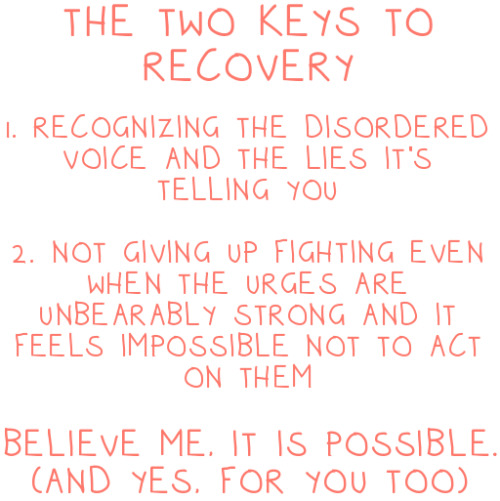
But what I can do is trust the facts and trust the experts. And that's what I'm going to do until I can trust myself.