Thursday, November 14, 2013

"Well aren't you just a little failure..."

It is definitely a sign that you miss your roommate when you are hearing her voice in your head, saying the things that she always says, the way that she always says them.  

"Hello!" 
"Something to share with the class..?" 
"You just made my Southern come out!" 
"Why are the stairs so hard?!"
"Well aren't you just a little failure... Aren't I encouraging!?" 

Out of all the things that my roommate says, the only one that continually replays in my head is "Well aren't you just a little failure..."  And that is the track in my head, not because she ever meant it (really, she never did--it was always in a joking manner), but because that's exactly how I feel right now.  That's what my ED wants me to believe right now.


It's also how I am feeling right now.  I mean, look at me.  I am 19-years-old, living back in my parents house.  I can't even go to college on my own.  I can't even be successful at feeding myself.

I feel like a failure in comparison to everyone else.   

Now there are many things about that simple statement right there that need to be broken down, so bear with me. 
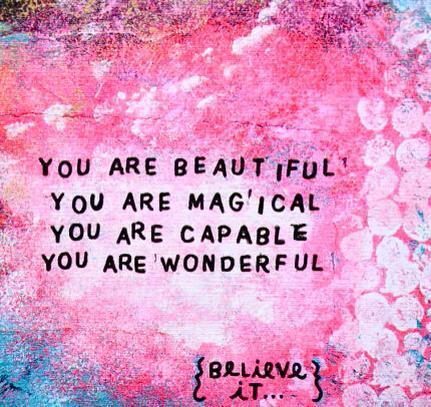
The first part of that phrase, "I feel like," says a lot.  Feelings are not always accurate.  Actually, most of the time, they are not, especially in cases of people who struggle with eating disorders, especially anorexia.  I mean, part of my eating disordered thinking right now involves unrealistically high standards--standards that I will NEVER reach, that no one could ever reach.  So I am always going to feel like I'm failing in that regard, even if I am not.  

And looking at the facts of my life, I am not, in fact, failing at anything.  If I would have chosen to not make my health a priority, I most likely would still be juggling academics, extra-curricular activities, work, friendships, and so much more in a very successful manner.  I can be a high-functioning anorexic, when my depression is not acting up and when I make that choice to not care for myself.  

Let me define failure according to the dictionary:
     1.   lack of success
     2.   omission of expected or required action; lack of deficiency of a desirable quality
     3.   action or state of not functioning

Point 1: I am a student at Gettysburg College, one of the top liberal arts schools in the US.  I have A's and B's.  I have a job.  I count all of that as success. 

Point 2: I am taking expected/required actions right now.  I am acting in the best interests of my health, something that is expected by everyone, no matter who they are.  I am taking action to attempt to finish this semester.  I am not inactive.  

Point 3: I am not in a state of not functioning.  I am still writing (obviously).  I am working to come up with a solid treatment plan.  I am working with the college to finish this semester.  I am functioning.  Maybe I am not a fully productive member of society, but I am still functioning.  
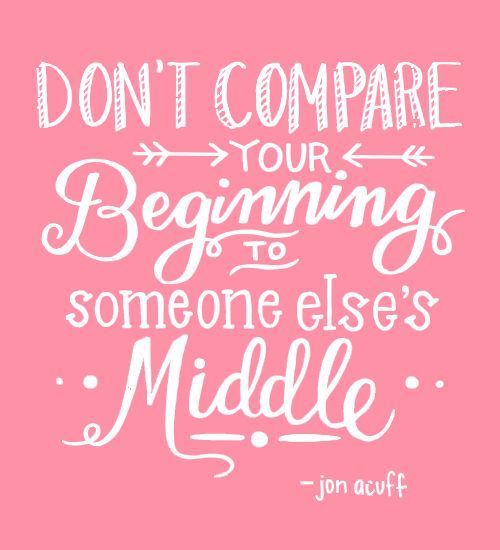
I think what I'm really getting hung up on is the "in comparison to everyone else," part of the sentence.  I mean, I look around and all of my friends are on the Dean's List or accepting job offers; doing senior recitals or writing plays; getting engaged or having babies; doing research or leading immersion trips. 

But other people are also not fighting a life-threatening battle with anorexia, so making that comparison is not able to be made.

And I am "failing" to complete a semester of college... Or at least feel like it, but again, using the definition and the explanation above, I am not truly failing.

So maybe this feeling is stemming from the fact that I think I am failing at recovery.  Maybe that is really what this is all about.  

Yesterday at the assessment, I was told that I was the third or fourth person she had assessed in the past week who went through Maudsley/FBT/Adolescent program in late high school, went on to college, and was now back getting treatment in the Adult Program.  So it's apparently pretty common.  
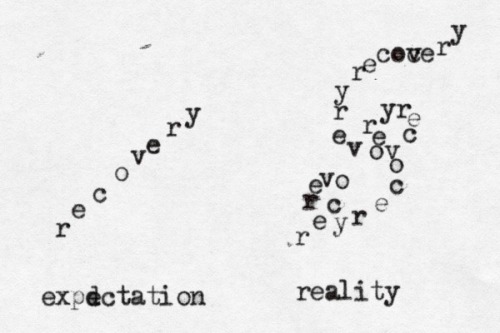


Also, my Wise Mind knows for a fact that the recovery process isn't perfect!  It's full of slip ups and mistakes and lapses and relapses.  
None of that means failure.  

Stop. 
Pause.  
Reframe. 

I am NOT a failure.  
The only way I can fail is if I stop trying to recover. 


Monday, November 11, 2013

I think I'm scared...

I'm really bad at emotions.  I hate them, actually.  Having them, feeling them, identifying them, expressing them, communicating them... its all hard for me.  

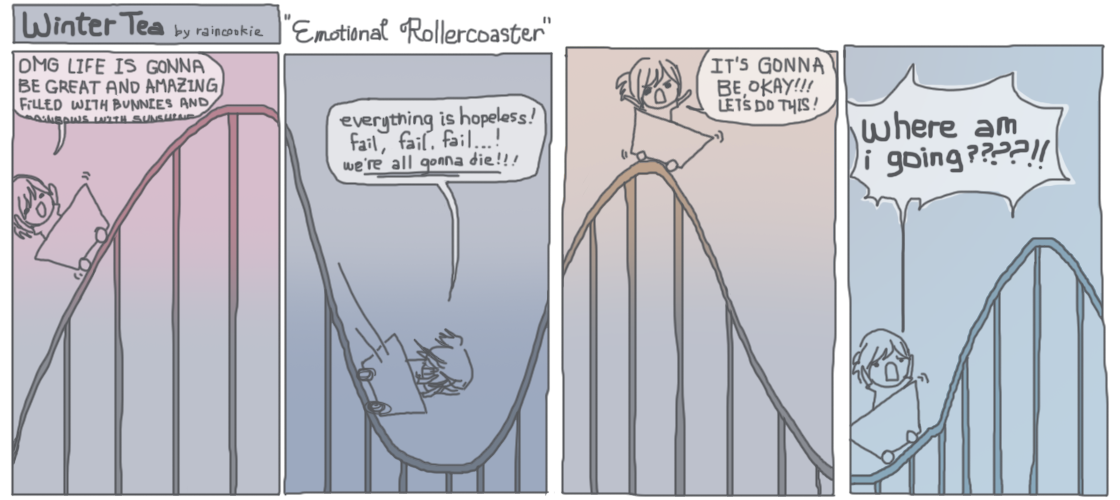
These past few days have been a roller coaster of emotion for me, as much as I hate to admit it.  I've gone from not really feeling anything to anger to apprehension to fear to more anger and I don't know what all else.  Like I said, I am really bad at emotions.  


But right now, I think that I am just afraid.  

I spoke with my mom this weekend for the first time about what has been going on.  Like picked up the phone and called her.  Needless to say, she did not react in a way that I wanted.  That made me angry.  I threw my phone and yelled at my roommate and stormed off.  Exactly how I used to act as a child when I would get angry.  I calmed down a bit, received an angry text from my dad, and then I got angry all over again.  

Sunday morning, I woke up feeling a bit overwhelmed.  I knew that I only had a few more days left here, at Gettysburg, and that worried me.  I knew I was going to have to speak with my suitemates about what was happening, which worried me.  And I still had not heard back again from my parents, which isn't normal, so that also worried me.  

I don't like emotions, especially anxiety because you have to feel it full out--it's not one that can be numbed out with sleeping or television or walks or anything. With depression or angry, I can numb out by sleeping or watching a movie.  I don't have to feel it in order to get through it, and so I don't.  But as much as I try to numb out my anxiety and ignore it, it never actually works.  

I woke up in a panic from a 'nightmare' at 4:30 am this morning.  In it, I was seeing people and having conversations with people who were not able to be seen by other people.  Talking to and seeing people who did not even exist.  I know how crazy that is, even though in my dream, I was on campus in Gettysburg, where people apparently see ghosts all the time.  

I don't believe in ghosts.  
I woke up because I literally went insane in my dream.  

No one is awake at 4:30 am.  Not even my brother, who I'm pretty sure doesn't actually sleep ever.  I typed a note in my phone that says, What if I'm actually crazy?  What if there is really something wrong with me?  I then put some music on and tried to go back to sleep.  I woke up every 15 minutes gasping for air, in tears, until 7:20, when I just decided to give up on sleeping any more.  

At that point, my roommate was awake, so I was able to talk to her about what was going on.  And I told her about my fears of actually being crazy (I do have an uncle with schizophrenia and it does manifest itself around this time in people's lives), and it was her that suggested that maybe it's just my anxiety and fear about this whole situation that is getting away from me.  That maybe that is why I'm not sleeping well and I'm lashing out and my dreams are weird.  

I'm beginning to think that she's right.  I am afraid.  As much as I try to portray that I am not afraid, I am.  So much so this time than every other time I have been forced to seek treatment over the past six years.  

I think it's because this time, I actually want the help.  I want to recover.  Not because I have to in order to work at camp.  Not so that I can go to college in another state.  Not so that my parents will leave me the hell alone.  

I want to recover for my health, for my future, for my life.  There's so much more at stake this time.  And because of that, it is perfectly normal to have emotions like fear and anger.  It's okay to feel them.  What is not okay, however, is turning around and running because of the fear.  

I was reminded of this over the weekend by a very wise woman who has been encouraging me so much in this terrifying process of leaving school to get help: 

"Recovery is not easy. Recovery is hard. Eating disorders are easy. Eating disorders will kill you. This may be one of the hardest things you do in your life, so it's normal for you to feel really anxious and upset and stressed and scared and all of those things! Those are all okay. The right thing and the easy thing are rarely the same thing!!!"


Saturday, November 9, 2013

Reality checked

"Do you actually want to recover?"

That's one of the very first questions that my best friend from treatment asked me in our hour and a half conversation Wednesday night when I first began to tell her that I was struggling.  Not what's going on, but "Do you want to recover?"  We talked through a lot on the phone that night.  About what my behaviors have been, what my thoughts are, what my expectations of going home for treatment were.  And she reality checked everything. 

I've been fighting the idea of going home for a few weeks now, mainly because I don't think that things are that bad.  Denial is something that is fairly common among eating disorder patients.  It sounds something like this for me: 

  • Everyone diets, so what I'm doing isn't bad. 
  • I know what an eating disorder is, and I DO NOT have one. 
  • What I’m doing is no big deal. 
  • There's nothing wrong with me physically and I'm still very high functioning academically, so obviously, I am not sick. 
  • I'm still eating food, so this isn't restricting.
  • I'm not thin enough or skinny enough to have an eating disorder.
  • I’ll just lose weight until I am X pounds and then I’ll stop.
  • I am in complete control, and I could stop if I chose to do so.
  • Things aren't as bad as they were in high school, so I'm obviously not relapsing. 
Denial. 

The sicker I became, the more the excuses seemed real and the more my brain believed them.  I went from eating two meals a day to only one to not taking my meds to restricting even more and limiting myself to under X calories a day to throwing up what little I was eating to abusing diet pills to obsessing over weight.  And I still thought that I was fine because I hadn't seen any physical weight loss.  


Then I went home this past weekend and when saying goodbye to a friend's mom who knows about my struggles with ED and depression, she said that I needed to "Stop losing weight."  
"What?"  
"You've lost a lot of weight since I saw you last in September." 

Even in that moment, it was hard to believe her.  The next day, I got dressed for church in an outfit that I had worn less than a month ago.  I couldn't keep my pants up and my shirt was so baggy... ugh.  Unfortunately, I didn't bring a nice belt home because I didn't think that I would need one, since these pants fit a month ago, they were still going to fit.  

Luckily for me, my brother had left a nice belt at home. And at first, I completely freaked out when I realized that was going to be my only option.  My brother has always been skinnier than me.  Always.  So there was absolutely no way that his belt was going to fit me... even at the very last notch.  But I put it on because I was running late for church and had no other options.  I held my breath while I put it on his belt... It didn't just barely fit.  It fit like any of my belts do.  

Had I really lost that much weight? No.  I couldn't have.  I don't see it, so obviously it can't be true.  This belt is probably just too big for Jacob, which is why he left it at home instead of taking it with him.  

But it still bothered me.  The whole weekend bothered me--exchanges with my parents, with my friend's mom, with how my clothes fit on Sunday, with my brother's belt.  And when I got back to school on Sunday night, I checked my weight, hoping to ease the dissonance in my mind.  

Numbers don't lie.  They showed that I was X pounds under my "ideal weight range," according to my growth curve (my treatment team at home doesn't use BMI to determine ideal weight ranges because of reasons stated here). 

I started to think that maybe I had a problem.  Maybe I needed to go home and get help... but it wasn't that bad yet.  I was still in control.

Monday night I was attempting to study for an exam and had a major depressive episode.  And Tuesday I ended up talking to Dean Cole and we decided that maybe it would be best for me to go home and get some help.  I called my team on Wednesday, trying to reach Katie, mainly, because I like her best (yes, I have favorites...) but was unsuccessful.  Then Annie called me.  I was scared, and I wanted to talk with her, wanted her to make me feel better and tell me that I was right and didn't need any more help and definitely didn't need to go home.  

She called me out on all of my bullshit.  She told me that I was sick, that I needed help, that I was sicker than I was able to understand.  She told me that my idea of going home for a few days or a week was just complete bullshit--I wasn't going to recover that way.  Maybe I would be able to keep things in check for another month or so, but I was just going to relapse again and again until I spent serious time working towards recovery.  

I gave her every excuse to not work toward recovery, and each time she told me, 'Yeah, I totally get that, but here's why you're wrong...'  I talked to her about school and how I was scared that I wouldn't be able to return next semester if I went home for serious treatment.  Her response was that was good, that I'm not going to recover in college--no one can. That I should take the year off and reach full recovery... Something that terrifies me very, very much.  We talked about maybe going to rehab (different from inpatient), so that I could work intensively on my recovery and not have the added stress of being at home.  (Not to mention that it may increase the likelihood of me being able to return to Gettysburg in the Spring).

She reminded me that I am very much diluting the quality of my life and that since she has recovered, she's been able to enjoy things like pizza multiple times a week and ice cream and all the foods that I am terrified to eat right now.  And now that she's comfortable with her body, she can do all sorts of things she never would have before.  She also reminded me that I am killing myself.  

I hung up the phone with her feeling like someone had just punched me in the face.  But also convinced that whether I recover or not is completely up to me and that I need to put the effort in and work my ass off in treatment so I can get better and get back to my life.

Wednesday, November 6, 2013

Preparing for remission

"If you hear some in the eating disorder community talk about recovery, you could be forgiven for thinking that they were trying to get you to buy a timeshare at a resort. Recovery, they say, is where you love yourself. You love your body. You accept your imperfections. Your life is good, so good. You’ve gotten to the root of your disorder. And you are never, ever, NEVER going to relapse. You are IN RECOVERY and you are here to stay.

Of course, plenty of people acknowledge that recovery isn’t perfect. But if you look at the way the eating disorder community tries to construct recovery, it tends to be built as this idealized form of what Life is Going to be Like from Now On, Forever and Ever, Amen. This isn’t what recovery is like. Getting hit in the face with the rude reality of the day in, day out, utter slog of recovery (didn’t I just eat yesterday?) was enough to make me seriously consider quitting.

[...]

There’s a saying floating around in the world of Pinterest or Tumblr that “The worst day in recovery is still better than the best day in relapse.” To be really honest (am I even allowed to say this?), sometimes it isn’t. Sometimes, when life is really painful, the ED is numb and that feels a whole hell of a lot better than recovery. I know it’s not in my best long-term interests to return to the ED, but there you have it. I didn’t fall into the trap of an ED because I wanted to be thin. I fell in the trap because I finally found something that would make the anxiety and depression just a little bit better."


A couple of days ago, I stumbled across Carrie Arnold's blog post, entitled "Letting go of the idealized recovery."  And it hit really close to home; I mean, aren't you supposed to go through treatment just once and then you're cured forever?  Good girls don't relapse.  Especially if you are a psych major--you know better.  

But here I am.  

Last night, I was talking to a friend of mine and I told her that I thought that maybe I needed IOP.  And I have been thinking more and more lately about maybe talking to my mom and my team at home and possibly taking the rest of the semester off in order to get back on my feet.  

But eating disorders are hard.  Mine doesn't want me to move forward.  It really, really does not want me to get any sort of help.  Because like Carrie Arnold said, "When life is really painful, the ED is numb and that feels a whole hell of a lot better than recovery... I didn't fall into the trap of an ED because I wanted to be thin.  I fell in the trap because I finally found something that would make the anxiety and depression just a little bit better."  Then it just consumes you and prevents you from seeking help, from moving forward.  

Since I first brought up the fact that I was relapsing to my professor and Dean Cole, things have gotten worse both behaviorally, emotionally, and cognitively.  I know that (I just don't care a majority of the time), but now they're both starting to know that as well.  And people I saw at home over the weekend were worrying and well... Dean Cole decided that it was time to involve my parents, especially since I was thinking about maybe taking some time off of school.  

And the two of us talked over a few options that I had as far as when would be a good time, how that would work on the college's end, and so on... But I still don't know what I need.  I know what I want, which is very eating disorder minded.  But I don't rationally know what I need because I don't have an objective sense of how bad things are right now.  Which is hard.  I just know things have gotten worse (to put numbers on it, I would say that when I first noticed I was relapsing, my brain was about 25ish% eating disordered, but now it's definitely closer to 90% eating disordered).  

So I came up with the idea that I go home and see my team for some sort of assessment and then figure out what sort of treatment it is that I need.  And Dean Cole agreed that was a good idea.  I still was very adamant about not talking to my mom, though.  So I sent her a text, which I finally received a reply to a little while ago.  

I don't know why the response that I received angered me so much.  It did, but the second response that I received made me more angry.  She asked me if I was going to be safe tonight, like just because I'm relapsing, I'm going to kill myself or harm myself in some other permanent way.  Right.  That makes me really want to actually talk to her and go home now... 

But that isn't my point. 

See, over the course of tonight, I have talked with two very wise women and both of them have used medical examples as ways to explain to me why relapse is, for lack of a better word, okay and why there is no shame in it.  

My aunt said this: "You know enough about it to know there are relapses and remissions-- almost like a cancer patient.  You need to do what it takes to put it in a very long remission."

Just keeping it all in perspective, that eating disorders are, in fact, an illness.  That we classify them solely as mental disorders is misleading for many and that we treat them as things that can be cured by one round of antibiotics is also incorrect; they are sicknesses that require treatment--medical appointments with a physician, chemo, radiation, nutrition, support.  They're not something that you can just get over or something that will be cured easily.  It takes a lot of time, hard work, and pain in order to heal.  It's a lot of doing things that scare you and make you uncomfortable.  

One of my biggest fears at this point is that my team will tell me they don't want me to come back to school once they talk to me.  I'm trying to convince myself that it's more important for me to take care of my health and well-being than it is to finish this semester properly, but it's going to take some convincing, especially since my mindset is so eating disordered (as evidenced by me asking my friend last night why I needed to eat again if I had already eaten once yesterday).  

But if I think about the illness part of it, if this was cancer, I wouldn't myself to suck it up and wait for the right time to get treatment.  I shouldn't be telling myself that with my eating disorder either.  And I definitely still shouldn't be feeling shame about struggling again.  This is just a relapse.  Going home and following my team's instructions, even if I do not like them, will hopefully help to put this illness into remission.  

My other big fear is that people will see me differently because I am struggling again.  I found this quote by Daniell Koepke the other night that makes me feel a lot better about that: 

“The fact that you’re struggling doesn't make you a burden. It doesn't make you unlovable or undesirable or undeserving of care. It doesn't make you too much or too sensitive or too needy. It makes you human. Everyone struggles. Everyone has a difficult time coping, and at times, we all fall apart. During these times, we aren't always easy to be around — and that’s okay. No one is easy to be around one hundred percent of the time. Yes, you may sometimes be unpleasant or difficult. And yes, you may sometimes do or say things that make the people around you feel helpless or sad. But those things aren't all of who you are and they certainly don’t discount your worth as a human being. The truth is that you can be struggling and still be loved. You can be difficult and still be cared for. You can be less than perfect, and still be deserving of compassion and kindness.” 

Regardless of how shitty and shameful I feel about relapsing and needing to go home, I am still worthy of love; I am still worthy of being cared for; I am still worthy of kindness and compassion, from other people, but especially from myself.

And that includes getting the treatment that I need. 


Tuesday, November 5, 2013

Hello darkness, my old friend

I don't think that I've had a night this bad in a long, long time.  I'm assuming that it's some sort of combination of low blood sugar, depression, exhaustion, and stress.  I don't know.  All I know is that I am spiraling into depression.  Not the suicidal, I want to die depression.  But the I literally cannot move off of my bed and function kind of depression.

Which kind of really, really stinks because I have an exam tomorrow.  For which I have not reviewed my notes, read the chapters, or prepared in any way, shape, or form.  So that's how my night is going. And literally at this point, I am considering keeping my butt in my bed all day tomorrow because functioning is not a thing that is going to happen any time soon.

I don't know why it is all so hard.  It shouldn't be.  I mean, I logically know that depression is a chemical imbalance in your brain.  I know that there's really nothing that I can do to help myself get through it.  Well, other than take my medication (which I'm scared to start doing without seeing a psychiatrist), exercise (which is triggering for my eating disorder), eat right (which is not going to happen right now), get enough sleep (I'm in college...), and talk to a therapist (which won't help, yay chemical imbalances!).  But knowing what I have to do and doing it are two completely different things...

And even just looking at the irrationality of my thoughts and emotions right now... it's rather frustrating.  The fact that it's starting to impact, at a very drastic level, things that I fought so hard to keep, is not okay.  My schoolwork, my job, my friendships... I don't know.

Normally I would nurse my depression by staying in bed all day and watching Netflix or television and not eating.  I would spend the day sleeping and not caring that I wasn't getting anything done.  But I actually have responsibilities tomorrow.  Like my exam.  And the prospie.  And Big/Little APO Revs.

So I cannot avoid it all.  My desire to please people is going to overcome my depression once again.  Well.  At least my desire to fulfill my immediate obligations is going to.  I'm not sure about things like class or lunch/dinner dates or my exam.  Because right now, I don't think I could even attempt to manage it.

Everything just seems really hard right now.

And I know that I really need to go talk to someone about this.  I know that I'm not doing okay and that I need to sit down and be real with someone, but there's two obstacles to this that I am experiencing.

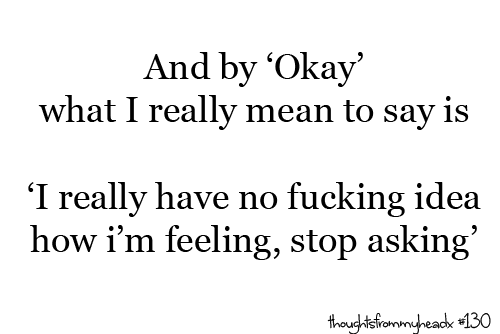
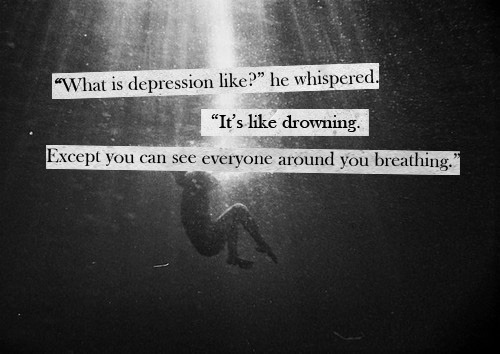
The first one is relatively common with people with depression.  I don't know how to explain what I'm feeling to anyone.  Not even psychology people.  My friends will not understand it.  My roommates, my family... None of them will really get it unless they've been there.  Or they'll be like my mom was and continually ask me how I'm feeling or if I'm doing any better today than I was yesterday.  And even those who know that I'm struggling with things right now, I feel like I can't tell them because I don't know how to explain what I am feeling in words to anyone.  I just feel it.

I did, however, read an article the other day that very accurately captured what depression feels like.  You can read it here.

There is also a very accurate Buzzfeed post that captures depression very well.


Then there's the fact that I am definitely still in denial about how bad things are getting.  I mean, what logical reasoning did I have behind not wanting to talk to my parents about all of this or about not wanting to leave school to take care of my health?  I don't know.  But if I'm at the point where I am counting calories, taking pills, obsessing over weight, not being able to concentrate on my academics, forgetting that I have things to do, not moving out of my bed for long periods of time, and all of the other symptoms that existed during my senior year and still do not care, then I am not well enough to be here.

But I also think that a lot of it has to do with the depression that I'm struggling with right now.  Depression causes apathy.  And it also causes a lot of other things, as well.  Like the urge to want to cry to someone and be held and loved and taken care of because I am at my breaking point, but the simultaneous need to isolate and remain silent and not talk about it because social interaction is really just too much.

But then, even if I spoke about how I'm feeling, people would not understand.  Or they would walk away.

Keeping friends right now is very, very difficult.  Mainly because social interaction is difficult.  Getting out of bed is difficult.  Breathing is difficult.  All of those autonomic functions that are supposed to be normal and natural--they're about five hundred thousand times more difficult when you are experiencing severe depression like I am right now.  People don't want to be friends with you or try to help you when you can't even get out of bed.

Then there's the fact that people don't understand how the connection between eating disorders and depression works.  Did the eating disorder cause the depression?  In which case, just start eating again and the depression will get better.  Did the depression cause the eating disorder?  Well, that sucks, but you have to get up and eat.  Sadness isn't an excuse for not eating.  I don't even understand how it works.  My psychiatrist doesn't either.

What people can do, however, is be there for support.  Here are a couple of links on how to help friend who is struggling with depression.  Keep in mind that these may not work with everyone, but from what I've read, they seem relatively okay.  Some of these things have worked in the past for me and my friends, while some haven't.  But check these out:

How to Help a Depressed Friend (And When to Stop Trying)
Five Ways to Help a Depressed Friend

I'm going to be struggling with this for a very, very long time.  It may or may not ever get better. Right now, I'm leaning more toward the not part of that.  I'm probably always going to have depressive episodes.  And every time, they are going to suck.  They are going to be miserable and make me want to pull my hair out and push people away and cry and stay in bed and not move ever.

Just like right now.

And right now, I don't know how I'm going to deal with it.  Because I feel too overwhelmed and depressed and stressed out and too much nothingness and loneliness and emptiness and exhaustion to deal with this in any sort of relatively healthy manner.  Maybe tomorrow things will be better... But I really doubt it.


Monday, November 4, 2013

Fear Food vs. Trigger Food

I was talking with my social psychology professor today after my counseling appointment.  And her husband came in, realized he forgot his wallet in his office, left, and returned, setting a Halloween Oreo down in front of me.

I kind of freaked out a bit.

Because there was an Oreo.  And I was expected to eat it.  And I hadn't eaten anything all day.  And it was an Oreo.  With calories in it.  And fat.  And it was a cookie.  A fear food.  An Oreo.

"Oreos are the worst cookie." 

My chemistry teacher in high school hated Oreos.  She had all sorts of reasons about why they were bad for you.  And well, I don't like them much either.


Fear foods.  They suck.  I have a lot of them right now.  Bacon. Sausage. Bread. Cheese. Pizza. Chips. Non-diet soda. French fries. Fast food. Mac and cheese. Mashed potatoes. Cookies. Cake. Candy. Doughnuts. Restaurant food in general. Food that I do not know the specific calorie count of. Hot chocolate. Fried food. Peanuts. Peanut butter. Butter. Sour cream. Eggs. Caloric beverages. Anything like that.

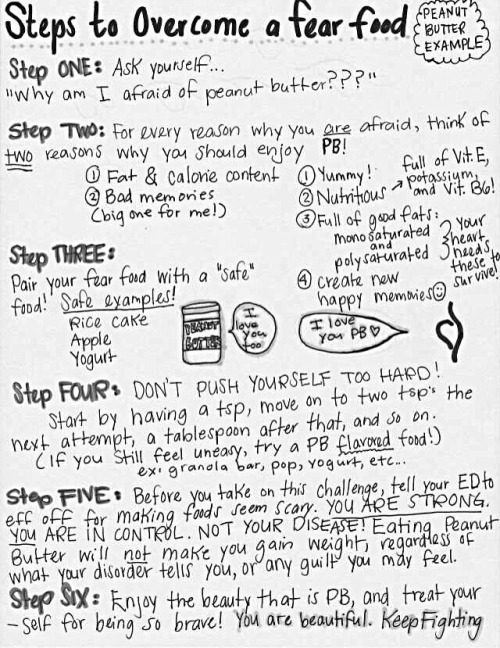
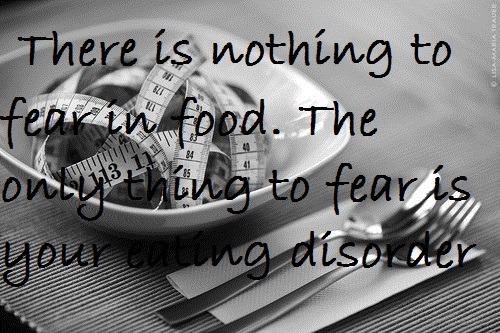
Today I learned that there is a distinction between "fear foods" and "trigger foods."  You can read more about that here.  Basically, a fear food is a food that a person with an eating disorder is literally afraid of. It could be something that person thinks will pass calories just by touching, which is an example of a type of magical thinking called the law of contagion, which is the belief that if two things touch, the properties of one will be transferred to the other. Or the food itself will just elicit anxiety to the patient.  These foods are systematically eliminated from a person's life.  One of the goals of treatment is to eliminate fear foods to allow a recovered person to enjoy them in every day life again.

Fear foods during treatment
When I was in treatment during my senior year, my family therapist had me make a list of my fear foods and a list of foods that I just didn't like.  I couldn't even lie about which were which because she had my mom check it, based against what I liked as a child.  And then she told my mom to feed those things to me frequently, on the premise that once my body was nutritionally stable, the fears would slowly go away and I could return to regular, intuitive eating.

I remember one morning before one of my bowling matches, my mom had made me bacon and eggs to eat. This was still pretty early on in treatment. I flipped out. I absolutely refused to eat the two strips of bacon that were on my plate. And per my family therapist's instructions, my mom said, okay, but we're going to sit here until you decide to eat it, which means that you might not be going to your match. I think we sat in silence for a good 45 minutes until my dad got involved. He started yelling and threatening and then my parents started arguing and talking about me like I wasn't even in the room. I think I snuck up to my room then, but my mom said that we still weren't leaving the house until I ate it.

I think that I managed to get away with eating only one piece of bacon that day. It was the first time in four or five years that I had eaten bacon. And I haven't eaten any since then. I'm still afraid of the caloric and fat content involved in eating it.


Trigger foods are foods that trigger unhealthy eating behaviors.  In me, they set off a binge-purge cycle.  A person who eats a trigger food cannot control their behaviors much in the same way that when an alcoholic has one or two drinks, they cannot stop drinking.  The physiological changes that had been made in the brain are too strong and the cravings too intense for a person to stop on their own once they begin. In treatment, the goal is to help the person avoid trigger foods, until they reach a mindset where they can handle eating trigger foods without being triggered.  Keep in mind that a person may also never reach this point, just like some alcoholics can never have alcohol once they enter into recovery.

For me, my biggest trigger food is ice cream.  Any time I eat any type of ice cream or any kind of ice cream, I have to fight off a binge-purge cycle.  More often than not, I will eat a normal amount of ice cream and not be able to resist throwing up.  It's something that I cannot keep in my body because of the powerful triggering effects it creates. So now I just don't eat it.

Trigger foods are different from fear foods in that they elicit a behavioral response, while fear foods elicit an emotional response.  A lot of times, these two types of foods can be confused.  I know that they were confused for me during treatment.

Both are things that need to be dealt with in treatment in order for someone to fully overcome their eating disorder and return to "normal" eating.  And maybe some day, later on in my recovery journey, I will be able to conquer my fear foods, but for right now, I'm just going to take it one day at a time.

Back to the Oreo story. The reason that he brought us the Oreos is apparently because "treats increase positive affect, but only if they are not expected." He then went on to explain the study behind it and how when he was working in someone's lab, they used to give their participants a cookie when they did the debriefing to increase their positive emotions. I do have to admit that I felt a little bit better because he surprised me with something as small as Oreo, although I'm not sure that it made up for the amount of anxiety that it provoked... These studies are focused on the "normal population" after all, so generally not people with eating disorders. (Future study idea? I think yes.)

And that Oreo? I ate it. Not in front of my professor and her husband (who is also a professor, but not my professor, so I feel like I can't loop him into the "my professor" category), but I ate it.  I think that might be progress.  I'll take the little victories when they come.

Why Recovery is Worth It: So that I can eat what I crave and enjoy it.

Friday, November 1, 2013

Friends and Triggers.

"Sorry for creeping, but I also just read your post before that from the wedding. It made me cry. I haven't seen you much lately--I didn't know how rough of a time you had been having recently :( I love you so much, you are a wonderful person! You will overcome this. There WILL be a time when you will be able to look at things without seeing them through your eating disorder, I just know it. Hearing about your experiences is painful, and it makes me angry at this disorder for affecting you and hurting you, as silly of a stance as that may be :( I'm sorry I can't truly relate to everything that you have to face in order to keep healing and recovering, but I will always care. I may be relatively helpless for the most part, but I'm here for you."

Amanda and I last year.

I received this message from one of my very best college friends, who has been a lifesaver for the past year and a half, after I shared with her my post about my dislike of Halloween and my insecurities that come with this holiday. I dissolved into tears instantly. Just seeing her "get it." Seeing her understand and just accept my anorexia for what it is--a disease. Something that I cannot control as hard as I try. It's a rare moment.

It's very rare that I find these people. It is very rare that I get this reaction. Most of the time, what I hear from the general population of my friends is an apology, some awkwardly phrased questions about it, and then a topic change. And then there's the people who tell me that I should just pray about it. Or the ones who say they don't understand because they think I'm beautiful... Because that's all that eating disorders are about.

I've actually gotten a lot of flack today for disliking Halloween. Some people get it and others don't. I actually had a conversation with one of my other friends about it today. She told me that Halloween isn't all about food. It's conversations like this that remind me just how consumed I am and just how much the general population does not understand about eating disorders.

And as I'm starting to finally convince myself to give this very unclear, terrifying and unfinished route of healing a try, I know that I'm going to need friends. More than ever. But what sucks is that my anorexia has destroyed so many of my relationships this year. I am more isolated than I have been in a long, long time. Or at least, I feel that way.

But then there's also the idea that people don't understand exactly how hard this is. They don't understand how eating disorders work. And normally, I would sit down and take the time to teach them. To teach them how to support me, how to talk about it with me, how the whole thing works, but I am just so tired of it right now. I'm at the point where I just want people to understand it all and just know. I don't want to have to teach them. I don't want to have to explain it.

I want people to react like Amanda and be angry at the disorder for all that it's taken from me and how it's hurting me. I want people to listen and not see me as crazy. I want people to understand that I need them to walk through this with me--to be patient with me on bad days, to push me forward, to celebrate the small victories like eating a snack or having a meal with someone or getting out of bed in the morning. I want these people on my side, supporting me in this. Because I can't do this alone.

I was at the grocery store a couple days ago with the second friend I mentioned, C, and another girl, M. The other girl had (and in my opinion still does) struggled with anorexia previously and knew about my current struggle with it. I figured that she would get it. But we're at the grocery store and she makes a comment about not wanting to get something because it's "not healthy." The other girl encourages her to put it back, while I encourage her to get it if she wants it. She decides to put it back. C tells me that M is trying to lose weight and she's only trying to support M. I say something about how M doesn't need to lose more weight and it isn't healthy for her, mainly from an eating disorder stand point. This event was just triggering for me. But that coupled with the fact that M continues to talk about weight and how much she wants to lose and throw around numbers and tell me about how she hasn't eaten... when she knows that I'm not in a good place. She personally had an eating disorder and knows how to talk about them. She told me that she wants to help support me through this. But she is triggering to be around.

I had another friend who I spoke with recently about Halloween and skimpy costumes and body comparison and she responded to me that she understood and that I wasn't alone because she did it too. And then she said, "They're all so skinny... It's gross." And I don't know why that statement made me so uncomfortable... maybe because I had just finished the conversation with my other friend and was frustrated with her not understanding. But in my mind, I thought, if she thinks that the girls who I am, for lack of a better word, idolizing are gross, then what does she think of me? Does she think I'm gross for wanting that?

Lately I've found it so hard to just go through normal life without being triggered by something. Whether it's in class and we're talking about the physiological and brain basis of feeding or in another class talking about weight bias. Or in my apartment and my roommate is talking about what she's eaten that day. Or I'm walking somewhere and see a girl running on the sidewalk.

I've forgotten how hard this all is. How alone I feel in this. How misunderstood I feel.

It's frustrating when people don't understand, when I finally get up the courage to talk about it and people aren't understanding and don't seem willing to learn. It just perpetuates the shame that I feel and the secrecy that I hold around my eating disorder. And how much harder this makes recovery.

Why recovery is necessary: So I can have the strength and energy to teach others the facts about eating disorders and how they can support a loved one recovering from one and so I can not be triggered by the littlest things.