Thursday, May 15, 2014

Saying Goodbye to Julie

Goodbyes are really hard for me--always have been. I remember leaving to go home from visiting family and being absolutely miserable because I wasn't going to see them for another few months. Every summer, saying goodbye to my campers and staff was always the hardest part; I missed them almost immediately. And when I graduated high school, I said goodbye to many close friends who I loved dearly and we all went our separate ways. Some of these people I rarely talk to anymore. 

The past few months have been a time of farewells for me. In September, I said goodbye to my PopPop when he lost his battle with cancer. In November, I said goodbye to Gettysburg to come home and get treatment for my eating disorder and depression. In January, I said goodbye to day treatment and IOP as I transitioned to outpatient programing, leaving behind wonderful staff and supportive friends. In February, I officially said goodbye to Katie, the nurse practitioner who had worked with my ED doctor; she was my salvation in high school as I fought against Maudsley therapy and she saved my life in the most literal way. And today, I had to say goodbye to Julie, my dietitian, who is one of the most wonderful women I have ever met. I didn't know she was leaving until today. 

I originally met her in day treatment. She would fill in for Christina on the days Christina wasn't available to check meals. I loved her for how laid back she was about everything. She was really responsive when I told her that standing behind me made me nervous, and when I hadn't seen her in a while, she gave me a hug on a day that I really needed it. When I asked Julie if she would see me for outpatient, she was so excited to work with me, which made all the difference to me. In her nutrition sessions, I learned so much about why dieting is bad, why all foods are good foods, and what normalized eating looks like. 

Working with her in outpatient, I learned so much about how to take care of myself and I was always supported by her in everything. In one of our first couple of sessions, she told me that she thought that my brain had caught up with its health, but that I just hadn't decided to be kind to myself yet. She took the time to explain what that meant--being kind to myself meant being my own friend. How if I was talking to a friend, I would tell her not to use diet pills because they don't work, only give false hope, and are bad for her heart. If I was talking to a friend, I would tell her she needed to eat because food keeps her alive and functioning. And Julie told me that I would tell a friend all of her good qualities and say she was beautiful inside and out and she should accept herself the way she is because she can't change who she is. She can't change the body she was given. And in that conversation, I could tell how much Julie meant all of those things for me and how much she wanted me to believe them. 

"I came to love her the way you love someone who saves you from drowning."

It was always so easy to talk to Julie, even when things were hard. She let me talk about my body image issues, which are really hard for me to even talk about with anyone. And she was really comforting in those moments. She reminded me that I am stuck with the body I have--my shape, my height, my hair color, my skin complexion, etc, and that I might as well accept it and love it because its not going to change. She reminded me that I was more comfortable in my ED body than my weight restored body because I was comparing myself to a 12-year-old's body. She encouraged me to start loving my body now becase it is going to keep changing as I get older. And she was always really honest about her own body image struggles, and Julie always stressed how important self-care is in helping her on those days. 

But there were also times in outpatient when I was really angry with her, like in February when she told me that I basically needed to get my shit together or she was going to not see me until I was more willing. I was so angry with her about that. She told me that she can only do so much for me and at some point, I have to make the choice to listen. Julie also said that she gets offended when she spends time working with clients and they don't listen to what she's saying. I was really upset about this because I felt like she was just giving up on me, even though she told me that she cares about me, worries about me and wanted to keep working with me. She could be really harsh when I needed it to get back on track... Like the week that she threatened to send me back to day treatment for two weeks. 

As harsh as she was when I was struggling (and when I really needed a kick in the butt to get me back on track), Julie was incredibly encouraging and gave lots of praise when I was doing well. It always made me uncomfortable when she told me I was "rocking it" or some other compliment because I never really felt it, but I have no doubt that she believed it with all her heart. Today, after she gave me one last hug, she told me that she had complete faith in my ability to recover and stay healthy. She told me that she believed I could do anything that I put my mind to and that I was going to do great in college. Julie told me that she does not doubt my ability to succeed in anything. 

I don't know how to say goodbye to someone who has challenged me and changed my life forever. I don't know how to express my gratitude for everything that she has done for me or how to tell her how much I'll miss eating snacks with her or looking at pictures of her kids. 

I have no idea how to say goodbye to this woman who has helped to save me from myself.

Goodbyes are hard. I wish this one didn't have to happen, but I know it was inevitable. In a few short months, I'll be saying more goodbyes to people who saved my life and have changed me for good, and I'm not sure how I'll manage it.

How do you say goodbye to someone who you basically owe your life to, knowing that you'll probably never see them again because that's just how these things are? How do you let go? How do you find closure when the relationship ends? And how do you be okay when someone who saved your life is suddenly gone? 

Tuesday, May 13, 2014

Sunday Sermons: "Life After 'Welp'"

I am the worst at posting these on Sundays, but I will get to it one of these days. My notes from May 11th will be up soon!

**Note: I did not write the sermon. Pastor Jeff spent time on it, so please don't plagiarize and steal the sermon from my notes.

-----

"Life After 'Welp'"
May 4, 2014
Grace UCC, Pastor Jeff Nelson

Scripture:
Acts 2: 14a, 36-41
Luke 24: 13-35

  • The expression 'welp' is used to show fatalism, acceptance, resignation
    • Usually about something beyond one's control
    • One usually would have rather it happened otherwise; not an ideal situation, painful
    • Trying to move on
    • For example, 
      • A ball is fumbled on an important play--'Welp'
      • Someone hits a home run off the best pitcher--'Welp'
    • Apply this same spirit to more serious matters--natural disasters, loss, end of relationships, etc. 
    • Similar to saying 'What are you gonna do?' 'That could have gone better,' etc
    • Gives a collective voice to resignation, pain, and the struggle forward
  • In Luke, the disciples walking are in their collective 'welpness' because of Jesus' death
    • There were two certainties in that time: 
      • Death
      • What Rome wanted to happen would happen (ie. Jesus' death)
    • The disciples were resigned and in 'welp'
    • Stranger comes along, who is actually Jesus, but the disciples cannot see him
      • Asks what the disciples are talking about
      • The disciples tell the story of Jesus and of how the women went to the tomb and found that he was raised
      • They are trying to understand
    • The stranger (Jesus) talks of a different suffering Messiah
    • They get to where they are going and Jesus walks on, but the disciples invite him to stay
    • All of them sit down to share a meal
      • Jesus breaks bread and the disciples see him as Jesus
      • The disciples realize that Jesus has been with them the entire time in their 'welp'
    • The disciples go back and tell the story
      • "It is true!" 
      • Jesus was with us the entire time
  • Ignatius of Loyola wrote a meditation on how God is present in all things
    • Not just the good, the easy, the feel good, but the things that upset us, that hurt, the things that make us cry out, the 'welp'
    • God is actively loving, creating, sustaining, etc in all things
  • When we celebrate the sacraments, we remember that God is with us in all things, even though we can't see him walking with us
    • It happens in moments when people come together and this is how our 'welp' becomes 'It is true.'

My thoughts: 
The other day on Facebook, I posted an image that now seems more relevant than ever. It is reminiscent of the poem "Footprints in the Sand" and relates very well to this sermon. 


I have a hard time believing that God is with me even in my state of 'welp.' I struggle to see how God is actively loving, creating, and sustaining me in times of pain and hardship, in times of struggles and relapse. In those times, I just feel like I am being dragged along by someone who wants me to suffer, instead of carried. And there's moments when I get a glimpse and am able to say 'It is true!' that God is with me always--an evening spent in conversation with a friend, the smile and laughter of a child, words of encouragement from a mentor, and so on. But for the most part, I don't see it. I'm in my state of 'welp' right now, not in the part after it. 

Friday, May 9, 2014

Set Point Theory

Two days ago, I sat in my doctor's office waiting to see her for the first time in a month. I'd had my weight and vitals checked two weeks prior, of course, but never actually got to see my doctor. Finally, I heard the faint knock on the door which signaled her entrance into the exam room and saw her all-too-familiar smile as she opened the door. Before I could forget, I handed her paperwork and asked if she could fill it out so I could return to college in the fall. 

"Sure... As long as you get back into your weight range." 
"I'm not in my range?" 
"Nope. You're out just by a little bit... X pounds."
"Why?" 
"I don't know. You tell me!" 

Inside I was pissed (and I still am)--how the hell am I out of my weight range? I've been following my meal plan for the most part... I don't understand. Followed immediately by the frustrations of doing everything 'right' and how I'm supposed to, yet still being 'wrong.'


Then there was the conversation with my doctor about what my dietitian said last week: 
I don't care what your weight is as long as you are following your meal plan.

My dietitian's rationale was that if I am eating and exercising appropriately, my weight is going to fall where it is supposed to be because there exists a weight my body naturally wants to be. My doctor's reasoning, on the other hand, has to do with my not having been in recovery long enough for my brain to be able to regulate things like my natural weight; she says it can sometimes take over a year for your brain to get back to normal once your body has been restored to an effective weight, which is why it is important to stay in a certain weight range. Going outside of one's range may make one more vulnerable to relapse. For example, when I returned to school this past fall, I was slightly under my weight range and I slipped and then relapsed--HARD. She said she wants me to have a bit of a buffer so if I start to struggle again, I won't fall as hard. 

My doctor and my nutritionist at first glance, appear to have conflicting professional opinions, which is why I did some of my own research when I went home. My research found that both my dietitian and my doctor are speaking to the same concept--this thing called 'set point.' 

Carrie Arnold defines set point weight as "the weight range (usually around 5 to 10 pounds) your body will maintain comfortably without any external input from you--that is, without calorie counting, food restricting, excessive exercise, or purging."


Mirror Mirror, an organization dedicated to educating about eating disorders, has a very good article on set point theory, which you can read in full here. I just want to hit some of what I found relevant--

"Everyone has a set point and just like you have no control over how tall you will be, or what color your eyes and hair will be, you also have no control over what your set point will be. Your body is biologically and genetically determined to weigh within a certain weight range. Set points vary for each individual person. That is why it’s not a good idea to go by the weight charts that you see in medical books or hanging in your doctor’s office."
Read: Weight is biologically and genetically determined; you can't change it. Also, BMI charts are crap.
    "When you go below your body’s natural set point, your metabolism will react and start to slow down to try and conserve energy. Your body will start to sense it’s in a state of semi-starvation and will try to use the few calories it receives more effectively. You may start to sleep more, your body temperature will drop, which is why you hear so many anorexics complaining of being so cold, and after too much weight loss many women experience the loss of their menstrual cycle. Basically their reproductive system shuts down because their bodies probably could not handle a pregnancy. Many people that are dieting also experience uncontrollable urges to binge. That is because your body is telling you that it needs more food than you are providing it to function properly.
    "Just as your metabolism will slow down when you go under your body’s set point, it will also increase if you go above it. The body will try to fight against the weight gain by increasing the metabolism and raising the body’s temperature to try and burn off the unwanted calories."
    Read: Your metabolism will adjust accordingly to keep your body as close to your set point weight as possible. 
    "If you have been dieting for years, it can take up to a year of normal eating for your body’s metabolism to function properly and return you to the weight range that is healthy for you."
    Read: It takes time for your body to figure out it will be regularly getting appropriate amounts of nutrition, so your metabolism will not start functioning properly as soon as your start eating. It takes time to adjust--sometimes up to a year!
    I guess what I took out of all of this is the idea that my body has already genetically and biologically determined what the most effective weight is for me. There is nothing I can do to change my weight. And while what Julie said is true--as long as I am following my meal plan and getting adequate nutrition and exercise, my weight will take care of itself--however, I am in recovery from an eating disorder. In layman's terms, my brain and body are confused and unstable so even missing a single snack or getting in a 20 minute walk can cause my fragile metabolism to shift. Therefore, I need to trust my doctor and stay in my weight range until I am more stable, and then my body will be able to take care of itself. 

    (But really, someone remind me of this tomorrow. And today. And every other day. Because although writing about it helps me understand it, the writing doesn't make me believe it any more than I did before.)


    -----

    To read more about set point theory, check out these articles: 
    "Set Point Theory" by the Centre for Clinical Interventions
    "A Hunger Artist" by Emily Troscianko, published on Psychology Today
    "A Thigh of Relief" by Jenni Schaefer

    Thursday, May 1, 2014

    Sunday Sermons: "See for Yourself"

    I've decided I'm going to start a new weekly series exploring my faith on my recovery journey called "Sunday Sermons." (Yes, I know it's not Sunday, but eventually I will actually get it posted on Sundays!) Basically, I'm going to include my sermon notes and then some of my thoughts on what I got out of the sermon. 

    **Note: I did not write the sermons. The person who did spent a lot of time on it, so please don't steal the sermons from my notes. 

    -----

    "See for Yourself"
    April 27, 2014
    Grace UCC, Pastor Jeff Nelson

    Scripture:
    John 20: 19-31
    1 Peter 1:3-9
    • ​Think about an embarrassing moment and/or a moment when you've been the only one to give voice to a different perspective 
      • ​Sometimes others have defined you by this moment
      • This isn't fair
    • ​Doubting Thomas is how we know him
      • The name is because on the evening of the empty tomb, Christ appears to the disciples and they rejoice, but Thomas wasn't there. When the disciples tell Thomas what they saw, he is skeptical​.
      • Christ reappears to them all a week later and Thomas believes because he's seen with his own eyes
      • Jesus says "Blessed are those who have not seen and believe"
        • ​This is read as a scolding
        • ​However, other disciples probably would have reacted the same way
    • How would we have reacted if we were told this had happened? 
      • As people, we tend to want to experience things for ourselves
    • There is a temptation​
      ​
      ​ to see confirmation as the end of everything, as if there's nothing left to know or explore
      • ​This is false. 
      • We need to explore, learn, and ask questions so that new things can emerge
      • We need to claim the promises and beliefs for ourselves
    • ​Bottom line: Our faith is never finished--there are always new things, so we need to seek our own experience, not just take the word of others. 

    ​My thoughts: 

    This really hit home for me as I've been struggling in my faith lately. I know the Bible and I know Christianity and what I'm supposed to believe and say and do and all of that, but I really need to claim the promises for myself. I need to claim the beliefs for myself and figure out how they fit in my life. I need to be more like Thomas and ask the questions that ​
    ​aren't yet fully formed in my mind so that I can grow in my faith and really develop a personal relationship with God. 

    The last bit I totally related to recovery. I have a hard time believing in true freedom and true recovery because I haven't experienced it for myself or even watched someone recover (although I've met people post-recovery). And that's okay. I need to question, doubt, explore, and learn so that I can figure out exactly what recovery is for me, because it's not the same for everyone. Also, just like faith, recovery is never finished. There's always something new to experience, so instead of taking the word of others about what recovery should or should not feel like, we need to seek it for ourselves. 

    It's kind of cool (and extremely frustrating) how recovery and faith can go so hand-in-hand. This message really challenged me to re-explore what both of these things are for me, personally, instead of just relying on the word of those around me as to what I should believe, think, do, feel, etc. 

    I guess it's time to start/continue figuring out what faith and recovery REALLY mean for myself! 

    Thursday, April 17, 2014

    Willfulness vs. Willingness

    Lately I've been doing a lot of thinking about willingness and willfulness, probably something to do with the fact that it seems like every time I have a conversation about my ED, it comes back to those two words. In DBT, there is a lot of talk about willingness vs. willfulness. Marsha Linehan describes willingness and willfulness like this: 

    Willfulness is... 
    Sitting on your hands when action is needed, refusing to make changes that are needed. 
    Giving up. 
    The opposite of "doing what works," being effective.
    Trying to fix every situation. 
    Refusing to tolerate the moment. 

    Willingness is...
    Doing just what is needed in each situation, in an unpretentious way. It is focusing on effectiveness. 
    Listening very carefully to your wise mind, acting from your inner self. 
    Allowing into awareness your connection to the universe--to the earth, to the floor you are standing on, to the chair you are sitting on, to the person you are talking to. 

    In skills group, we've talked about how willfulness tends to create more black and white thinking and, willfulness usually ends up hurting you in the long run. We also discussed how you have to decide whether you want to work on being willing, but your motivation has to come from yourself. 

    I  don't feel like being willing at all right now. I don't feel like being effective, listening to my wise mind, acting from my inner self, or allowing into awareness my connection to the universe. I feel like sitting on my hands and not making changes. I feel like giving up. I don't feel like tolerating the moment. I don't feel like doing what works. 

    I feel really willful. 

    I've been working with my therapist a lot about how to be more willing, and the last time I saw her, we talked about how even though I am doing things as if I was willing to do them, but I'm not feeling willing at all. And she said that willingness does not equal feeling willing, but that willingness means doing the next right thing, even if I don't feel like it and I hate it. Willingness is a behavior, not an emotion! 


    I don't have to feel the least bit willing to be engaging in willingness. I just need to be doing the next right thing in that moment. Which means eating my next meal or my next snack. It means taking my meds every day. It means getting up, taking a shower, and leaving my house every day. It means doing all of these things, even when I'm having a bad depressive day, even when I'm overwhelmed with anxiety, even when I'm having a bad body image day. 

    And maybe, just maybe, doing these things will seem less robotic and feelingless. Maybe one day, I will actually feel willing, instead of just behaving willingly. Maybe one day things will get better.

    But for now, I guess I'm just stuck going through the motions. As the saying goes, "You don't have to want to... Just be WILLING." 

    Sunday, April 13, 2014

    20 Things I Want to Accomplish in My 20s

    Today I am 20 years old, which is pretty awesome and exciting, in all honesty. Your 20s are supposed to be the best years of your life. Ann Brashares wrote, "I look back on my 20s. It’s supposed to be the prime of your life, the most vital, the most beautiful. But you’re making your critical decisions and sometimes your most critical mistakes." And here I am starting out on this ten-year adventure of beautiful, vital, and critical decisions that will drastically affect the course of the rest of my life. And in these next few years, there are some things that I definitely want to learn and do.

    20 Things I Want to Accomplish in My 20s


    1. Graduate from Gettysburg. First thing is first--I want to finish my remaining two years of school

    2. Travel and see the world. For real. I have a passport, and there is going to be no other time in my life when I am free to do as I please (for the most part). I don't have a full-time job and I don't have kids, so there's nothing stopping me from exploring and seeing all that there is to see! 

    3. Get accepted into a good grad school and start a fulfilling career. This is a super practical thing that I need to do. And grad school is only two and half years away! Right now, I'm wanting a PhD in clinical psychology, but that could change in the next few years. Grad school, though, is inevitable for me in my 20s. 

    4. Learn and practice self-care. One thing that I am very ineffective at is taking care of myself, especially when things get busy and life gets hard. I'm going to have years and years of struggles and challenges ahead of me, and knowing how to take care of myself is going to be crucial. 

    5. Take risks. Risks are uncomfortable for me, but you don't live by staying safely in your comfort zone. The old quote is that "Ships in the harbor are safe, but that's not what ships are built for." They are built for sailing, and we are built for living. 

    6. Learn from and let go of the past. The past is the past. Things that happened in the last 20 years, although they affect me in this moment, they are not the present. The past contains lessons, but I won't find my future and my life by living there. I need to take what I can from the last years and go forward in life. 


    7. Surround myself with the right people. I want people in my life who encourage me and help me to become the best me that I can. It says somewhere that you're a combination of the six people you spend most of your time with. I want friends in my life that offer hugs, challenges, laughs, cries, pain, warmth, and kindness. I want the right people in my life to help mold me. 

    8. Go on a road trip (or trips) with my friends. 

    9. Learn how to make and keep a budget. I'm not going to be living off of my parents forever. One of these days, I'm going to be out on my own, making my own money, and I'm going to have to know how to be responsible for it. 

    10. Stop comparing myself to others. My life is my life. I'm 1 person out of 8 billion people on this planet--there's no one else that is exactly like me. 

    11. Develop healthy habits. I want to be able to exercise in moderation, feed my body, have good sleep hygiene, and everything that I need to be the best person that I can be. 

    12. Stop expecting life work out perfectly, just as I planned. It doesn't. Ever. Do that. So, yeah. 

    13. Find a mentor (or two or three). Someone who's been here and can help guide me through the next years of my life. 

    14. Take lots of pictures. Memories are priceless, and one day, I might not be able to remember so clearly. A picture is always worth a thousand words. 

    15. Learn how--and when--to say "no." Most important. I am not Superwoman. I cannot do everything. 

    16. Accept my body for what it is. As Julie says, I will never be a different height or a different shape or have a different complexion or a different hair color. My body is what it is. 

    17. Write more. About my life, about others, about anything. I just want to write. 

    18. Dive deeper into my faith. I want to figure out where I stand and what I believe in more than a "go-to-church-every-Sunday" way. I want to read the Bible and know the Bible, not just what it says but what it means and why it says what it says. 

    19. Get a pet. I want something cuddly to come home to at the end of the day. Eventually I'll be out of school and will be able to have a cat or a dog in my own apartment.

    20. Learn how to love myself as I am. Not if I got better grades or weighed less or was a better friend. As I am, in this moment. Period. 


    -----

    "Follow Your Arrow" by Kacey Musgraves
    If you save yourself for marriage
    You're a bore
    If you don't save yourself for marriage
    You're a horrible person
    If you won't have a drink
    Then you're a prude
    But they'll call you a drunk
    As soon as you down the first one

    If you can't lose the weight
    Then you're just fat
    But if you lose too much
    Then you're on crack
    You're damned if you do
    And you're damned if you don't
    So you might as well just do
    Whatever you want
    So

    Make lots of noise
    Kiss lots of boys
    Or kiss lots of girls
    If that's something you're into
    When the straight and narrow
    Gets a little too straight
    Roll up a joint, or don't
    Just follow your arrow
    Wherever it points, yeah
    Follow your arrow
    Wherever it points

    If you don't go to church
    You'll go to hell
    If you're the first one
    On the front row
    You're self-righteous
    Son of a-
    Can't win for losing
    You'll just disappoint 'em
    Just 'cause you can't beat 'em
    Don't mean you should join 'em

    So make lots of noise
    Kiss lots of boys
    Or kiss lots of girls
    If that's something you're into
    When the straight and narrow
    Gets a little too straight
    Roll up a joint, or don't
    Just follow your arrow
    Wherever it points, yeah
    Follow your arrow
    Wherever it points

    Say what you think
    Love who you love
    'Cause you just get
    So many trips 'round the sun
    Yeah, you only
    Only live once

    So make lots of noise
    Kiss lots of boys
    Or kiss lots of girls
    If that's what you're into
    When the straight and narrow
    Gets a little too straight
    Roll up a joint, I would
    And follow your arrow
    Wherever it points, yeah
    Follow your arrow

    Wherever it points

    Sunday, March 9, 2014

    I Got In A Fight Last Week...

    I got into a fight. On Twitter. It sounds so lame and immature... But someone needed to say the things that I did, and honestly, I regret nothing.


    One night last week, I was scrolling through my Twitter feed, when I can across a tweet claiming that the cure for depression is "a weekend of nature, sit[ting] under a tree and watch[ing] the water cascade over a cliff." As someone who has struggled with diagnosed clinical depression for a very long time, I was offended by this tweet. My response to it was: "Depression is a disease and chemical imbalance in one's brain, not an emotion. Stop #mentalhealthstigma & belittling the problem!" (Let's take a minute and think about how hard it is to tell someone facts and why they're wrong in 140 characters...) The replies I received were less than informed, and in some cases down right mean. I think my favorites were the ones that told me I was "brainwashed" and "Perhaps the chemical imbalance in your brain is a RESULT of you negative thinking/attitude" and "#YourHashtagsMeanAsMuchAsYourDegree #Nothing."


    Depression is a serious mental illness that affects 5-8 percent adults in the United States each year. Less than half of these people will get help for their disease. This is a problem. Stigma and misinformed people are a problem. So let's look at some myths (and some arguments) that I came across in my Twitter fight.

    Myth #1: Depression is not a disease.
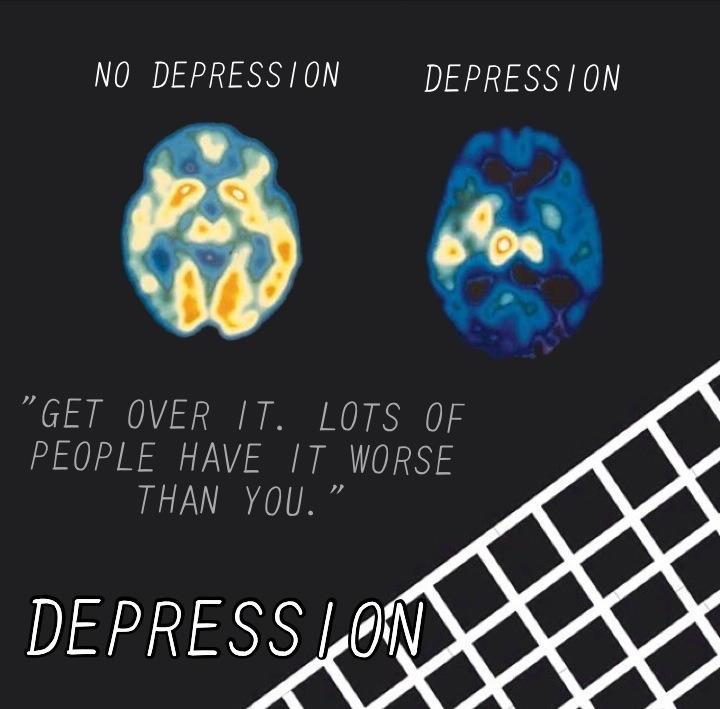
    The dictionary defines disease as "a disorder of structure or function in a human, animal, or plant, esp. one that produces specific signs or symptoms or that affects a specific location and is not simply a direct result of physical injury." By this definition, depression must be a disease because brain scans have shown decreased activity in certain areas of the brain in depression patients, higher levels of stress hormones, and various genetic and biological causes that cause symptoms impacting one's thoughts, feelings, behavior, mood, and physical health. For some, depression is a life-long condition in which periods of wellness alternate with recurrences of illness. Depression is a leading cause of disability worldwide and represents a global public health challenge. According to the World Health Organization, it is the forth-leading contributor to Global Burden of Disease, and by 2020, depression is projected to be the second-leading cause.


    There is no doubt, then, that depression is an illness.

    Myth #2: Depression is a disease.
    This is intentionally contradicting the point I just made. Depression is a disease, but it is not a straightforward medical disease. Confused? So was I, don't worry. Dr. John Grohol explains it in this way:
    Diseases are manifestations of a problem with some physical organ or component within the body. And while the brain is also an organ, it is one of the least understood and easily the most complex organ within the body. Researchers and doctors refer to a diseased organ when something is clearly wrong with it (via a CAT scan or X-ray or laboratory test). But with our brains, we have no test to say, “Hey, there’s something clearly wrong here!”
    One could make the argument, as many have, that because brain scans show abnormalities in certain biochemical levels within the brain when they suffer from depression or the like, this “proves” that depression is a disease. Unfortunately, research hasn’t gotten quite that far yet. The brain scans show us something, that much is true. But whether the scans show the cause or the result of depression has yet to be determined. And more tellingly, there is a body of research that shows similar changes in brain neurochemistry when people are doing all sorts of activities (such as reading, playing a video game, etc).
    Depression is not a pure medical disease in the traditional sense, but a mental illness or mental disorder. It is complex in that reflects its basis in psychological, social, and biological roots. While it has neurobiological components, it is no more of a pure medical disease than ADHD or any other mental disorder. Treatment of depression that focuses solely on its medical or physical components — e.g., through medications alone — often results in failure.

    Dr. Azadeh Aalai relates it in this way:
    Psychiatrists oftentimes use the parallel of the diabetic who takes insulin to treat his condition; so, too, must the depressive take his or her meds, they claim. This is a wildly inaccurate parallel for a number of reasons. Firstly, one can definitively diagnose and validate diabetes as a medical condition. One can also identify with certainty the underlying medical reasons behind the diabetic’s condition. Lastly, one can also identify with certainty the extent to which the disease can be controlled/treated with the administration of insulin (in the case of type I diabetes in particular). There is no definitive blood test or otherwise physical examination that can determine a depression diagnosis. In fact, contrary to the entire medical paradigm, the symptoms of the illness actually serve as the basis of the diagnosis in the case of depression. Moreover, there is not a clear intervention, medical or otherwise, that can be implemented for a depressed individual that will work in all cases.
    Summary: Depression is a mental disorder or mental illness--not a disease purely in medical sense, but it is still a disorder.


    Myth #3: Depression is a product of your environment.
    This one made me laugh a little bit. The boy who said this was clearly confused because he gave an example of a kid being depressed because his parents were fighting. First of all, that is not clinical depression--that's sadness. The two are not synonymous, but I will get to that later. Second of all, all mental illnesses are biopsychosocial in nature.

    The first component is biology, which includes both the biochemical makeup of the brain, as well as inherited genes. Neurochemistry, especially neurotransmitters like serotonin, has been shown to correlate with depression, but the brain is so complex, that much is left undetermined for certain. Lately, research has started to show a genetic predisposition to mental illnesses like depression, but none of this determines if an individual will be affected. Having a relative with depression only increases your risk for getting depression by 10-15 percent. Correlation does not equal causation. The second component of this model is psychological, which includes a person's personality, how he or she was raised to deal with stress, how he or she deals with emotions, and other aspects. The final component of this model is social, which includes relationships and how we interact and communicate with others.

    The biopsychosocial model is the most widely accepted model in all of psychology because it states that mental illness cannot be caused by biological or psychological or social factors alone--it takes a combination of all three to bring about any mental illness.

    Myth #4: Depression is a choice.
    Depression is not something that a person chooses to have! Seriously. A person with depression does not want to feel the way that he or she feels. It is not something that can be willed away any more than cancer or diabetes can. Research has shown depression correlates with chemical changes in the body, which cannot be overcome simply by a change in thinking. Depression is a medical condition that arises from errors in brain chemistry, function, and structure due to biological, psychological, and environmental factors.


    Myth #5: Depression is just sadness/laziness/weakness. 
    False. Equating depression with any of these things is like saying a common cold is the same as pneumonia.
    Depression is not just ordinary sadness, grief, or laziness. Again, to quote Dr. John Grohol:
    Depression is overwhelming feelings of sadness and hopelessness, every day, for no reason whatsoever. Most people with depression have little or no motivation, nor energy and have serious problems sleeping. And it’s just not for one day — it’s for weeks or months on end, with no end in sight.
    Depression is not a sign of weakness--it can strike anyone at anytime. It does not discriminate against gender, race, age, sexuality, religion, culture, or any other factor. Someone with depression is not just feeling sorry for him or herself. Some of the most prominent and accomplished individuals have suffered from some form of depression, including:  Alexander the Great, Napoleon Bonaparte, Abraham Lincoln, Theodore Roosevelt, Winston Churchill, George Patton, abolitionist John Brown, Robert E. Lee, Florence Nightingale, Sir Isaac Newton, Stephen Hawking, Charles Darwin, J.P. Morgan, Barbara Bush, Ludwig von Beethoven and Michelangelo.


    Myth #6: Depression is just a phase and if ignored, it will go away. 
    This is false. Depression is a medical condition that requires treatment and support. In fact, many times symptoms of depression will get worse if left untreated. One of the most effective treatments of depression is through behavioral activation. This is the idea that in order to decrease depressive symptoms, one must act opposite to them--activate one's behavior--in order for them to decrease (which will not be instantaneous).

    Myth #7: Antidepressants work no better than a placebo and have dangerous side effects.
    This one I had to do some extensive research on and the jury is still out on it, not just in my brain, but in the scientific community. Talking about antidepressants, Dr. Azadeh Aalai wrote:
    The standard the FDA requires for psychiatric meds to be approved and sold to consumers is not a high one: only two independent studies that yield significant results in favor of drugs is required, regardless of how many trials may be required to render such findings. In other words, “so long as research eventually yields evidence of efficacy, the failures would remain off the books. This is why antidepressants have been approved even though so many studies have shown them to be ineffective” (Greenberg, 2010, p. 216). Moreover, research suggests that the reduction of depressive symptoms seen with antidepressant use may be more indicative of a placebo effect than the merits of the drug itself. For instance, some sources contend that up to 80% of the effectiveness of antidepressants is due to placebo effects (see Greenberg, 2010). This comes at a high cost, given the documented (and not so documented) side effects—chief among them that in some cases, ironically, use of antidepressants actually increases suicidal ideation (particularly among adolescents).
    A study done by Harvard in 2005 more deeply probed the risks of antidepressants, as did a study at the University of Colorado. Multiple studies have shown the effectiveness of antidepressants over the use of a placebo. People will analyze these studies inside and outside and upside down, but the speculation that antidepressants are no more effective than a placebo has not yet been evidenced in research, and like all medications, psychiatric medications come with their risks and side effects. However, if the medications are taken properly, under supervision of a trained medical doctor, the risks are generally minimal.

    Myth #8: School shootings are caused by antidepressants, proving they do more harm than good. 
    So. I don't even know what to do with this one. To me, it is a clear case of people assuming that correlation is the same as causation. I did a Google search of school shootings and antidepressants and found not a single credible source in the first few pages of results. To make sure that I was not missing anything, I did a search of PsychInfo, which gave me no results. There has been no research done in the academic community which states a definitive link. I read a statistic (and only one statistic, and not from a valid, peer-reviewed source) that stated 90 percent of school shootings could be linked to antidepressants. Since Newtown, there have been 44 school shootings in the United States, as of February. An estimated 31 million Americans are on antidepressants. That is a very small percentage, even if all those involved in the school shootings were taking antidepressants. Correlation does not imply causation. A link between two things, is not always causal, and in this case, assuming that cause is not only incorrect, but irresponsible AND it continues to promote stigma that keeps people from getting help!


    Myth #9: The only way to treat depression is through the use of antidepressants. 
    Treating depression is not as simple as just taking a pill. Medication alone is not enough and is generally most effective in addition to psychotherapy. Cognitive Behavioral Therapy (CBT) has been shown to be particularly effective in the treatment of depression. Lifestyle changes such as balanced nutrition, regular exercise, and adequate sleep have been shown to help as well as things like mindfulness, meditation, and yoga.


    -----
    Resources and References:
    http://www.nimh.nih.gov/health/topics/depression/index.shtml
    http://psychcentral.com/lib/an-introduction-to-depression/000650
    http://www.nami.org/Template.cfm?Section=depression
    http://www.nytimes.com/health/guides/disease/major-depression/overview.html
    http://www.huffingtonpost.ca/2013/11/13/depression-myths-_n_4268047.html
    http://psychcentral.com/lib/what-is-depression-if-not-a-mental-illness/000896?all=1
    http://www.psychologytoday.com/blog/evil-deeds/200809/is-depression-disease
    http://psychcentral.com/blog/archives/2009/10/18/7-myths-of-depression/
    http://www.psychologytoday.com/blog/the-first-impression/201302/5-myths-about-depression
    http://www.healthcentral.com/depression/just-diagnosed-822-143_3.html
    http://psychcentral.com/blog/archives/2009/10/18/7-myths-of-depression/
    http://www.healthline.com/health-slideshow/9-myths-depression#1
    http://www.hpb.gov.sg/HOPPortal/health-article/10202