Sunday, August 3, 2014

Sunday Sermons: Recalculating

Lately I've had a love/hate relationship with church. It seems every Sunday, I sit through the sermon and I leave feeling like I was smacked in the face with some important life truth. This Sunday was no exception, however, I also left questioning my plans to return to college in the fall. Pastor Jeff is doing an excellent job of challenging me in my faith. 

Today's sermon was based on Numbers 22:21-35: 
22 But God was very angry when he went, and the angel of the Lord stood in the road to oppose him. Balaam was riding on his donkey, and his two servants were with him. 23 When the donkey saw the angel of the Lord standing in the road with a drawn sword in his hand, it turned off the road into a field. Balaam beat it to get it back on the road.
24 Then the angel of the Lord stood in a narrow path through the vineyards, with walls on both sides. 25 When the donkey saw the angel of the Lord, it pressed close to the wall, crushing Balaam’s foot against it. So he beat the donkey again.
26 Then the angel of the Lord moved on ahead and stood in a narrow place where there was no room to turn, either to the right or to the left. 27 When the donkey saw the angel of the Lord, it lay down under Balaam, and he was angry and beat it with his staff. 28 Then the Lord opened the donkey’s mouth, and it said to Balaam, “What have I done to you to make you beat me these three times?”
29 Balaam answered the donkey, “You have made a fool of me! If only I had a sword in my hand, I would kill you right now.”
30 The donkey said to Balaam, “Am I not your own donkey, which you have always ridden, to this day? Have I been in the habit of doing this to you?”
“No,” he said.
31 Then the Lord opened Balaam’s eyes, and he saw the angel of the Lord standing in the road with his sword drawn. So he bowed low and fell facedown.
32 The angel of the Lord asked him, “Why have you beaten your donkey these three times? I have come here to oppose you because your path is a reckless one before me. 33 The donkey saw me and turned away from me these three times. If it had not turned away, I would certainly have killed you by now, but I would have spared it.”
34 Balaam said to the angel of the Lord, “I have sinned. I did not realize you were standing in the road to oppose me. Now if you are displeased, I will go back.”
35 The angel of the Lord said to Balaam, “Go with the men, but speak only what I tell you.” So Balaam went with Balak’s officials. 

Pastor Jeff began his sermon by talking about the conspiracy Mapquest, GoogleMaps, YahooMaps, and all other directional websites have to get him lost. (Personally, I just think it's a user error...) Then he spoke about how now, he has a GPS, but sometimes, he still gets lost and when he does, it passive-aggressively complains about the fact it has to recalculate. 

His question was: Is the exasperated recalculating voice our own when we have to shift direction in order to find where we need to go?

We all have goals for our lives--dreams we want to achieve educationally, professionally, personally--and even though we know the directions, we sometimes miss a step or turn or a new situation may arise, be it a health problem, a family problem, or just a door being shut. And in these moments, we find we need to recalculate and this may come with anger, frustration, sadness, annoyance and other emotions. 

In Numbers, Balaam has a special relationship with God. He's going to meed the king of Moab, but God is not super thrilled by that idea, so He sends an angel with a sword to stand in Balaam's path and for some reason only allows Balaam's donkey to see it. The donkey, seeing the danger, diverts the course in order to save Balaam from percieved danger three times, and Balaam, frustrated because he has to recalculate, hits his donkey each time for not staying on course. 

After the third time, the donkey says to Balaam, "WHY DO YOU KEEP DOING HITTING ME?! IT HURTS!" And the donkey and Balaam then argue, until God allows Balaam to see the angel, who explains why the donkey kept averting the course. 

Balaam, now realizing he maybe should not be going to see the kind of Moab, wisely decides he should go home rather than risk his life, but the angel encourages him to go on to meet with Balak, but only if he does what God says. 

Pastor Jeff then began to talk about the journey of faith and how it involves discernment. There are moments when life recalculates us, and in those moments, we need to ask, is God leading us or are we deciding where we go? We need to discern the difference between our voice and God's. We need to be actively figuring our which is which, following the one and leaving the other.

Especially when life seems to recalculate us. We need to turn to God and ask, "Now what?"

This process of discernment means paying attention to the divine messengers God places in our paths--our friends, teachers, mentors, maybe even our donkeys. Who is God asking us to pay attention to? What are the voices saying? Is God asking us to recalculate our plans for our lives or to go ahead with His blessing?

God is always speaking to us in the moments when life recalculates us, not passive aggressively, with exasperation, anger, frustration, or annoyance, but with a voice of love, challenge, and grace.

Ten months ago, my life recalculated me. It sent me home from my dream college to deal with my health and mental illnesses. It took me down a road I never thought I would be on at this point in my life. I still find myself exasperated and saddened I missed out on a semester and a half of college.  

In 22 days, I am planning on moving back to Gettysburg for what should be my junior year of school. And for the past four months or so, I have been having doubts about returning. Others in my life have also been having similar doubts, to which I've put on a brave front, but the truth is... I'm filled with so much anxiety and fear about returning that I'm not sure it's the right decision. If it was the right decision, I'd feel 100% confident in it, wouldn't I? 

And this morning, I was challenged to ask myself another question: Is God leading me or am I the one deciding where I go? 

I honestly don't know. If I look at the could-be messengers God has placed in my path, I am hearing mixed opinions. I'm listening to the voices but I don't know what they're saying to me. 

How do I know who God is speaking through? How do I know if God is telling me to go ahead with the journey I'm on or if He is asking me to recalculate my plans? What if I don't have enough faith to discern any of this? What if I misunderstand God's voice and make the wrong decision? 

I don't know. 


Thursday, July 31, 2014

On Being a Recovery Blogger In Recovery

I am a recovery blogger.

I write about my recovery from my eating disorder and my other co-occurring conditions.

On my Facebook page, I share links about mental illnesses and recovery. I share body positive articles; I share articles about anxiety and depression recovery, about body image, about mental health in general.

I am an eating disorder and mental health activist.

I am an Assistant Editor and Writer for Libero Network, and I blog on occasion for The Project Heal.

I am a psychology major hoping to one day specialize in the treatment of eating disorders.

But I am also in recovery.

This means that sometimes, I am full of hypocrisy. Sometimes, the words I write, the articles I share, the advice I spew out of my mouth is full of truths I don't believe. Sometimes it's riddled with ED's deception goals to fake people into thinking everything is peachy. Sometimes it's all just bullshit.

Sometimes I have months like these past few and cannot for the life of me spin my experiences in a positive manner. Months where I take two trips to the emergency room and receive stitches for self-harm. Months where I accidentally drink too much in front of my entire extended family. Months where I am not even close to full meal plan compliance and my doctor threatens to not let me go back to school. Months where I struggle just as much to keep food down as I do to get food in my body.

I think I sometimes get so wrapped up in my role as advocate that I try to manage perceptions of me so I will seem more credible and trustworthy because I've been through the war. Who wants to wants to read a recovery blog by someone who's struggling? What kind of credibility do I have offering advice on healing when I'm not healed? How do I promote acceptance and recovery when I don't always want it for myself?

So instead of admitting I don't know all the answers, instead of admitting weakness, instead of sharing my struggles, I hide. I avoid coming to my blog and sharing my journey. I avoid writing posts and articles for other organizations. I avoid commenting on any articles I share on Facebook.

Here's the thing--the very nature of recovery means some days will be miserable and others will be amazing. It means some days are wired for struggle while others are pure bliss. It means there will be bad days and good days.

Sometimes my wanting to control my image perception as an advocate gets in the way of my recovery. It's hard to focus on recovery when you become obsessed with gaining blog followers and becoming a successful writer. It is harder to recover when you are consumed by your image, your credibility, your fears.

I originally began this blog for me, as a way to connect with others, process my journey, and chronicle my life. It was a way to achieve healing and peace within my own mind. I just wanted to write.

I think it's time I get back to that.


Sunday, July 13, 2014

Thoughts on Shipwrecked in LA

For a while now, my Social Psych professor has been encouraging me to read Shipwrecked in LA by Christin Taylor, and after a few months of watching the book collect dust on my overcrowded bookshelves, I finally read it.


Taylor's book is centered mainly around her post-college life and her dreams of becoming a missionary within Hollywood's film industry. However, as is bound to happen, her plans for her future seem to come crashing down around her just a few months after moving to Hollywood. For the next few years, Taylor faces an overwhelming internal crisis as she attempts to discern her true purpose and self when everything had fallen apart. Taylor interlaces the novel with relevant and current research surrounding what is termed a shipwreck, which she summarized here:
Shipwreck is the metaphorical coming apart, the crash that rips through the very fabric of our identities. Everything we have thought about ourselves, our lives, our futures, even our faith, suddenly comes apart beneath us, and we are left scrambling, trying to put together any type of lifeboat to make it to shore. (p. 15)
Shipwrecked in LA your basic memoir, coming-of-age novel interspersed with some research about emerging adulthood.

The first few chapters took me some time to get into as her story seemed to be laced with the stereotypical trials of a PK (Preacher's Kid), or more accurately for Taylor, an MK (Missionary Kid): the entry into the "real world," no longer softened by the cocoon of the church. It was in those moments when I was tempted to give up reading the book altogether because I really didn't want to hear about how uncomfortable she was watching Hannibal with other film students or how she struggled to love on everyone in the irritated environment that is the world outside the church. My attitude is most likely a result of the fact these are some of the things that most irritate me about living in a Christian community. (Although to tell you the truth, I faced that same uncomfortableness with the drinking culture at college, although that was more to do with my being sheltered as a child and less to do with my faith.)

But I am glad I didn't put the book down after the first few chapters.

The research she cited in her book made continuing on worth it in itself, but her story became remarkably more similar to mine. Even though I was filled with envious frustration at Christin Taylor's ability to hold tightly onto her faith, I learned a great deal from her commentary on it. In chapter 13, she explained where faith comes from:
Faith is ultimately a response to a promise you consider trustworthy, to a sense of well being offered by an experience or person. We encounter something or someone, feel a sense of connection, wholeness, or relation, and faith is born to us and in that thing. (p. 83)
I found this description to be very powerful, especially since it gave me an operational way to define such an abstract contruct as faith. This definition fits, very easily, into what I feel I've been feeling I'm lacking when it comes to my faith.

Part 3 of Taylor's story is where I really started to relate to her. She talked about struggles she had with anxiety. She recounted a crying episode she had her freshman year of college saying, "I couldn't tell her what was wrong, because I didn't know. But I remember feeling frightened that I would 'burn her out'" (p. 108). She could have taken the words right out of my mouth in that sentence and how I feel about searching for recovery support. Another time she related envy over a longing to have a home, saying "I wanted to belong, fit in, be known, and not feel so outside the community, so wind-tossed by my emotions and fears" (p.114). Again, right out of my mouth--most days that's all I want.

Part 4 of Christin Taylor's story is entitled "Company for the Road," and it focused on the people who helped her rediscover herself, piece herself back together after her shipwreck. The research in this chapter and Taylor's story itself touched a raw spot in my heart, mainly because it is so difficult for me to allow others to share in my journey, but as research shows, it is so vital to not walk alone. In Part 5 of her book, Taylor illustrated how her shipwreck transformed her sense of self and allowed her to see the world in a new light.

In her epilogue, Taylor talked about the research of Sharon Daloz Parks:
Sharon Daloz Parks says that life does not end in the waters of a shipwreck. That seems to go without saying. Yet when we have encountered shipwreck, it is difficult to believe that there could be meaning, life, or faith beyond the wreckage. But as Parks says, "If we do survive shipwreck--if we wash up on a new shore, perceiving more adequately how life really is--there is, eventually, gladness." And this is where the beauty sets in.
We look up and discover a vital, more nuanced understanding of life. We are transformed. And though nothing can lessen the loss or pain of the shipwreck, somehow the existence of this pain within the new discovery revitalizes us and invades our beings with joy.
We do not want to go back to life before the shipwreck. We do not want to slip into that old way of looking at the world. As Parks says so eloquently, "We do not want to live in a less-adequate truth, a less viable sense of reality, an insufficient wisdom."
[...]
Parks says that the power of the experience of shipwreck in our lives lies precisely at the heart of our inability to imagine that we will ever come out of it. This makes sense. We have no idea what life will look like beyond our tragedies. As she puts it, "How could we know that even this might be survived?" Even if we are brave about our shipwrecks and meet the dissolution of our identities and faith with courage, we may still believe that nothing as good as what we have experienced waits for us on the other side. Life will just go on. We will survive. But then, when we discover that meaning and joy wait for us on the other side, we are amazed. 
In the end, our identities pull back together not only through suffering, but somehow, miraculously, through joy (p. 238 & 248).  
It was in those last 10 pages I found the most hope, in the idea that on the other side of the pain I am experiencing right now, there is joy and meaning and beauty. And in the idea that it is completely normal not to see life, meaning, or faith beyond the wreckage of my life right now.

As I'm writing this, I am able to notice the judgments that come through my head about Christin Taylor's story, judgments that want to minimize her pain and her shipwreck, as well as judgements about myself for not holding onto my faith as tightly as she had. I'm finding I need to remind myself that everyone fights hard battles and theirs are just as hard for them as mine are for me. But it also reveals another truth, that everyone has their stuff, everyone has their shipwrecks, everyone has imperfect lives. I am not alone in that.

As frustrating as her book was to read sometimes, I got hope out of it. In the ED world, especially among those who have recovered, people say that when you recover, you become so much stronger and life is better on the other side. I don't know if I've ever fully believed that. Taylor takes her story and her research and shows that in a completely different situation, life is, in fact, better on the other side of the pain and the struggle. Taylor's book ultimately made me feel less alone, to read her story and the research to see that even in different circumstances, others have felt the same as I do. It made me feel hopeful. It makes me willing to try to believe that one day, I will reach the other side of this. 

Saturday, July 5, 2014

Scars (Possible TW)

Today I had a day off from all my responsibilities for the first time since class began at the beginning of June. My parents and I traveled to Michigan to celebrate one of my favorite holidays with extended family. Overall, it was quite an enjoyable day, and I walked away blessed by time in fellowship with my family and my soul reenergized by the love they have for me. 

It was also a day filled with internal chaos and struggle, some minor food anxieties as can be expected around any holiday, but mostly, my struggles had to do with body image, although not in the way one might expect. 

My body is covered in scars. 

Some of these scars are from old injuries when I was a child--from falling over the fence surrounding the portion of our yard my rabbits played in, from old softball injuries when I scraped half my leg open sliding into a base, and of course, from mosquito bites (and poison ivy!) that I could not keep myself from scratching. But those are never the ones people notice when they look at me. People notice the scars on my shoulder, the scars that blanket my forearm and wrist, and now, the newly healed ones on my thigh, which are not always completely hidden by whatever shorts I choose to wear. 

These scars all have stories, although there are so many I cannot always remember them. But I can point out the ones from when my longtime best friend and I had our first huge fight, which led to the demise of our friendship. I know which ones came from desperate efforts to feel something when it seemed impossible to feel anything at all. I know which ones were half-hearted attempts to end my life and which were whole-hearted attempts to keep myself alive. I know which ones grounded me and silenced the voices and memories when they all came on too strong. 

But none of these are stories I want to share when someone asks what happened to me. And after all these years, I still freeze whenever someone asks about my scars. Sometimes I can muster out an excuse about a biking accident or a pet or lately, about an accident at work, but usually I just shrug off the questions, quietly say, "Nothing," and change the subject. 

Every move I made this weekend was guided by how I could best make my scars invisible to my family. Not once did I feel comfortable in my skin, not once did I relax into the safety and support I was enveloped in while with my relatives. It turns out the only person to ask about them was my 12-year-old cousin, although I'm sure he was not the only one who noticed my scarred skin. 

I have a hard time admitting that I struggle with self-harm. It's something I would rather avoid talking about because I feel a great deal of shame, embarassment, and guilt around it. I feel like everyone hears that and recklessly judges who I am based off lies and stigma they have bought into about people who self-harm. I feel like when people see my scars, they see me as my scars and not as a person.

I've heard it said that scars are battle wounds, that they remind us where we've been or how far we've come; people say that scars show strength and survivial. In the Tumblr community, people refer to self-harm scars as beautiful because they resent the struggle and the overcoming of something all-consuming. 

My scars are the farthest thing from strength and beauty. My scars are hideous reminders that the past is indeed real and that my life is not something beautiful. My scars show weakness and doubt. They make me ugly and imperfect, and I am reminded of that every time I run my fingers over the braille lines  I have etched into my skin and read the stories I carved into myself. My scars make me damaged goods for all eternity. 

Once something is damaged, it can't become beautiful again. It's always going to have remnants of the thing that damaged it, no matter how much effort is made to repair it. My scars damaged me, damaged my life. And it's never going to be beautiful and undamaged again, no matter how much work is put into repairing it. 

So why try to make something beautiful when it will always remain scarred? 


Monday, June 9, 2014

What if I Fail?

Today I am going back to school by beginning summer classes at a local college. It's been over six months since I've been taking classes, so this day is provoking a lot of anxiety in me because it's been so long. The questions are dancing around my head like crazy this morning. What if I've forgotten how to study? What if my brain can't handle learning new things just yet? What if I relapse into more intense depression or ED behaviors? 

What if I fail? 

I have a huge fear of failure. Failure, to me, means that I am not good enough, not worthy, not smart enough, not talented enough--not enough. I define my success in the academic world by how high my GPA is and how many As I get, but even that does not quell my anxieties. My high standards continually get in the way. School fuels my perfectionism, and my perfectionism fuels my eating disorder. 

And then there's the question of how I am I going to manage being in school again? I can't resort to the habits I picked up the year and a half I spent at Gettysburg because those obviously got me nowhere. How do I manage the stress? What if it gets too overwhelming? What if I'm not smart enough? 

What if I fail?

Ultimately, it all comes back to that one question. This time, it seems there is so much more put onto my successful completion of my summer courses because they are my test of whether I truly am ready to return to my education full-time come fall. If I fail at this, then I fail to be a student, fail to be who I truly am, and it seems, fail at life. 

My identity has always been so wrapped up in my education that when I left school for treatment, I had a hard time separating who I am from my life as a student. Now that I am returning to the academic world, my identity is once again starting to become my test scores, my grades, my success in the classroom. If I fail, who then would I be? 


The other thing causing me great anxiety is stepping into a room full of unknown people. The questions will be racing through my mind. What do they think of me? Am I okay? Do I fit in here? Do they like me? Will I make friends? Will I say something stupid in front of them? Are they judging me? These are the same insecurities I have always felt on the first day of every school year. 

My summer classes are going to test my abilities to really control my perfectionism and my eating disorder. I need to remember that failing is okay, that not having all the answers correct is okay. I need to remember that I am not my education, my GPA, or how many answers I get correct. I need to remember that this is about learning and progress and not about perfection. I need to remember that what other people think of me is none of my business. I need to remember to stop asking "What if I fail?" and to ask a different question.

What if I fail?  
What if I succeed? 

Happy First Day of Summer Classes! 


Sunday, June 8, 2014

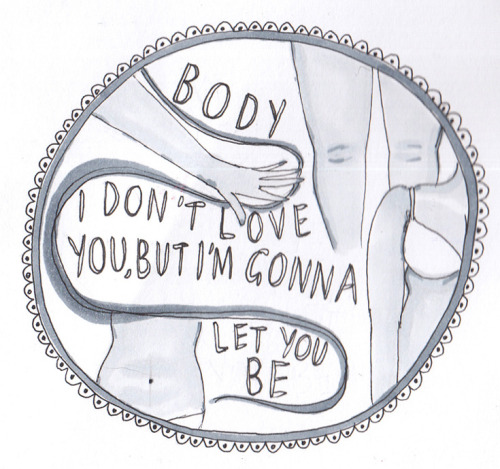
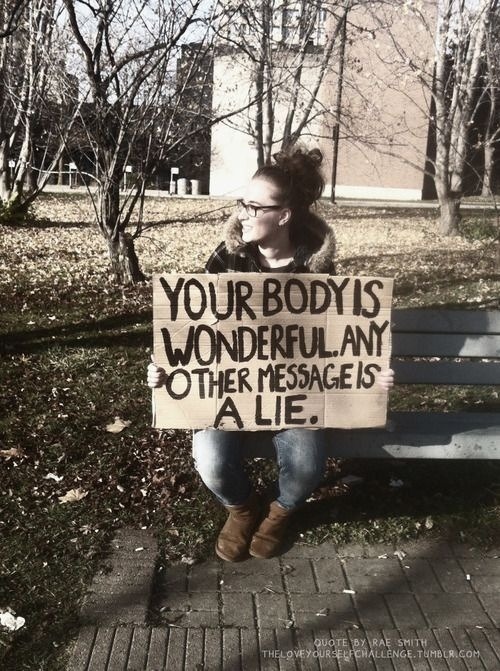
The Truth About My Body

A couple days ago, I posted this picture and the following message on my Facebook page: 


"For the first summer in years, I am at a healthy weight and today, I was able to feel confident and attractive in a bathing suit for the first time in years, which is huge. I am not fully comfortable with posting this photo for my friends to see, but tonight I am saying "Screw you!" to my eating disorder and all the lies that tell me I am not attractive or good enough. This is me (and my favorite, most supportive brother) and this is my body. My body is perfect and beautiful and awesome because it is healthy and it keeps me alive. 
Sarah: 1
Eating disorder: 0"


My anxiety was crazy high when I posted this because, well, I am not happy with how my body looks. It would be a lie to say that my body image has miraculously switched from feeling like shit about how I look to loving every inch of my skin. I do not. 


Earlier that day, I had felt attractive and even sexy in my bathing suit. I felt so good about myself. And then I saw this picture and began to critique every flaw I saw. I took a picture from almost five years ago and sat for hours comparing my eating disordered body to this photo, almost crying because the difference is so unreal to me. But I took a chance and posted it to Facebook... 

The support I received was unbelievable. 

"You go, girl! You are gorgeous, inside and out, and a true inspiration!" 

"I am crying reading this Sarah- I had such a horrible body image day and your beautiful words have really touched me! I am am SO SO SO proud of you!!" 

"You are an inspiration to everyone including myself who struggles with image. I love you, my pretty friend!"

"You are a doll, Sarah. And you do look beautiful. Really proud of you to step out, for we all need to think more like you do. Hugs."

"So very proud of you missy!! You ARE beautiful in every single way! You are on the right path. Xoxo"

"I loved reading this post Sarah! It's a great picture! THANK YOU for posting it! I'm sure that posting this will help you and it will help others struggling with the same issue. You are a Beautiful, Brave, AND Intelligent woman."

"Confidence = beauty! You are both! Stay strong Sarah, you are amazing!"

"You are such an inspiration in so many levels! Proud of you for coming this far, and knowing you will go further! you look wonderful!"

"Your message is beautiful. You are beautiful. And most importantly, you're confident! Love everything about you, my dear! You inspire me every day." 

"Hell yeah! You are beautiful, Sarah. The voice of that eating disorder is a lie. It does not exist. You are Sarah and you are a soldier. Very inspiring!"


These are just a few of the comments I received from friends and family. No matter how many times I read it, I still can't believe it. I have amazing and supportive friends and family, who bless me every day with their love for me and encourage me on my journey. I still am completely blown away by this. 

But I wasn't feeling better... Until one comment hit a nerve. 

"You deserve all of this and all of the confidence and positivity you are receiving. I love you girl."

In my mind, I don't deserve any of this love and support because I am not enough for it. I am not deserving of it. I disappoint people, I screw things up daily, I don't perform as well as I should. I'm finding it really is true that "We accept the love we think we deserve." I struggle to accept it because I am not yet sure I deserve it. 

This is okay. I am allowed to struggle with this. 

I read in a book once that "The truth doesn't have to be known, or believed, to be true," and that line has stuck with me because of the inherent rightness that exists in it. I don't have to believe I deserve any of this love, positivity, and confidence for it to be true that I do deserve it. I don't have to believe the words of my friends and family for them to be true. 

But I know the truth. 

The truth is that my body is healthy. 
The truth is that my family and friends are proud of me. 
The truth is that they think I am beautiful and an inspiration. 
The truth is that my weight and shape in no way affect whether I am beautiful or not. 
The truth is that my weight and shape in no way determine who I am as a person. 
The truth is that I have worked hard to get myself back to a healthy weight. 
The truth is that I deserve all of the love and encouragement and positivity given to me by my loved ones. 
The truth is that I deserve to be confident about my body because it is freaking beautiful how it is now--healthy. 

Maybe one day I will believe all of this as truth. But for now, I am glad I have supportive and loving family and friends to speak truth into my life. 


Tuesday, June 3, 2014

Sometimes I forget I have depression...

Sometimes I forget I have depression.

Not because I've suddenly recovered from it or it's miraculously gone away, but because most of the time, I am so focused on the fact that I have and eating disorder and I need to recover from my eating disorder. I never really, truly think about recovering from my depression. 

When I think about recovery, I always think about it in terms of eating disorder recovery. I guess that's because it's so easily tangible, whereas depression recovery is not. With eating disorder recovery, I can see the recovery by seeing records of my following my meal plan, by being told by my doctor that I am in my weight range, by no longer being orthostatic or bradycardic. But with depression recovery, it seems like the only thing defining recovery is the ambiguous 'feeing better.' 


I guess depression recovery can be measured by how much more I am leaving my house, how much less I am isolating, how many times I reach out to friends, but none of that seems to signify recovery to me. My depression is this all-consuming feeling of drowning, of being suffocated in this endless pool of hopelessness and pain. It is like being in a cave full of only darkness, where there are absolutely no exits anywhere. It's continual grieving for something that you never knew existed. 

Depression is not so much behavioral as an eating disorder--more mental and emotional, but it is so much more complicated than that. All that depression is becomes so mangled and tangled up inside of my head and interwoven into my life that operationally defining it is not something I can do. I know people have done it--professionals--but defining and explaining it for me, as someone who experiences its intricacies and quirks day in and day out, nothing seems adequate. 

It wasn't until recently I actually noticed I've been completely forgetting about my depression. I obviously know it exists... It crosses my mind every night when I take my antidepressants that, "Hey, Sarah, you have depression and if you stop taking these drugs, you'll soon feel like shit." But other than that, it's hardly ever a thought. 


A little over a week ago, I spent my part of my night/early morning in the emergency room because for the first time in months, I had selfharmed and I was worried I may have gone a little too far. A friend decided I needed to go to the hospital, whether I wanted to or not--I was definitely on the side of not, and so we went. I spent that early morning and the days following trying to figure out exactly what had happened, what had triggered me to do what I did that night. And no matter how much I thought about it, I was not able to quite discern what happened (usually it is fairly simple to see a causal relationship with my behaviors). 

It's slowly come to me that I used selfharm as a way to cope with the overwhemingness of the depression that I was feeling inside of myself that night. Nothing happened to trigger it, just like nothing ever happens to trigger it. It just is, sudden and suffocating. 

I guess lately that I've just been tuning out my depression, focusing on the tangible aspects of my eating disorder recovery, seeing everything I was feeling as an effect of no longer using eating disorder behaviors, and ignoring the fact I have a dual diagnosis of an eating disorder AND depression. 

I've realized I can't treat one and just ignore the other. Recovery does not happen on it's own, and although eating disorders and depression can share similar symptomology, they are not the same illness. I have to work on recovering from both. So now it's time to focus on both maintaining the progress I've made in my ED recovery and learning how to manage and live with my depression. 

Because even though I sometimes forget about it, I do have depression and it does highly impact the qualitiy of my life.