Sunday, March 9, 2014

I Got In A Fight Last Week...

I got into a fight. On Twitter. It sounds so lame and immature... But someone needed to say the things that I did, and honestly, I regret nothing.


One night last week, I was scrolling through my Twitter feed, when I can across a tweet claiming that the cure for depression is "a weekend of nature, sit[ting] under a tree and watch[ing] the water cascade over a cliff." As someone who has struggled with diagnosed clinical depression for a very long time, I was offended by this tweet. My response to it was: "Depression is a disease and chemical imbalance in one's brain, not an emotion. Stop #mentalhealthstigma & belittling the problem!" (Let's take a minute and think about how hard it is to tell someone facts and why they're wrong in 140 characters...) The replies I received were less than informed, and in some cases down right mean. I think my favorites were the ones that told me I was "brainwashed" and "Perhaps the chemical imbalance in your brain is a RESULT of you negative thinking/attitude" and "#YourHashtagsMeanAsMuchAsYourDegree #Nothing."


Depression is a serious mental illness that affects 5-8 percent adults in the United States each year. Less than half of these people will get help for their disease. This is a problem. Stigma and misinformed people are a problem. So let's look at some myths (and some arguments) that I came across in my Twitter fight.

Myth #1: Depression is not a disease.
The dictionary defines disease as "a disorder of structure or function in a human, animal, or plant, esp. one that produces specific signs or symptoms or that affects a specific location and is not simply a direct result of physical injury." By this definition, depression must be a disease because brain scans have shown decreased activity in certain areas of the brain in depression patients, higher levels of stress hormones, and various genetic and biological causes that cause symptoms impacting one's thoughts, feelings, behavior, mood, and physical health. For some, depression is a life-long condition in which periods of wellness alternate with recurrences of illness. Depression is a leading cause of disability worldwide and represents a global public health challenge. According to the World Health Organization, it is the forth-leading contributor to Global Burden of Disease, and by 2020, depression is projected to be the second-leading cause.
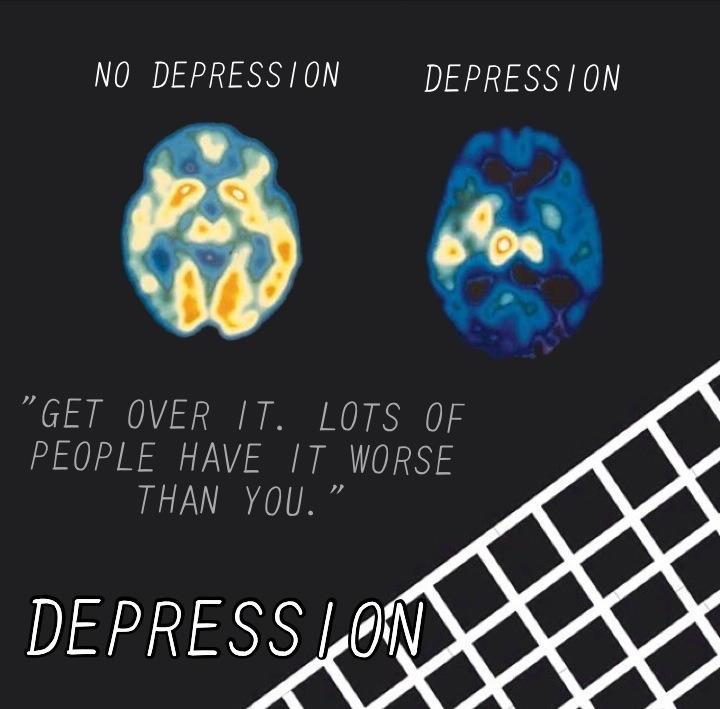

There is no doubt, then, that depression is an illness.

Myth #2: Depression is a disease.
This is intentionally contradicting the point I just made. Depression is a disease, but it is not a straightforward medical disease. Confused? So was I, don't worry. Dr. John Grohol explains it in this way:
Diseases are manifestations of a problem with some physical organ or component within the body. And while the brain is also an organ, it is one of the least understood and easily the most complex organ within the body. Researchers and doctors refer to a diseased organ when something is clearly wrong with it (via a CAT scan or X-ray or laboratory test). But with our brains, we have no test to say, “Hey, there’s something clearly wrong here!”
One could make the argument, as many have, that because brain scans show abnormalities in certain biochemical levels within the brain when they suffer from depression or the like, this “proves” that depression is a disease. Unfortunately, research hasn’t gotten quite that far yet. The brain scans show us something, that much is true. But whether the scans show the cause or the result of depression has yet to be determined. And more tellingly, there is a body of research that shows similar changes in brain neurochemistry when people are doing all sorts of activities (such as reading, playing a video game, etc).
Depression is not a pure medical disease in the traditional sense, but a mental illness or mental disorder. It is complex in that reflects its basis in psychological, social, and biological roots. While it has neurobiological components, it is no more of a pure medical disease than ADHD or any other mental disorder. Treatment of depression that focuses solely on its medical or physical components — e.g., through medications alone — often results in failure.

Dr. Azadeh Aalai relates it in this way:
Psychiatrists oftentimes use the parallel of the diabetic who takes insulin to treat his condition; so, too, must the depressive take his or her meds, they claim. This is a wildly inaccurate parallel for a number of reasons. Firstly, one can definitively diagnose and validate diabetes as a medical condition. One can also identify with certainty the underlying medical reasons behind the diabetic’s condition. Lastly, one can also identify with certainty the extent to which the disease can be controlled/treated with the administration of insulin (in the case of type I diabetes in particular). There is no definitive blood test or otherwise physical examination that can determine a depression diagnosis. In fact, contrary to the entire medical paradigm, the symptoms of the illness actually serve as the basis of the diagnosis in the case of depression. Moreover, there is not a clear intervention, medical or otherwise, that can be implemented for a depressed individual that will work in all cases.
Summary: Depression is a mental disorder or mental illness--not a disease purely in medical sense, but it is still a disorder.


Myth #3: Depression is a product of your environment.
This one made me laugh a little bit. The boy who said this was clearly confused because he gave an example of a kid being depressed because his parents were fighting. First of all, that is not clinical depression--that's sadness. The two are not synonymous, but I will get to that later. Second of all, all mental illnesses are biopsychosocial in nature.

The first component is biology, which includes both the biochemical makeup of the brain, as well as inherited genes. Neurochemistry, especially neurotransmitters like serotonin, has been shown to correlate with depression, but the brain is so complex, that much is left undetermined for certain. Lately, research has started to show a genetic predisposition to mental illnesses like depression, but none of this determines if an individual will be affected. Having a relative with depression only increases your risk for getting depression by 10-15 percent. Correlation does not equal causation. The second component of this model is psychological, which includes a person's personality, how he or she was raised to deal with stress, how he or she deals with emotions, and other aspects. The final component of this model is social, which includes relationships and how we interact and communicate with others.

The biopsychosocial model is the most widely accepted model in all of psychology because it states that mental illness cannot be caused by biological or psychological or social factors alone--it takes a combination of all three to bring about any mental illness.

Myth #4: Depression is a choice.
Depression is not something that a person chooses to have! Seriously. A person with depression does not want to feel the way that he or she feels. It is not something that can be willed away any more than cancer or diabetes can. Research has shown depression correlates with chemical changes in the body, which cannot be overcome simply by a change in thinking. Depression is a medical condition that arises from errors in brain chemistry, function, and structure due to biological, psychological, and environmental factors.

Myth #5: Depression is just sadness/laziness/weakness
False. Equating depression with any of these things is like saying a common cold is the same as pneumonia.
Depression is not just ordinary sadness, grief, or laziness. Again, to quote Dr. John Grohol:
Depression is overwhelming feelings of sadness and hopelessness, every day, for no reason whatsoever. Most people with depression have little or no motivation, nor energy and have serious problems sleeping. And it’s just not for one day — it’s for weeks or months on end, with no end in sight.
Depression is not a sign of weakness--it can strike anyone at anytime. It does not discriminate against gender, race, age, sexuality, religion, culture, or any other factor. Someone with depression is not just feeling sorry for him or herself. Some of the most prominent and accomplished individuals have suffered from some form of depression, including:  Alexander the Great, Napoleon Bonaparte, Abraham Lincoln, Theodore Roosevelt, Winston Churchill, George Patton, abolitionist John Brown, Robert E. Lee, Florence Nightingale, Sir Isaac Newton, Stephen Hawking, Charles Darwin, J.P. Morgan, Barbara Bush, Ludwig von Beethoven and Michelangelo.

Myth #6: Depression is just a phase and if ignored, it will go away. 
This is false. Depression is a medical condition that requires treatment and support. In fact, many times symptoms of depression will get worse if left untreated. One of the most effective treatments of depression is through behavioral activation. This is the idea that in order to decrease depressive symptoms, one must act opposite to them--activate one's behavior--in order for them to decrease (which will not be instantaneous).

Myth #7: Antidepressants work no better than a placebo and have dangerous side effects.
This one I had to do some extensive research on and the jury is still out on it, not just in my brain, but in the scientific community. Talking about antidepressants, Dr. Azadeh Aalai wrote:
The standard the FDA requires for psychiatric meds to be approved and sold to consumers is not a high one: only two independent studies that yield significant results in favor of drugs is required, regardless of how many trials may be required to render such findings. In other words, “so long as research eventually yields evidence of efficacy, the failures would remain off the books. This is why antidepressants have been approved even though so many studies have shown them to be ineffective” (Greenberg, 2010, p. 216). Moreover, research suggests that the reduction of depressive symptoms seen with antidepressant use may be more indicative of a placebo effect than the merits of the drug itself. For instance, some sources contend that up to 80% of the effectiveness of antidepressants is due to placebo effects (see Greenberg, 2010). This comes at a high cost, given the documented (and not so documented) side effects—chief among them that in some cases, ironically, use of antidepressants actually increases suicidal ideation (particularly among adolescents).
A study done by Harvard in 2005 more deeply probed the risks of antidepressants, as did a study at the University of Colorado. Multiple studies have shown the effectiveness of antidepressants over the use of a placebo. People will analyze these studies inside and outside and upside down, but the speculation that antidepressants are no more effective than a placebo has not yet been evidenced in research, and like all medications, psychiatric medications come with their risks and side effects. However, if the medications are taken properly, under supervision of a trained medical doctor, the risks are generally minimal.

Myth #8: School shootings are caused by antidepressants, proving they do more harm than good. 
So. I don't even know what to do with this one. To me, it is a clear case of people assuming that correlation is the same as causation. I did a Google search of school shootings and antidepressants and found not a single credible source in the first few pages of results. To make sure that I was not missing anything, I did a search of PsychInfo, which gave me no results. There has been no research done in the academic community which states a definitive link. I read a statistic (and only one statistic, and not from a valid, peer-reviewed source) that stated 90 percent of school shootings could be linked to antidepressants. Since Newtown, there have been 44 school shootings in the United States, as of February. An estimated 31 million Americans are on antidepressants. That is a very small percentage, even if all those involved in the school shootings were taking antidepressants. Correlation does not imply causation. A link between two things, is not always causal, and in this case, assuming that cause is not only incorrect, but irresponsible AND it continues to promote stigma that keeps people from getting help!
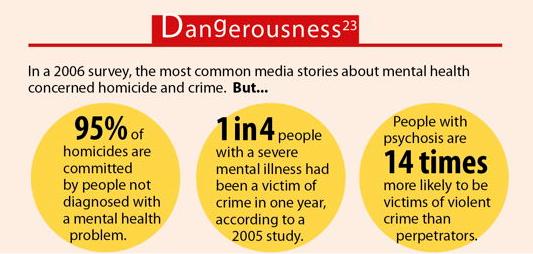

Myth #9: The only way to treat depression is through the use of antidepressants. 
Treating depression is not as simple as just taking a pill. Medication alone is not enough and is generally most effective in addition to psychotherapy. Cognitive Behavioral Therapy (CBT) has been shown to be particularly effective in the treatment of depression. Lifestyle changes such as balanced nutrition, regular exercise, and adequate sleep have been shown to help as well as things like mindfulness, meditation, and yoga.


-----
Resources and References:
http://www.nimh.nih.gov/health/topics/depression/index.shtml
http://psychcentral.com/lib/an-introduction-to-depression/000650
http://www.nami.org/Template.cfm?Section=depression
http://www.nytimes.com/health/guides/disease/major-depression/overview.html
http://www.huffingtonpost.ca/2013/11/13/depression-myths-_n_4268047.html
http://psychcentral.com/lib/what-is-depression-if-not-a-mental-illness/000896?all=1
http://www.psychologytoday.com/blog/evil-deeds/200809/is-depression-disease
http://psychcentral.com/blog/archives/2009/10/18/7-myths-of-depression/
http://www.psychologytoday.com/blog/the-first-impression/201302/5-myths-about-depression
http://www.healthcentral.com/depression/just-diagnosed-822-143_3.html
http://psychcentral.com/blog/archives/2009/10/18/7-myths-of-depression/
http://www.healthline.com/health-slideshow/9-myths-depression#1
http://www.hpb.gov.sg/HOPPortal/health-article/10202


Sunday, March 2, 2014

Where Nature Meets Nurture

Today at church was Camp Sunday. Unquestionably, it has always been one of my favorite days of the year, especially since I started volunteering and working at camp four years ago. Today, I stood up in front of my church family and talked about how much camp has changed my life. I said something similar to this:

When Kim asked me to talk about my camp experience, I jumped at the opportunity to share something that I am so passionate about, but then, I realized that summing up something that has radically changed who I am in 3 to 5 minutes is basically impossible. I spent only one week as a camper when I was 12, and I honestly don’t remember much of it. I returned to camp at 16 as a counselor in training, at 17 as a volunteer, and at 18 and 19 as part of summer staff, which caused me to experience, in some capacity, almost every camp Outdoor Ministries has to offer. 
Working at camp forced me to do a lot of things that felt uncomfortable and scary to me at the time, like leading songs and talking in front of large groups, thinking on my feet and rearranging an entire day for forty-some kids at the drop of a hat—which is not easy, resolving conflicts between campers and between staff, functioning most days on little to no sleep, meeting and working with a new team of volunteer directors and counselors every week, having to be upbeat, positive, and enthusiastic 100% of the time. I was out of my comfort zone the first day of staff training when I walked into a room of thirty or forty people that I would be living and working with for the next seven weeks, all of whom seemed more adult and much more capable than I was.  
But the thing about being pushed to do something you’re uncomfortable with is that it forces you to grow as a person, learn who you are, and really develop your sense of self. The most important lessons I learned in life, I learned at camp. Every child I worked with had something to teach me. From my kids, I learned to balance a spoon on my nose, to try new things, to be patient, to embrace my own weirdness, to be flexible, to be brave, to laugh at myself, to face my fears, to love... I could talk forever. 
My favorite weeks were the ones where I got to work with middle schoolers. Both summers I worked on staff, I was placed at fishing camp, and the kids I got to work with were all so unique and at camp, they’re free to just embrace who they are. Last year, there was one cabin of girls, all of whom had been my campers before at various camps. They bonded almost instantaneously. We had a lot of laughs that week, but we also had some serious conversations. Every night after the lights went out, my girls felt free to be vulnerable to me and to each other and we talked about their fears and insecurities about growing up, and I shared some of my experiences with them about friendships and life, but I mostly listened as they encouraged one another. 
I chose to work at camp because I wanted to make a difference in the lives of kids. I have no idea what sort of impact that I had on any of them or even if I made one. But what I do know is that these kids—my kids—all changed my life in some way or another. We had a running joke on staff that we didn’t get paid enough for what we had to put up with—the late nights, the storms both literal and metaphorical, the power and water outages, the lack of sleep and sanity—but honestly, I would go back and do it all over again for free because the experiences I had and the lessons I learned are priceless. 
This summer, I will unfortunately not be able to attend camp in any capacity because I have to take summer classes, and this is heartbreaking for me. But I want to encourage all of you to go to camp this summer—either as campers or as volunteers, which camp really needs right now, because it truly is a life changing experience and something you will never forget. If anyone has questions about the different camps offered or about volunteering as a counselor, please come talk to me! I’d love to give you more information!

You would think that something so significant to me would be easy to talk about, but it really isn't. Not when you have anorexia and so much of your recovery journey is tangled up in your time as a counselor (This post only briefly touches on how the two are intertwined).

Camp was the first place that I'd ever "come out" about my eating disorder, my depression, and my self-harm. I was 16 and a counselor-in-training, and something about the stress of the week or just the atmosphere of camp, I felt comfortable being vulnerable and breaking down, first to one of the counselors and then to one of the directors.

It was the director who really got me started on the path to recovery. She called my mom the week after and told her, when I was in St. Louis on a mission trip with my youth group. Enter my mom, enter therapy, enter my life changing. E continued to support me in the coming years--encouraging my recovery, letting me vent my frustrations, and just being a really good friend. I am forever grateful for this relationship.

One year later, I was back at the same camp. I remember one of my campers making a comment at dinner, something like, "The reason you're fat is because you eat too much." That hit exactly where I was vulnerable because I was only going through the motions of recovery. I handled her comment appropriately, but after, completely had a meltdown to another one of the counselors.

The next year, I was working on summer staff. When I was figuring out what I was going to say at church today, I looked back to a paper I had written about my first summer on staff for a class last year. It says this of my fifth week:

On Friday night, I received a phone call from a high school friend of mine.  She was in tears, and I couldn’t really make out what words she was saying.  But eventually I learned that her boyfriend had dumped her and that her battle with anorexia had landed her in the hospital.  Her heart was skipping beats like crazy; she was dying.  I hung up with her and I cried.  
I cried because she was so sick.  I cried because she was both literally and figuratively heartbroken.  I cried because I was two hours away and couldn’t be there with her.  But mostly, I cried because that could have been me.  
What you don’t know is that in the months leading up to my summer at camp, I had been in treatment for anorexia.  It had gotten to the point that my parents were going to pull me out of my senior year of high school and send me to residential treatment.  I wasn’t supposed to be working at camp that summer. 
But I was; pretty successfully, I might add.  So while I was busy taking care of my kids and my camp family, they were also taking care of me in ways they couldn’t even imagine.  They were helping me heal, helping me become confident in myself, and helping me prove that I could go to college in the fall.  Camp had gotten me through treatment and ready for the real world.  
I spent almost my entire twenty-four hours off with my friend at the hospital. I went home only to shower, hand my dirty laundry off to my mom, and sleep.  I arrived late for the start of camp on Sunday afternoon and promptly fell apart.  However, my boss understood and let me talk everything out with her before my kids came that afternoon.

Camp was the immediate reason that I cared about even trying to get better at the end of my senior year of high school.  A couple weeks before it was supposed to start, my doctor told me that I wasn't allowed to go work at camp for the whole summer. I was furious and this fury pushed me to see her concerns and agree to follow what she was instructing, in order for me to work at camp.

That first summer on staff completely changed my life. It pushed me to my limits, but I was also held in by some wonderful, wiser, and loving people that I am so privileged to now call friends. At the time, two of these women were my bosses and were really supportive and encouraging of my recovery and my health, even in the chaos that is summer camp. I developed relationships with campers, counselors, and directors who loved and accepted me just as I was and who gave me the strength to keep fighting, the courage to be myself, and a reason to keep going, even after the summer ended. That week after I spent my time off with my friend in the hospital, I called E and told her how grateful she was that she had called my mom those two years before. I was determined to stay in recovery.

The next year, during my camp interview, my boss asked me indirectly about my ED and how things were going. She felt comfortable enough with my progress to hire me back for a second summer, but she was--and still is--there for me when times get rough.

That second summer was hard. I went through lifeguard certification, which was tough because I had been avoiding exercise as it is an ED behavior for me, but I passed. I dealt with so many insecurities and so much drama from other people on staff. But I also met some amazing kids... Kids who were afraid to be who they were because they were worried about what others thought. Kids who were bullied at school. Kids with appearance insecurities. Kids who thought that no one would ever love them for who they were. And some of these moments, I could share bits of my story with them.

I'm not going back to camp this summer, as I said at church this morning. I have to take summer classes, and honestly, I don't think it would be healthy for me to go back to camp this summer because recovery takes time and I can't force it into a timeline. Lately, I've been feeling so disconnected from this young woman who worked two summers on camp staff--this young woman so determined to recover and be healthy and a good role model for these precious kids. Even talking this morning in church seemed so inauthentic because I couldn't say the real impact that camp had on my life.

As much as camp allowed me to enter into periods of recovery, it also left me vulnerable to relapses later, like the one that sent me home from college this year. But camp also taught me so much. That I am strong. That I am worth fighting for. That I am loved. That I don't have to be perfect. That I don't have to change. That I don't have to be something that I'm not. That I can have questions and doubts and insecurities and still be loved. That life isn't perfect. That I can be flexible. That I'm okay just as I am. That I can make it through anything I put my mind to.

Camp allowed me to become, at least while I was there, the woman who is capable of fully recovering from her eating disorder. In the time since then, I have lost that person. But she's not gone forever. One day, she will be back at camp again.
Camp and my kids have kept me alive thus far. Today, I feel like I have a renewed purpose to fight for my life and health, like I have a renewed strength.
Camp has--and will continue to--save my life.

Thursday, February 20, 2014

The Eater.

I caught up on my blog reading today. These two struck me where I'm vulnerable right now.


I hereby agree, from this day forward, to fully participate in life on earth.  I agree to inhabit the appropriate vehicle for such participation - a body.  As a requisite for the sustaining of that body, and of the life that dwells therein, I agree to be an eater.  This agreement fully binds me for the duration of my stay on earth.

As an eater, I agree to hunger.  I agree to have a body that needs food.  I agree to eat food.  I recognize that as the biological need to eat is fulfilled with greater awareness and efficiency, the benefits of my well-being will increase.  I further acknowledge that ignorance of the eating process may cause undesirable consequences.

Because the essence of my participation in life is one of learning and exploration, I agree to experience uncertainty as an eater.  I recognize there are a great variety of foods to choose from, and I may not know which to eat.  I may have a choice of different nutritional approaches, and not know which to follow.  I may have an assortment of habits, and not know how to manage them.  I recognize that my relationship to food is a learning process, and I will inevitably make mistakes.  Therefore, as an eater, I agree to accept my humanness and learn as I go along.

I acknowledge that as the body changes from infancy to old age, so will the eating process change.  I recognize that my body may call for different foods as the days, seasons, and years progress.  My dietary needs will also shift in accord with changes in my life-style and environment.  I understand that there is no one perfect diet.

As an eater, I accept pain.  I recognize that I may suffer pain when the body is disturbed by my choice of food or eating habits.  I may also experience pain when emotional and spiritual hungers are confused with physical hunger.  I further understand that eating to cure a pain cannot be remedied by eating may bring even more pain.  I further agree to accept a body that is imperfect and vulnerable, that naturally decays with the passage of time.  I recognize there will be moments when I am incapable of caring for it myself.  I agree, then, that to live in a body is to need the help of others.  I also agree to be vulnerable as an eater.  I acknowledge that I will be helpless as an infant and will need to be fed.  I may be equally helpless when I am old and unwell.  I further recognize that even when I am fully capable, I may still need the warmth and care of someone who can feed me.  Therefore, as an eater, I agree to be nourished by others.

If I have a woman's body, I acknowledge that I have a special relationship to eating and nourishment.  I recognize that as a giver of life, I am the nourisher of life as well.  Whether through my cooking or the milk of my body, I acknowledge that the union of food and love is a quality that marks my womanhood and has a profound effect on human-kind.

As an eater, I acknowledge the domain of the sacred.  I recognize that the act of eating may be ritualized and inspired.  It may be given symbolic meanings that are religious or spiritual in nature.  It may even be joyous.

I further agree that eating is an activity that joins me with all humanity.  I recognize that to be an eater is to be accountable for the care of the earth and its resources.  I acknowledge that despite our differences, we are all ultimately nourished by the same source.  As such, I agree to share.

I recognize that at its deepest level, eating is an affirmation of life.  Each time I eat, I agree somewhere inside to continue life on earth.  I acknowledge that this choice to eat is a fundamental act of love and nourishment, a true celebration of my existence.  As a human being on earth, I agree to be an eater.  I choose life again and again...

Nourishing the Soul posted this response from a reader: 

"This eater feels shaken. Feels jolted. I can intellectualize my body’s need for food — its inability to go on without nourishment. But I don’t like to admit it. I didn’t want to be reminded of my humanness — my weakness and fragility. So I manipulated it.
I used food to prove that my life was in my hands. I could choose to sustain it or to starve it away. And so I chose to waste. Waste my resources, my body, my relationship. Deprive them all as I watched them dwindle away. I learned that starvation takes away all ability — steals my capacity to move, think, sleep, love.
I can’t starve my body without starving my soul. I starve and I quickly whittle away my logic, my passion, my desire. I believe that I am mighty. That I don’t need the things that all others need — I am the exception in a scenario of no exceptions. I believe that I am not an eater, a feeler, a bearer of life, until I don’t want to be the exception anymore. I want to need food to live, but I don’t want to live.
And then I am re-introduced to life, and curiosity, and pain. To humanity, to weakness, and to strength. To the overwhelming world of eaters. My brain still battles my body. Once a month I am reminded that I somehow came to sustain my life again, and I feel simultaneous joy and suffering. Relief and fear. My heart beats, my hair grows, my body offers to house another. I am alive because I am an eater — or I am an eater because I am alive.
Perhaps the choice is not about eating or not eating, but about living or not living. Embracing life or rejecting it. itching in a basement, all sources of light blocked out by opaque bags installed, but failing to keep the bugs off of my skin, or stepping out into a lawn of weeds and blooms to feel the sun warm my skin.
I eat for that warmth. I eat to experience the sunrise reflected on the Rocky Mountains outside my window. I eat to stand at the tops of those mountains, and to rest peacefully in my bed afterwards. I eat to embrace my mother and connect with my father. I eat to laugh with my brother. I eat to accept I am imperfect, and to acknowledge the beauty of that. I eat to enjoy a moment. I eat to solve a puzzle, read a book, write a poem. I eat to be curious, eat to learn, eat to inquire and desire. I eat to believe, I eat to breathe. I eat to live.
I eat because I am an eater.
I eat because I have a soul, and I have come to learn that I can’t be a soul without a body.
I eat because I want to learn to celebrate my existence. I eat because it doesn’t matter who I was yesterday, and I want to discover who I will be tomorrow. I eat because some days, some moments I hunger for life. I eat to give the hunger space to grown until it’s satisfied. Reappear and be satiated once again.
And again. And again. 
I eat to say that I am okay with this hunger. 
I eat to say I am okay."

Why Eating Food is Important

1. Food = fuel. 
2. Starvation decreases brain volume along with grey and white matter responsible for multiple cognitive functions. 
3. I like being warm. 
4. Not eating makes my depression worse. 
6. I want to be a good role model for my cousins, younger friends, and camp girls.


7. Cellular respiration. 
8. To be able to do fun winter things like ice skate and ski with friends.
9. So that I can have kids one day. 
10. So my digestive system will be happy with me always. 
11. To decrease anxiety. 
12.  So I can enjoy cooking yummy things. 
13. Breakfast/lunch/dinner dates with friends. 
14. Having energy! 
15. Being social. 
16. People will worry less about me. 
17. My immune system will function better. 
18. I'll know what actually being sick feels like--not just what being ED sick feels like. 
19. Julie will continue to love me and work with me. 
20. I will get my life back. 


21. To go back to Gettysburg. 
22. So I can make a difference in the world. 
23. Because I want to learn all the psychology. 
24. I need a fully functional brain to learn. 
25. So I can give blood and save lives. 
26. So I get get my blood drawn for a simple TB test. 
27. TRAVELING. 
28. Exploring the food of different cultures. 
29. Have energy to play with kids. 
30. I will be less tired. 
31. Just overall feeling better. 


32. Food is medicine. 
33. For health. 
34. So I can function. 
35. To not be sick anymore. 
36. Decreased mood swings. 
37. Food is delicious. 
38. I want to live a long life. 
39. Because my heart likes food. 
40. I like it when my organs are all functioning properly. 
41. So my muscles will stop aching because my body is eating them. 
42. To keep my metabolism stable. 


43. I like being alive. 
44. Road trips will be more enjoyable. 
45. My body needs nutrients. 
46. To be nice to myself. 
47. To be able to treat EDs one day and not feel like a hypocrite. 
48. Movie theater popcorn! 
49. Everyone needs to eat. 
50. Because the only way out is through.
51. I am stronger than this. 


52. To get my PhD.
53. Because my body won't run on X calories just because I decided it would. 
54. There's more to life than food. 
55. Because fuck diet culture.
56. The definition of beautiful does not involve the word skinny. 
57. Perfection isn't attainable. 
58. Sometimes you have to do what you don't like in order to get to where you want to be. 
59. So I can rewire my brain. 
60. Because my future daughter(s) will have a healthy relationship with food. 
61. Life is too short to be at war with myself. 
62. So I can go to grad school somewhere warm and not close to home. 
63. To reach my potential. 
64. Because there's more to life than scales and calories. 
65. I deserve it. 


66. So I can fill my life with busyness again. 
67. Because I want recovery. 
68. Scales only give a numerical representation of my relationship with gravity, not my worth. 
69. People don't actually care what you look like or what/how you eat. 
70. Tomorrow is a fresh start. 
71. I like remembering things. 
72. So I can date a boy and maybe marry him one day. 
73. Because not eating is exhausting and sucks. 


74. Birthday cake! 
75. So I can go out for my 21st birthday and drink without worrying about the calories in alcohol. 
76. I hate doing behavior chains.
77. Fewer mental breakdowns. 
78. So I can be comfortable in my own skin. 
79. Tacos. 
80. I'll actually look forward to seeing Dr. G and Julie because they're amazing people. 
81. Long hikes in the woods. 
82. So that taking most of this year off will not have been for nothing. 
83. Because I want to be one of 30-40% that fully recover. 
84. To not feel guilt or shame over what, when, and how much I am eating. 


85. Chocolate. 
86. There is no good excuse for not eating. 
87. I don't want to end up in the hospital. 
88. Long bike rides. 
89. To be happy. 
90. Because people have faith in me. 
91. So I can go running for enjoyment, not in order to burn calories or lose weight.
92. To heal relationships ruined by my eating disorder.  
93. Thanksgiving and other holidays. 
94. Food is nothing to be afraid of. 
95. So that I can win this war. 


96. To be a better therapist. 
97. I want to get better. 
98. My body needs nutrients to function. 
99. So I can be fully present in every situation. 
100. Because I am not my eating disorder.


Wednesday, February 19, 2014

In 13 Days...

I hope you're happy.
I hope you're happy now.
I hope you're happy how you've hurt your cause forever; I hope you think you're clever.

I hope you're happy.
I hope you're happy, too.
I hope you're proud how you would grovel in submission to feed your own ambition.

So though I can't imagine how, I hope you're happy right now...

SUMMARY: In the past 13 days... 
  1. I took a trip in a snowstorm to Gettysburg, with an overnight stop in Chambersburg, to see friends.
  2. I became okay with taking extra time to finish school and not graduating in four years. 
  3. I found out that I WILL be graduating in 2016!!! Even though I had to take almost a full year off of school.
  4. I chased an adorable two-year-old around the science center.
  5. Life chats!
  6. Two of my friends were hospitalized and released a few days later for mental health related reasons. 
  7. My roommate kicked serious ass at her senior recital. 
  8. I stole her picture off a bulletin board in the CUB.
  9. Katie, the nurse practitioner who works with my ED doctor, resigned. 
  10. I watched Tangled
  11. I visited my brother and a friend at CMU on my drive home. 
  12. I survived driving in another snowstorm!
  13. I got a lottery number for housing! 
  14. I was offered a volunteer position at Summa hospital in the psych ward. 
  15. I spent twenty minutes looking for my car...
  16. We've solidified our housing arrangements for next year more. 
  17. I did my taxes! 
Some other stuff happened in there, too, mostly having to do with going to see my therapist and dietitian and doctor and going to groups. And exploring Beachwood--and by Beachwood I mean, how long I can sit in Panera before they kick me out. So all sorts of good and exciting things. 

But there's this thing called impression management, which is defined in social psychology and similarly in sociology as "goal-directed conscious or unconscious processes in which people attempt to influence the perceptions of other people about a person, object or event by regulating and controlling information in social interaction" (thank you, Wikipedia). Naturally, because I am human, I do that. 

I read somewhere that everyone wants to hear that you're fine, you're doing better, taking it one day at a time, making progress. And honestly, I would be lying if I didn't say that's exactly how I feel sometimes. Not just when talking with other people about their recoveries and lives, but when talking about my own. It's comfortable and easy for me to say that I'm doing better, that treatment has made a world of difference for me. 

All of that is true. 

I am doing better. Treatment has made a difference. 

But I would be lying if I said that every day is a good day. That's false. Some days just flat out suck. And sometimes, I have days--weeks--where things just go to hell in a hand-basket and behaviors your happen and I just don't care. There are days where wanting to get better and wanting to graduate and get my PhD and travel and have kids and change the world mean nothing against my eating disorder. Sometimes things, no matter how good they look to the naked eye, are actually pretty crappy. 


In case you were wondering what really happened in the past 13 days... 
I slipped. 
My ED took over. 
I had behaviors. 
I disappointed people. 
My dietitian told me that I "have not decided to be kind to myself" and I had a mental breakdown. 
I completely blamed myself for my friends' hospitalizations. 
I cried. A lot. 
I had more behaviors. 
I got so caught up in taking care of other people that I forgot to take care of myself.
I made excuses for behaviors. 
I ignored the fact that I am sick and in treatment and that means that I cannot live normally. 
I had more behaviors. 
I disappointed the same people again. 


Recovery isn't easy. It looks easy and sounds easy to those who haven't been through it or something similar. But it's not. Sometimes it just sucks. And sometimes its impossible to be okay. That's where I'm at--the sucky and not being okay part. The part where I have to make a choice between a difficult, hard, challenging, hellish path that brings life and a much easier one that eventually brings death... A choice that seems so simple. 

The hard path, that brings life. 

But right now, I'm not so sure that I'm up for the challenge...


"Just Might (Make Me Believe)" by Sugarland

I got miles of trouble spreadin' far and wide
Bills on the table gettin' higher and higher
They just keep on comin', there ain't no end in sight
I'm just holding on tight...
I've got someone who loves me more then words can say
And I'm thankful for that each and every day
And if I count all my blessings, I get a smile on my face
Still it's hard to find faith

But if you can look in my eyes
And tell me we'll be alright
If you promise never to leave 
You just might make me believe

Its just day to day tryin' to make ends meet
What id give for an address out on easy street
I need a deep margarita to help me unwind
Leave my troubles behind...

But if you can look in my eyes
And tell me we'll be alright
If you promise never to leave 
You just might make me believe

I used to believe in us
When times got tough
But lately I'm afraid that even love is not enough

But if you can can look in my eyes
And tell me we'll be alright
If you promise never to leave you just might make me
Oh, you just might make me
You just might make me believe

Thursday, February 6, 2014

Winning > Losing

I avoided Facebook for much of yesterday, which is a problem. Not in the sense that taking a time out from technology like Facebook is bad, but because I've been avoiding it for another reason.

Tuesday night was the finale of The Biggest Loser, as I'm sure most everyone is aware by now due to massive media coverage of it and all the critiquing that has been done post-reveal. I personally do not watch the show nor do I care to begin. I actually hate the show and secretly (I guess it's not much of a secret now) judge every person who watches that show--I mean, seriously, who spends their time watching a show that encourages people to engage in self-starvation and overexercise?! How is essentially teaching eating disorders entertainment? I literally have no idea. But what I do know is that my Facebook yesterday was flooded with articles about the controversy over how much weight the winner had lost... And that a lot of people were calling her anorexic and saying she looks sick and way too thin.

(First problem. Making judgments about another's body. Just stop. None of us know if that is a healthy weight for her. None of us know her medical history or how she's feeling. Also, stop with the criticism! Seriously. Just stop it. You have no right to stick labels on someone for how much they do or do not weigh.)

I had a conversation with friends I met at the NEDA Conference in October about it. One said, "Just looked at some of The Biggest Loser stuff (I never pay any attention to that crap)... So infuriating! She's not a winner, she's sick!" followed by, "I hate the show. I hate Jillian Michaels. I hate it all!" Another friend from the conference advised me against looking into show and even writing a blog post on it.

I've tried to avoid reading most of the articles because I've generally found them to be triggering, but I'll share a few of the good ones that I've skimmed here (trigger warning for numbers in these articles):

The Biggest Loser and a Bigger Hypocrisy by Carrie Arnold
The Biggest Loser and the Eating Disorder Epidemic by Lee Wolfe Bloom
Freaked Out by Rachel Frederickson's Biggest Loser Win? Read This by Golda Poretsky
The Biggest Losers by Timberline Knolls' CEO and Medical Director (Not specifically about last night's show, but worth the read)
Why Her 'Biggest Loser' Win Left Me at a Loss by Meredith Turits

I'm not writing this to express my concern over Frederickson's weight loss. I'm not writing this to chime in on the same chords so many of these articles have touched on--that the loss of 60% of your body weight and a BMI of 18 are medical criteria for anorexia. I'm not writing to warn against the dangers of extreme dieting and self-starvation and how that can lead to binge eating. I'm not even writing this to talk about the fat- and thin-shaming that is going on as a result of this show.

I'm writing this because I disagree my eating disorder disagrees with all the people who have called her too thin and sick looking. My eating disorder idolizes how she looks.

Yes, I said it. I want My eating disorder wants to look like that.

But here's the thing, my body is not built to look like that. It's genetically not wired to look that way. In fact, if I looked like that, I would probably be in the hospital because my organs would be eating themselves, I'd be severely bradycardic and orthostatic, and I generally just wouldn't be able to function. That's why it is so important in eating disorder recovery to get to your set point weight--not a 'healthy' BMI, like many believe, but set point weight. Set point weight is the weight that your body genetically is programmed to be at. It does not follow BMI charts--it could be under or over what is considered to be normal. It does not follow societal standards for what is acceptable. But is is what is best for your body.


I don't like my set point weight. I'm not sure that anyone with history of eating disorders actually likes their set point weight. But instead of getting angry and turning to ED behaviors in order to be less than what my body wants naturally, I'm working on trying to accept it. Trying to radically accept the fact that my body and genetics want me to weigh X pounds instead of the X pounds that I my eating disorder would prefer to weigh.

So here's what I'm trying to focus on--all the wonderful things that my body, at it's healthy, set point weight, can do. What's important to me, in this moment, is respecting my body's limitations. If it's tired, I sleep. If it's hungry, I feed it. If it's restless, I go for a walk. If it's craving intellectual nourishment, I read and write and study. But I'm learning to be fully present in my body, not to just inhabit it. And if I am fully present in my body, that means I am listening to it. I am taking care of it's needs and wants and not forcing it to do things that it doesn't want to do.

Our society is good at telling us exactly the opposite. It's good at telling us that we need to be less, take up less space, weigh less, be thinner. It's good at telling us that when exercising, no pain means no gain. It's good at telling us to not eat the carbohydrates, the proteins, and the lipids, the basic macronutrients required for survival, that our body so desperately needs and craves. And shows like The Biggest Loser only reinforce these things.

And after reflecting on all of the outcry about The Biggest Loser finale, I have questions. Why are we so concerned with Rachel Frederickson, her weight loss, and her health? Why are we not this concerned when our sisters, mothers, friends, relatives, etc engage in similar unhealthy behaviors in order to lose weight? Why are we so concerned with losing weight instead of creating healthy and strong bodies? Why are we so concerned with being the biggest loser?

If I look only at the number on the scale, the size on my clothes, the calories I am consuming and burning, I will always be unhappy because there will always be someone who weighs less, who is a smaller size, who ate less and exercised more. My focus becomes so zeroed in on these things that I forget about everything else.

Through my recovery process, I'm learning to not focus on them. My dietitian asked me a couple days ago if I wanted to know anything regarding my weight range--if I was in it, above it, below it, what end of it I was in. And I simply told her no. I know I will never be satisfied with a number on the scale because what satisfies me is having a healthy body and a healthy soul. This means nourishment, rest, and moderate exercise for my physical body. It means listening to it when it tells me to take a break or slow down or that I'm pushing too hard. But it also means realizing that I am so much more than my body and that I am not defined by a number nor am I defined by what I look like on a particular day. It means cultivating relationships, feeding my intellect, expressing my interests and regularly doing something "just because."


It means living my life and not caring whether or not I am the biggest loser. By accepting my body as it is, at it's set point weight, in it's rightful, healthy state, I am the biggest winner because I'm winning my life. Not a smaller dress size or a ton of money or more confidence, but a life full of adventures and possibilities.

My friends, winning is always better than losing. May we all try to be the biggest winners of life and not the biggest losers of weight.


For more information about set point weight, see Kelsi's posts here:
Set Point
Overshooting Set Point Weight
Overshooting Set Point & Kristi's Story

Monday, February 3, 2014

[Dis]CHARGE!

I am now officially done with IOP. My vitals are pretty stable. I'm almost back in my weight range. I'm not using behaviors. I'm following my meal plan. Behaviorally and medically, things look good and are getting close to "normal." But emotionally and psychologically, I'm not there yet. And according to my treatment team, this means that I am ready to move on to outpatient.

However, I have been having a lot of mixed feelings about it all. On one hand, I am so glad to be done and be a "free woman" again, as one of my treatment friends phrased it. But on the other hand, I'm absolutely terrified of having so much time to myself, as well as just generally being fearful of behavioral lapses and relapses (the latter has more to do with returning to school in the fall, which is still a long way off). 

Ever since I was in middle school, I have never had a lot of time to myself. My mom was always on me for over-committing myself to things, being too busy, and not having any time to relax. I was either at school, an extracurricular, doing homework, or hanging out with friends. I rarely took time out for self-care and rest. Being busy was who I was. I was my education, my extracurriculars, my friendships, my busyness. In the summers, I was my camp job. Overarching all of that was my eating disorder, my depression, my anxiety. For the past few months, I have been my treatment.

Now, I have none of that. No job, no extracurriculars, no school. My friends are all off at their own colleges, five hours away in Gettysburg, or worried about high school. And now treatment, although it is not ending completely, is becoming a less significant part of my life.

So the question that remains is, who am I, as just Sarah? Who am I without my accomplishments, my academics, my involvements? What is it that I value? What matters to me? How do I want to spend my time? How is Sarah, the person, defined?

My therapist suggested to me in our last session that I make two lists--one consisting of what I know I am and what I want for myself and my life and a second of what I know I am not and do not want for myself and my life. I haven't yet started on this task--I had a busy weekend of chaperoning an elementary lock-in at church, babysitting, and catching up on all the sleep I did not get because of those things. But I'm planning on beginning it soon.

Now that I have been discharged and have an extra 18 hours in my week, it is time to charge forward into this new Sarah-ness that is governed solely by Sarah and her dreams and aspirations, her likes and dislikes, her values and personality. 

Something that has been very motivating in getting myself to this point in recovery is wanting to feel fully alive and in touch with life--being able to fully feel every memory and moment as it occurs and to enjoy it in it's entirety. And until today, partially influenced by this blog post, I have been unsure as to how to make that happen for me. Feeling fully alive has to do with living life according to my values, my desires, my aspirations and letting go of everything that is not in line with those things and not me. It means not living for academics, but still gleaning knowledge; it means not putting my worth in how well my friends like me, but still cultivating relationships; it means not putting my identity in what I do, but still participating fully and passionately. 

It's time to discover what feeling fully alive means... 


Time to charge forward into creating who I am and who I want to be. 
Time to charge forward in the next phase of recovery.
Time to charge forward into life.
Time to live with my heart as my compass. 


"Compass" by Lady Antebellum
Alright
Yeah it's been a bumpy road
Roller coasters
High and low
Fill the tank and drive the car
Pedal fast, pedal hard
You won't have to go that far

You wanna give up 'cause it's dark
We're really not that far apart
So let your heart, sweet heart
Be your compass when you're lost
And you should follow it wherever it may go
When it's all said and done
You can walk instead of run
'Cause no matter what you'll never be alone (never be alone) oh oh oh
Never be alone oh oh oh

Forgot directions on your way
Don't close your eyes don't be afraid
We might be crazy late at night I can't wait til you arrive
Follow stars you'll be alright

You wanna give up 'cause it's dark
We're really not that far apart
So let your heart, sweet heart
Be your compass when you're lost
And you should follow it wherever it may go
When it's all said and done
You can walk instead of run
'Cause no matter what you'll never be alone (never be alone) oh oh oh
Never be alone oh oh oh
You wanna give up 'cause it's dark
We're really not that far apart
So let your heart, sweet heart
Be your compass when you're lost
And you should follow it wherever it may go
When it's all said and done
You can walk instead of run
'Cause no matter what you'll never be alone (never be alone) oh oh oh
Never be alone oh oh oh

When it's all said and done
You can walk instead of run
'Cause no matter what you'll never be alone